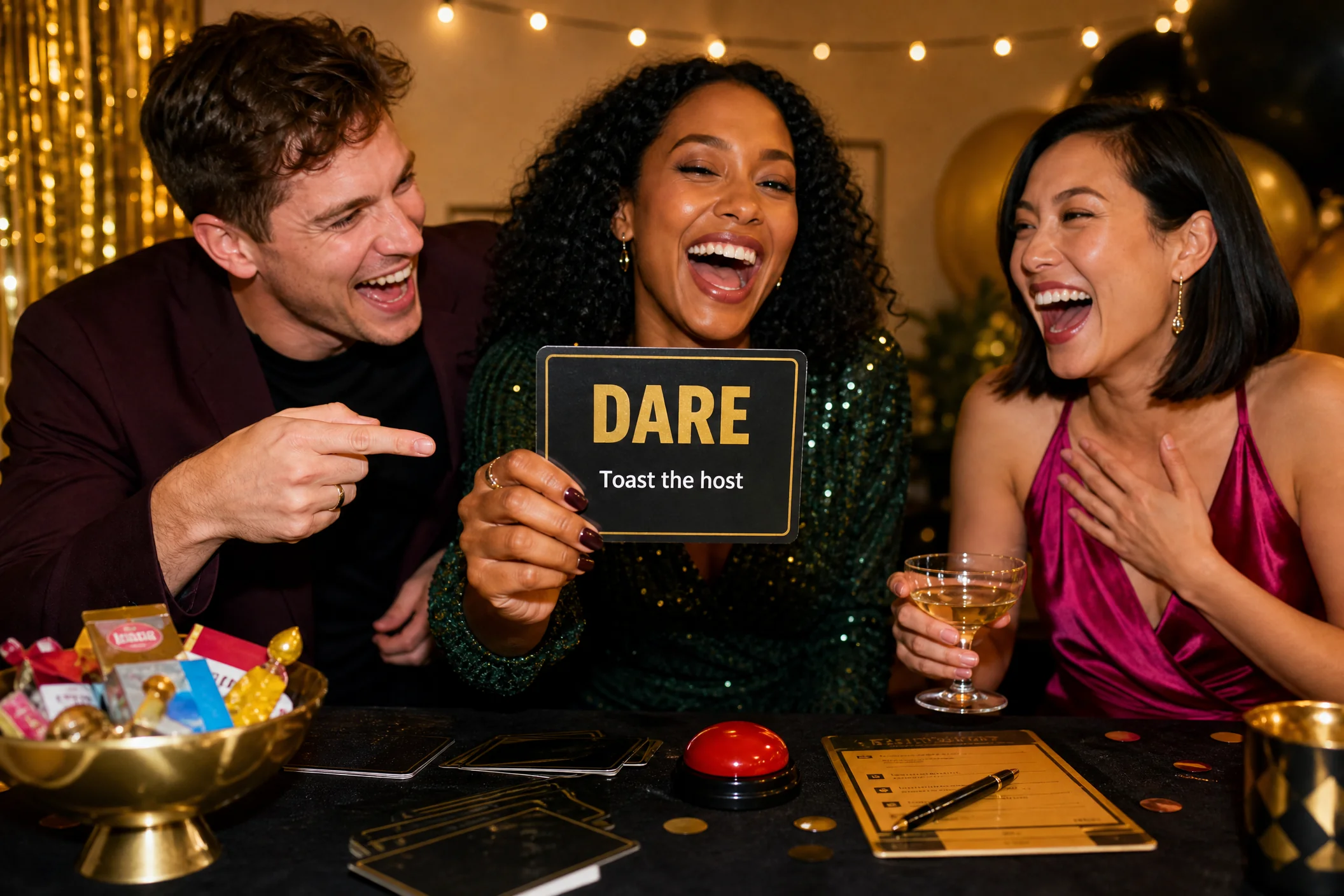
Quick answer
Party games get easy once you sort out 3 things: who is coming (kids, adults, or a mix), how many guests you have (under 10, 10 to 20, over 20), and the mood you want (icebreaker, active, or seated). Run 2 main games and 1 icebreaker across a 3-hour party, then let printable packs handle the prep in 15 to 30 minutes of printing and sorting.
Three questions steer your party games plan, whatever you are celebrating. First, who is coming: kids, tweens, adults, or a mix. Second, how many guests: under 10, 10 to 20, or over 20. Third, the energy you want: an icebreaker for arrivals, something active mid-party, and something seated to wind down.
Skip those 3 questions, pick games straight off an inspiration board, and you often end up with flops: a game that needs 4 players when 22 show up, or a rowdy one that clashes with a seated 50th birthday dinner. Instead, layer your games: an icebreaker for the first 30 minutes, a main activity around the 60-to-90-minute mark, and a calmer game to close.
The same approach works for almost any event. Whether you are hosting a 12-guest baby shower brunch, a 25-guest 30th birthday cocktail, a bachelorette weekend across 3 nights, a 40-guest backyard graduation, or a 60-guest workplace holiday party, those same 3 questions guide you. This guide walks you through the icebreaker block, trivia and bingo, active and outdoor games, word and card games, kids games by age, adult games, large-group and team games, themed packs (murder mystery, scavenger hunt, charades), and the free tools that draft your plan in minutes. The free Murder Mystery Party Generator and the printable Party Games Mega Bundle at the close take care of the heaviest prep, while the Adult Party Games and Game Ideas for the Family guides go deep on each audience.
- 2 to 3Games Anchor Most 3-Hour Events
- 30 to 60Minutes Average Play Time per Anchor Game
- 6 to 10Prep Items for a Medium-Size Group
🛒 As an Amazon Associate, we earn from qualifying purchases, at no extra cost to you.
Party Games Game Props
Shop on AmazonParty Games Cards
Shop on AmazonParty Games Dice Sets
Shop on AmazonParty Games Activity Bundle
Shop on AmazonParty Games Icebreakers
Shop on AmazonParty Games Supplies
Shop on AmazonHow Should You Pick the Right Party Game for Your Event?
The right game comes down to 3 quick questions that steady your plan for any event. Decide who is coming, how many guests you have, and the energy you want before you pick specific games; the rules, equipment, prep time, and play length fall into place from there. Here are the 6 things worth sorting first.
Start with who is coming. Most parties fall into 3 groups: kids (3-to-5, 6-to-9, 10-to-12), tweens and teens, and adults (cocktail, milestone, or a mixed-generation family crowd). Pick games that suit the age. A trivia round on the chart-toppers of the guest of honor's teen years is a hit at a 40th birthday and falls flat at a 6-year-old's party. For a deeper look by age, the Adult Party Games and Kids Party Games guides break it down.
Next, count your guests. Group size shapes what works: small (4 to 8 guests, table games and conversation-led play), medium (10 to 20, main games with 2 teams of 5 to 10), and large (over 20, station-style or bingo-style games that keep everyone playing). Let the room decide, not your wish list. A 4-player card game in a room of 22 leaves 18 people watching, and the energy drops. The Party Games for Large Groups guide covers the over-20 picks.
Then plan the energy. A 3-hour party moves through 3 moods: an icebreaker for the first 30 minutes (a low-key social warmup), a main game around the 60-to-90 minute mark (your big moment, often team-based or themed), and a calmer close in the final hour (seated word or trivia games). For arrival-window ideas, head to the Party Ice Breakers guide; the Game Ideas for the Family guide covers the multi-generational main event.
Check how much time you have. Prep falls into 3 levels: no-prep (verbal games like charades and two-truths-and-a-lie, nothing to buy), print-and-go (printable trivia cards, bingo cards, and scavenger lists, 15 to 30 minutes of printing and sorting), and full kit (themed kits, murder mystery scripts, and escape-room setups, 60 to 120 minutes to prepare). How much time is left before the party? That decides your level. With 24 hours and no printer, skip the murder mystery. The Printable Games guide covers the print-and-go options.
Two main games are plenty. Two main games plus one icebreaker is the right amount for a 3-hour party. Five or six back-to-back games run out of time, tire everyone out, and skip the cake and dessert. Run the icebreaker in the first 30 minutes, the main game around the 60-to-90 minute mark, and let the last hour flow on conversation. For main-game ideas, see the Party Trivia Ideas and Charades Terms and Party Ideas guides.
Make sure everyone can join in. Choose games that work for every guest, whatever their mobility, language, or ability. Skip drinking games when kids, pregnant guests, or non-drinkers are there. Use gender-neutral team names (Team Alpha and Team Beta, not boys-versus-girls). Offer a non-physical option for anyone who cannot stand or run. The Kids Party Ideas guide covers making kids feel included.
Build the Icebreaker Block for the First 30 Minutes
A strong icebreaker warms the room as guests arrive, moving them from check-in to first drink to first conversation within 30 minutes. Five easy formats work for almost any party: the name-and-fact prompt, the printed bingo card, the two-truths-and-a-lie circle, the printable conversation-card stack, and the find-someone-who scavenger sheet.
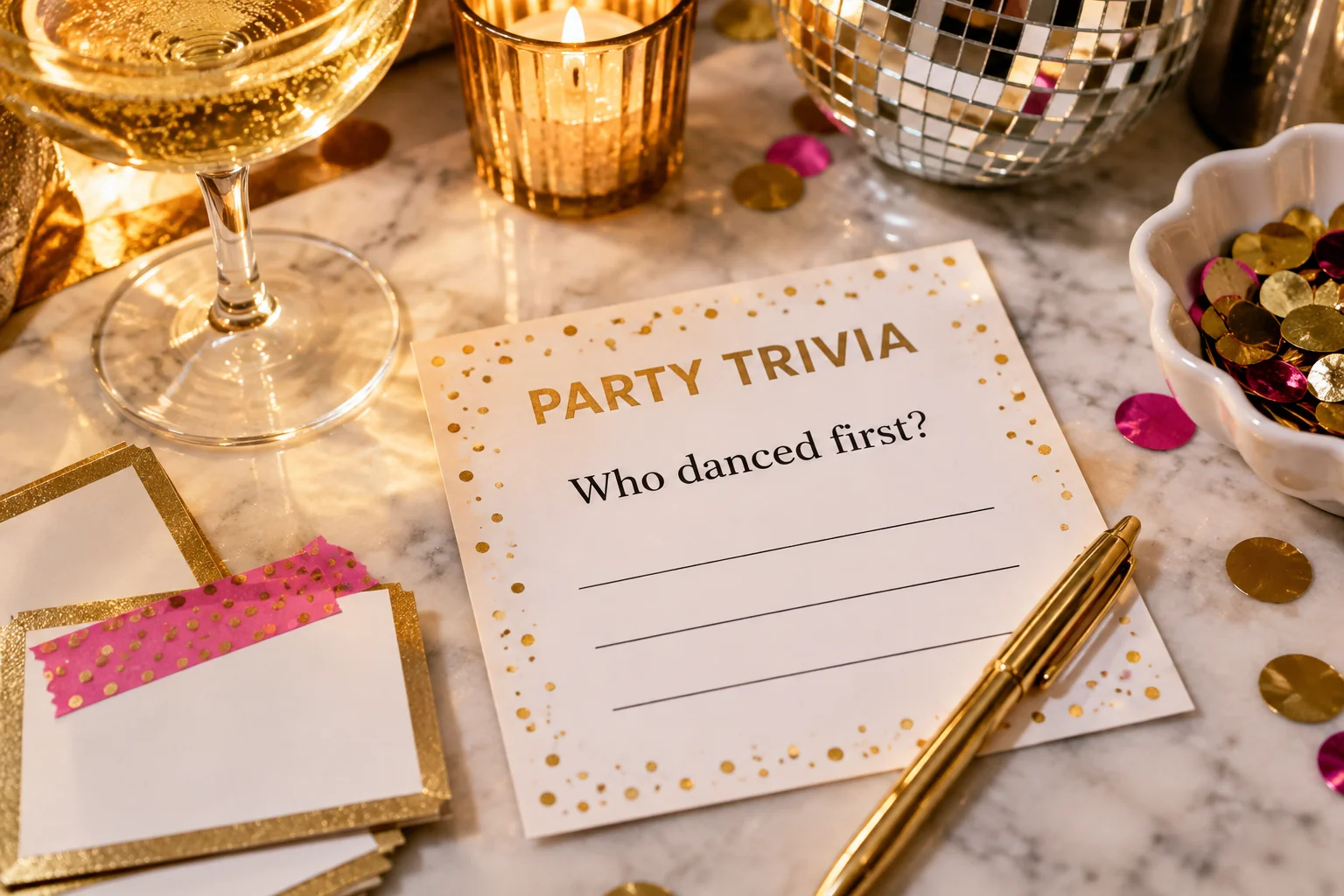
Run the name-and-fact prompt at check-in. Zero prep, one short script.
Hand each guest a folded card at the door with one prompt, then share your name plus one fact about how you know the host. Conversation sets its own pace, and everyone eases into the room. It suits 8-to-40-guest parties and gets lost at big workplace events over 60 guests. You will find more prompts in the Party Ice Breakers guide.
Hand out printable icebreaker bingo cards. Print a 4x4 or 5x5 grid where each square holds a prompt (find someone who has traveled to 3 continents, find someone who knows the guest of honor from elementary school, find someone wearing the event color). Guests roam the room collecting initials, and the first to mark a full row wins a small prize. It works for 15-to-50-guest events and runs happily alongside the arrival drinks. You will find more versions in the Bingo Game Ideas guide.
Run the two-truths-and-a-lie circle. Each guest shares 2 true facts about themselves plus 1 made-up fact, and the room votes on which one is the lie. It works best with 8-to-12 guests, splits into 2 circles for 15-to-20, and gets unwieldy above 24. Small bachelorette dinners, baby shower brunches, and intimate adult dinners are its natural home. The Bachelorette Party Ideas guide has icebreakers made for a bachelorette.
Lay out the printable conversation-card stack. Place a deck of 30-to-50 conversation prompt cards on each side table. Guests grab a card during natural lulls and pose the prompt to whoever is nearest. It quietly runs in the background all evening, keeps seated dinners lively past the 60-minute mark, and shines at workplace events and milestone-birthday cocktails. The Card Games for Parties guide covers more card games.
Print the find-someone-who scavenger sheet. Each guest gets a printed sheet with 10-to-15 prompts (find someone wearing gold, find someone with the same birthday month, find someone who has met the host at a previous party). Guests collect signatures as they arrive. It flows naturally into the first 30 minutes and pairs well with a trip to the bar. To turn the sheet into a hunt with written clues, the Scavenger Hunt Clue Ideas guide writes them by age, from rhymes to ciphers.
Let the occasion set the tone. Formal cocktails suit conversation-card stacks and bingo; casual milestones suit two-truths and find-someone-who; kids' parties suit name-game prompts. The Bachelorette Party Games & Activities guide covers bachelorette-style icebreakers.
Trivia, Bingo, and Quiz Game Formats
Trivia, bingo, and quiz games are a strong fit for the middle of the party, whether it is a cocktail, milestone, or family event. A few choices set the tone: your theme, how deep the question pool goes, whether guests play in teams or solo, whether you host live or let them go at their own pace, and the prizes.
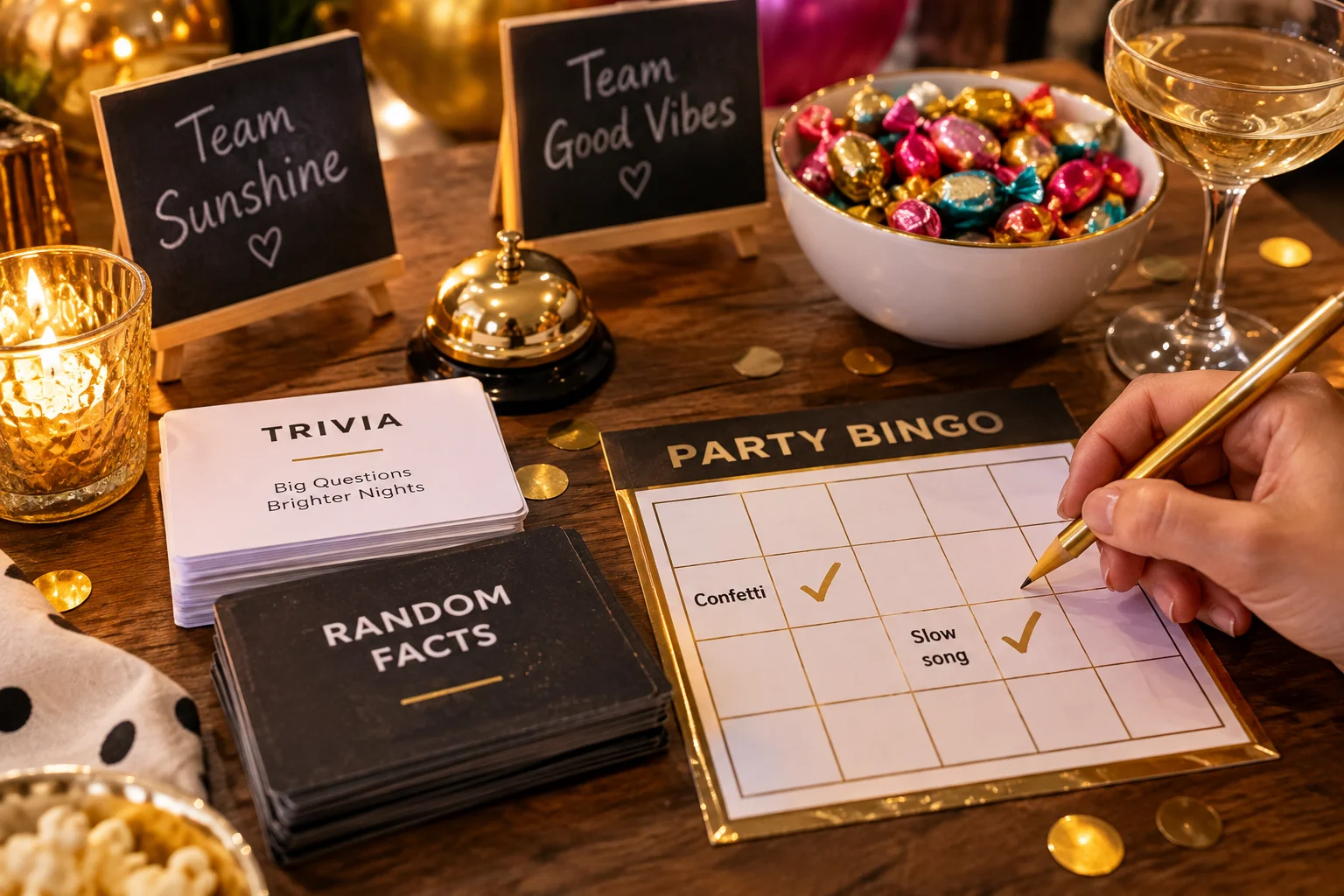
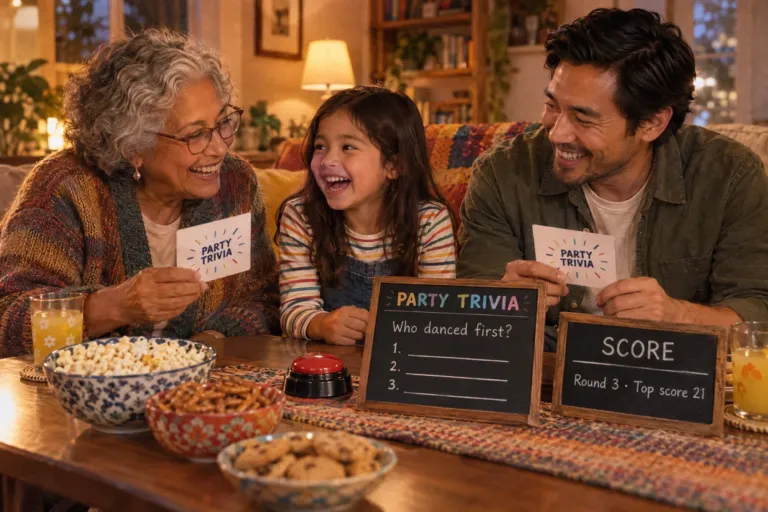
Pick your trivia theme. Six themes cover most party trivia: a decade (90s pop-culture, 2000s music, 1980s film), the guest of honor (their life history, college years, career milestones), the event type (baby trivia for a baby shower, wedding trivia for a couple's shower, food-and-cocktail trivia for a milestone), general knowledge (geography, science, history), a niche fandom (cooking, sports, music), and family history (for multi-generational events). More theme ideas open up in the Family Party Trivia Ideas guide.
Size your question pool. Plan 20 to 30 questions for a single round, 40 to 60 for 2 rounds with a halftime break, and 60 to 80 for a 3-round game-show setup with categories and point values. Mix the difficulty (40 percent easy, 40 percent medium, 20 percent hard) so the game stays fun whether guests know a lot or a little. The party game questions guide covers game-show-style prompts.
Choose team or individual play. Three setups cover most trivia: 2 teams (8-to-30 guests, equal sizes, with a scorekeeper), table teams (over 30 guests, each dinner table is a team), and pen-and-paper solo play (intimate dinners under 12 guests). Two teams bring the most energy at adult cocktail events. For over-20 trivia ideas, turn to the Adult Party Games guide.
Try a bingo variation. Bingo comes in 2 styles: the classic number-call version (caller cards and printed grids) for kids' parties, family events, and large workplace groups, and the themed-prompt version (squares hold prompts instead of numbers, and the caller describes scenarios that match) for adult cocktail and bachelorette events. The Football Bingo Ideas guide covers watch-party bingo.
Decide host-led or self-paced. In host-led trivia, you read one question at a time and track scores on a chalkboard or whiteboard. In self-paced trivia, guests work through printed sheets at their own pace over 20-to-30 minutes, then you announce the winners. Host-led keeps the energy higher; self-paced frees you to mingle. You will find prize ideas in the Competitive Party Game Ideas guide.
Plan your prizes. Three price levels cover most trivia: small (candy, mini bottles, $3-to-$10 per winner) for casual events, mid-range (curated gift boxes, themed mugs, books, $15-to-$30 per winner) for milestones, and experience gifts (spa vouchers, restaurant gift cards, $40-to-$100 per winner) for premium milestones. For gifts at a set price cap, see the Gift Exchange Ideas guide.
Run Active and Outdoor Games for Backyard Events
Active outdoor games bring a burst of energy to backyard, park, beach, and pool parties that table games cannot match. Out in the yard, 5 setups do most of the work: a lawn-game station, active team games, giant games, pool games, and a carnival-style station block.
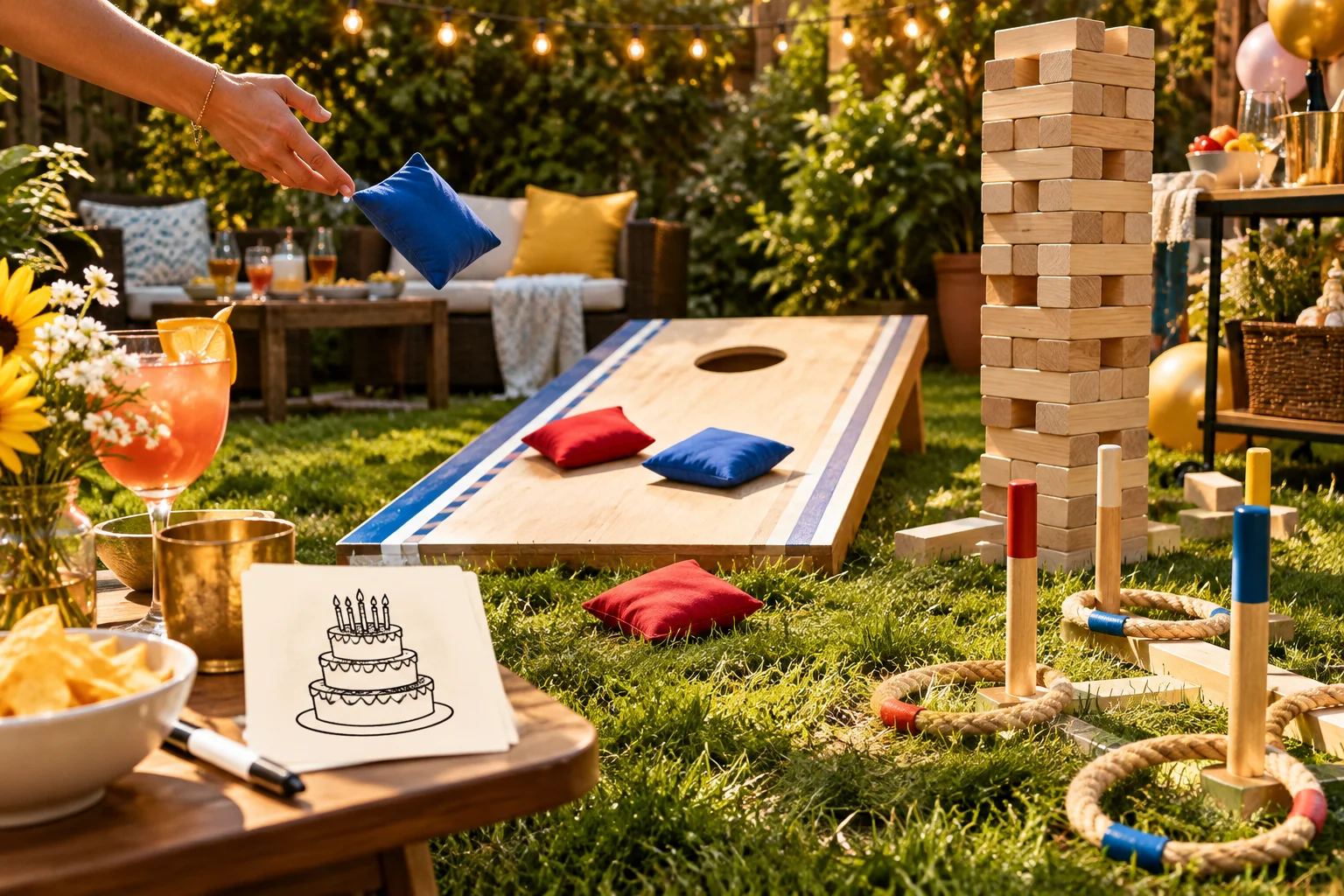
Set up the lawn-game station. Three classics work in almost any backyard: the beanbag toss (2-player or 4-player, $30-to-$80 set, 15-to-20 minute games), the ring toss with wooden stakes (4-to-8 player, $25-to-$60 set, 10-to-15 minute games), and the horseshoe-style throw (2-to-4 player, $40-to-$120 set, 20-to-30 minute games). You will find more in the Family Outdoor Party Games guide.
Run active team games. Three team games work well for big outdoor groups: the three-legged relay (paired teams of 2, running a course or zigzag, 5-to-10 minute heats), the egg-and-spoon balance race (solo or relay, at walking pace, 10-to-15 minute heats), and the water-balloon toss (paired teams stepping back after each catch, 10 to 15 minutes). The Water Game Ideas guide covers wet games.
Bring out the giant games. Oversized versions of word and stacking games are a hit in the backyard: the giant wooden block stacking tower (4-to-6 player, $40-to-$120 set, 15-to-25 minute games), the giant four-in-a-row vertical game (2-player, rotating across the group, $50-to-$150 set), and the giant lawn checkers or chess set (2-player, rotating, $80-to-$200 set). You will find more in the Giant Games guide.
Pick your pool games. Pool parties run on 3 types: pool volleyball or basketball (4-to-12 player, floating net and ball, 20-to-30 minute games), marco-polo and pool-tag (no equipment, 4-to-15 player, 15-to-25 minute games), and the pool-noodle relay (paired teams swimming with a foam noodle, 5-to-10 minute heats). Always supervise pool games at every age, and make sure a lifeguard or watchful adult is on duty at multi-kid pool parties. The Swimming Pool Game Ideas guide covers more pool games.
Build the carnival-style station block. Tickets, stations, a prize wheel.
Three-to-five stations give the yard a carnival feel across one 60-to-90 minute block: the ring-toss station, the bean-bag-toss station, the duck-pond pickup (for little kids), the balloon-pop dart game (for older kids and adults, with an adult supervising the throw line), and the prize wheel. Each station runs on a 5-to-10 minute rotation, and guests move between them collecting tickets to redeem for prizes at the end. The Carnival Game Ideas and Festival Party Game Ideas guides cover more station games.
Schedule active games for daylight and warm hours. Timing matters more than you would think. Outdoor games run best in the 60-to-90 minute stretch before dinner. Aim for 5-to-7 pm on summer evenings (finish before sunset) and 2-to-4 pm for afternoon kids' parties. For a whole day of holiday games, the Christmas Day Party Games guide runs them from morning to night.
What Makes Word, Card, and Guessing Games Work Indoors?
Indoor word, card, and guessing games suit seated, table-based parties best: little equipment, lots of warm conversation. Five formats cover most homes and venues: the verbal guessing game, the tile-based word game, prompt-card storytelling, the team drawing game, and the fast round-based game.
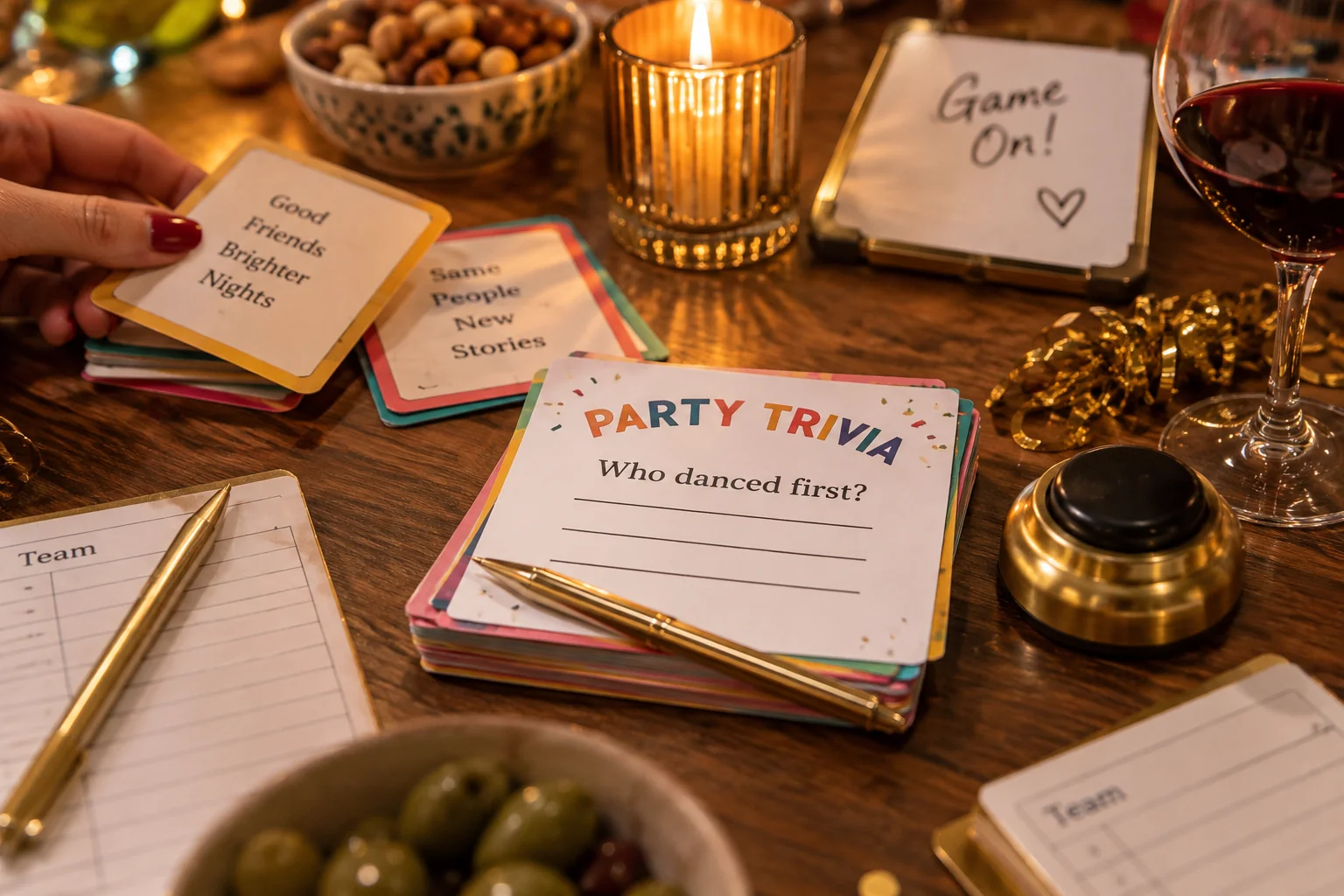
Run the verbal guessing game. Three classics never miss.
In the celebrity-on-the-forehead game, guests write a celebrity name on a sticky note, place it on another guest's forehead, and that guest asks yes-or-no questions until they work out who they are. In the song-title drawing game, one guest draws a song title while teammates guess. In the description-only word game, one guest describes a target word without using 5 forbidden related words. The Charades Terms and Party Ideas guide covers more verbal games.
Pick the tile-based word game. This one runs in the background.
Tile-based word games suit seated dinners and casual lounge evenings, and they reward quick play: players draw letter tiles and build their own grid of connected words against a 3-to-5 minute timer. They work for 2-to-6 players and pair naturally with dessert and coffee. Card games fill the same seated slot, and the Family Card Game Ideas guide has 6 of them.
Set out the prompt-card storytelling game. In storytelling card games, players take turns drawing a prompt card and weaving it into a short story. They work for 4-to-10 players over 30-to-45 minute sessions and suit intimate adult dinners and bachelorette weekends especially well. The Left Right Story Game guide covers round-table storytelling.
Run the team drawing game. Drawing games are a hit at 8-to-20-guest indoor parties: one team member draws a word or phrase while teammates guess against a 60-to-90 second timer. Use a small whiteboard or a stack of plain paper and markers; you need $10-to-$25 of supplies and 30-to-45 minutes. The Adult Party Games guide covers the grown-up version.
Pick a fast round-based game. Three fast games fit neatly into 15-to-30 minute stretches: the one-minute challenge relay (timed challenges with household items, 6-to-20 players), the buzzword call-out game (you read cards with quirky buzzwords, and the fastest guesser scores), and the speed-association game (players link words across quick rounds). The One-Minute Party Game Ideas guide covers more minute games.
Fit the game to your space. Room first, game second: cozy living rooms (under 12 guests) suit verbal and tile-based games; mid-size venues (12-to-30 guests) suit team drawing and storytelling; large indoor events (over 30 guests) suit fast rounds and trivia-bingo hybrids. For a kids' crowd, the Kids Indoor Game Ideas guide sorts indoor games by space and noise.
Plan Kids Party Games by Age Bracket
Kids' games sort neatly into 3 age groups, each with its own feel: toddler-to-preschool (3 to 5 years), early-elementary (6 to 9 years), and tween (10 to 12 years). Everything shifts as the kids get older: their attention spans, how well they coordinate, the prizes that land, the prep involved, and how much you steer from the front.
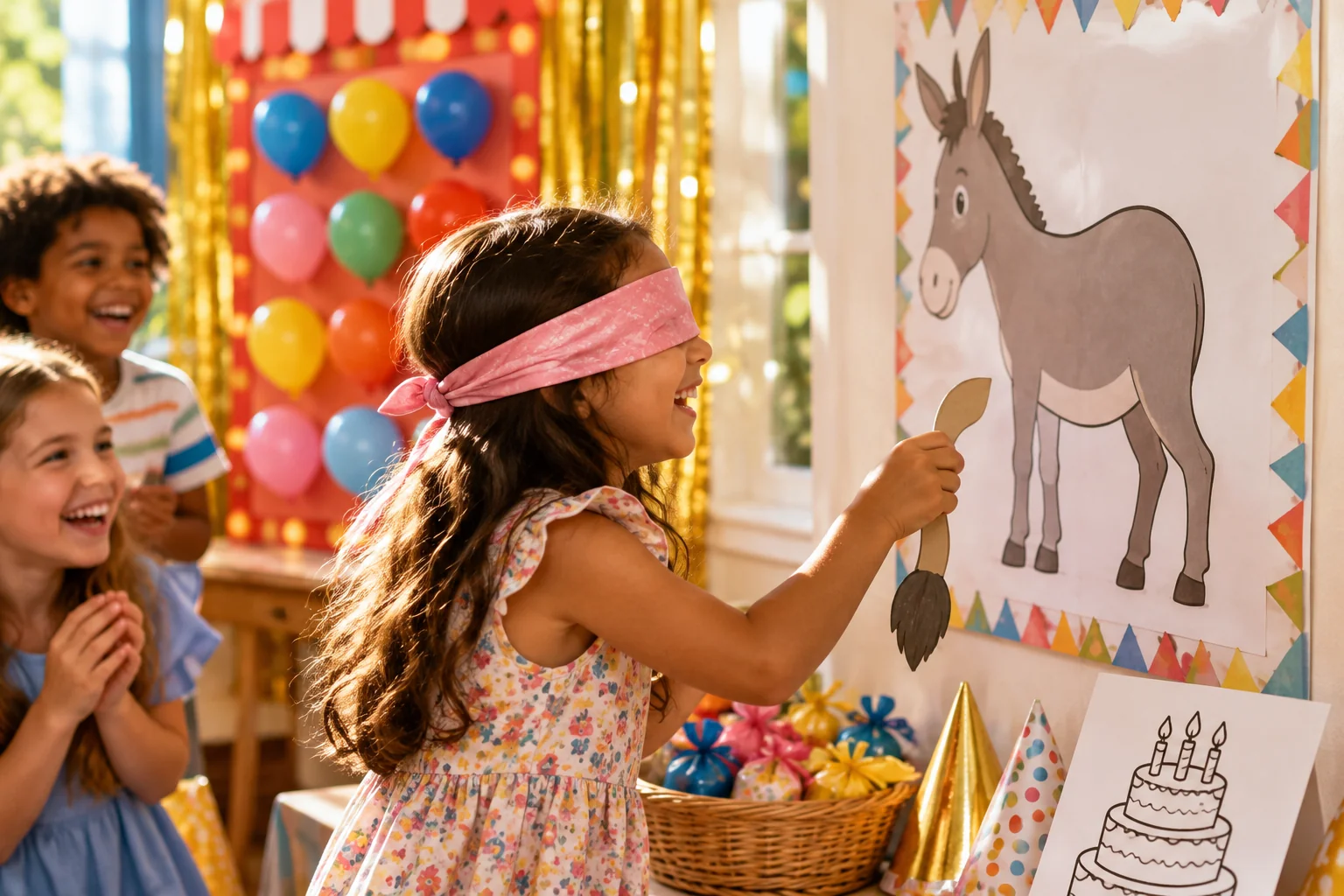
Games for ages 3 to 5. Three favorites suit the toddler-to-preschool range: the parachute color game (a 6-to-12-foot fabric parachute the kids grip at the edges, and when you call a color the kids holding it swap places), pin-the-element-on-the-poster (a themed wall poster with a piece missing, and kids place stickers with eyes closed), and the balloon-toss circle (kids stand in a circle keeping a balloon up with hand-pats only, and a dropped balloon is an out). Attention spans run about 5-to-10 minutes per game, so plan 3 per hour. The Kids Party Ideas guide covers more for toddlers; the Scavenger Hunt Ideas for Kindergarteners guide covers clue hunts sized for this age.
Games for ages 6 to 9. Three favorites suit 6-to-9-year-olds: musical chairs (one fewer chair than kids, music plays and stops, and the last one standing sits out until a winner remains), a scavenger hunt (hide 8-to-12 prize tokens around the yard or house for kids to find within 10-to-15 minutes), and relay races (paired or team relays with simple props, 10-to-15 minute heats). Attention spans run about 10-to-15 minutes per game, so plan 2 or 3 per hour. The Children's Birthday Game Ideas guide has more.
Games for ages 10 to 12. Three favorites suit 10-to-12-year-olds: a themed scavenger hunt with riddle clues (printed cards lead from one hiding spot to the next over 15-to-20 minutes), team trivia (printed sheets over 20-to-25 minutes, 2 teams of equal size), and a karaoke-and-dance-off block (a small wireless speaker, a song queue, and a rotating performer). Attention spans run about 20-to-30 minutes per game, so plan 2 main games for a 3-to-5-hour party. The Kids Indoor Game Ideas guide has more for indoors.
Plan prizes by age. Three levels cover most kids' parties: small tokens (stickers, mini-erasers, candy, $1-to-$3 per winner) for preschoolers, small toys (mini-figures, jump ropes, bubbles, $5-to-$10 per winner) for early-elementary, and small experiences (movie passes, ice-cream gift cards, $10-to-$15 per winner) for tweens. Pair every winner with a tiny consolation token so no child leaves empty-handed. The Kids Party Games guide has more.
Plan how much you will lead. Preschool games need a grown-up guiding every step (explaining rules, keeping time, handing out prizes); early-elementary games need you to set up, then the kids run with it once they know the rules; tween games run almost on their own once you explain the rules and set a timer. The Kids Party Ideas guide covers who does what.
Work around the birthday traditions. Kids' parties have their own set-piece moments alongside the games: the pinata, the cake, opening gifts, and the goody-bag handout. Put the games before the cake (kids get hungry), open gifts mid-party for under-12 groups, or skip gift-opening at venues to avoid awkward thank-yous. The Birthday Party Ideas guide covers the traditions.
Adult Party Games Across Cocktail and Milestone Formats
Adult party games suit cocktail, milestone-birthday, and grown-up themed events, with conversation-led energy and less running around than kids' games. Most of them come down to a handful of choices: the format (verbal, printable, or app-based), how much drinking is in play, whether you add a tribute to the guest of honor, seated teams or free mingling, and how you wind the night down.
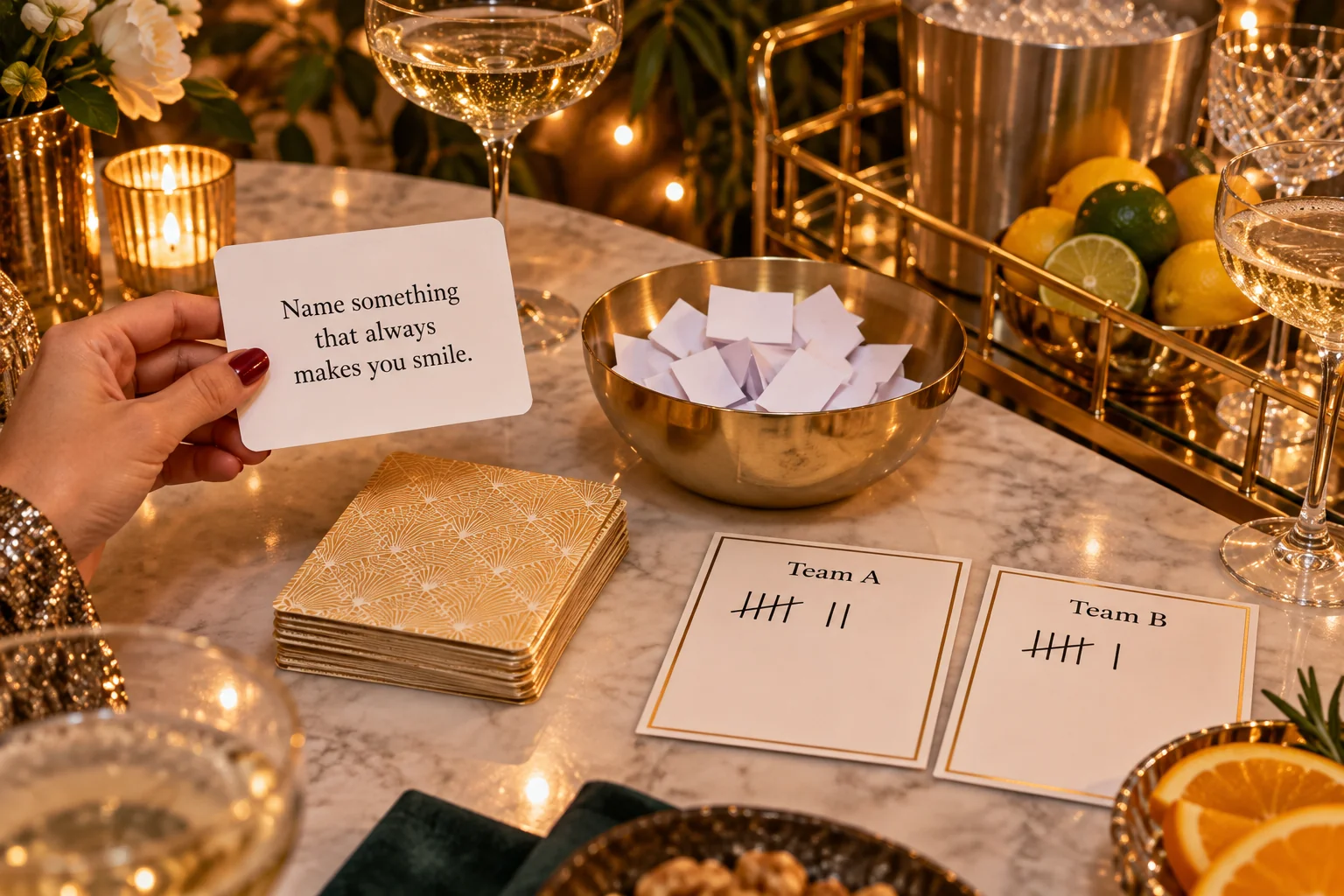
Pick the format. Three formats cover most adult games: verbal (no equipment, conversation-driven, like charades, never-have-I-ever, and two-truths-and-a-lie), printable (trivia cards, bingo cards, prompt-card storytelling), and app-based (smartphone-companion trivia and party-prompt apps, $0-to-$10 each). Choose based on how noisy the venue is and how guests are seated. The Adult Party Games guide has more.
Match the games to the drinks. Fit the games to how much drinking is involved. At light-alcohol or alcohol-free events (afternoon milestones, daytime cocktails), trivia, charades, and conversation prompts work well; at full-bar events (evening milestones, bachelorettes), you can add adult prompt cards and adult card games. Skip drinking games entirely when non-drinkers, pregnant guests, or anyone in recovery is there. The Bachelorette Party Ideas guide covers bachelorette games.
Add a milestone tribute. Milestone birthdays (30th, 40th, 50th, 60th) shine with a game that centers on the guest of honor: how-well-do-you-know-the-birthday-guest trivia, a decade-of-their-life music quiz, a photo-guess game (childhood and through-the-years shots), and a well-wishes card (guests write a note to the celebrant). The Birthday Party Ideas guide covers milestone games.
Choose seated teams or free mingling. Two layouts cover most adult game sessions: seated teams (table teams of 6-to-10, with you running trivia or charades from the front) and mingle stations (guests move freely between game stations, no fixed teams). Seated teams keep the energy high for a 45-to-60 minute stretch; mingle stations hold a steady rhythm across 60-to-90 minutes without wearing anyone out. The Adult Party Games guide covers layouts.
End with a wind-down game. A calmer game eases the last 30-to-45 minutes before send-off: the printed conversation-card stack on side tables, a rolling charades round with no scorekeeping, or a slow storytelling card game. Skip high-energy games in the final hour so guests are not worn out before the cake or the goodbye. The Games That Are Fun for Adults guide has more.
Plan prizes for adults. Three levels cover most adult games: small ($3-to-$10 per winner, mini bottles of bubbly, gift cards, candy) for casual milestones, mid-range ($15-to-$30, themed gift boxes, spa minis, books) for milestones, and no prize at all (only the win and the bragging rights) for grown-up dinners where a little handout would feel childish. The White Elephant Ideas guide covers adult prize swaps.
Party Games for Large Groups, Teams, and Workplace Events
Large-group games handle 20-plus guests by pulling everyone into play instead of leaving half the room watching. Five formats cover most big, team-building, and workplace parties: the station rotation, the team tournament, the everyone-at-once format, the lightning-round series, and a workplace-friendly setup.
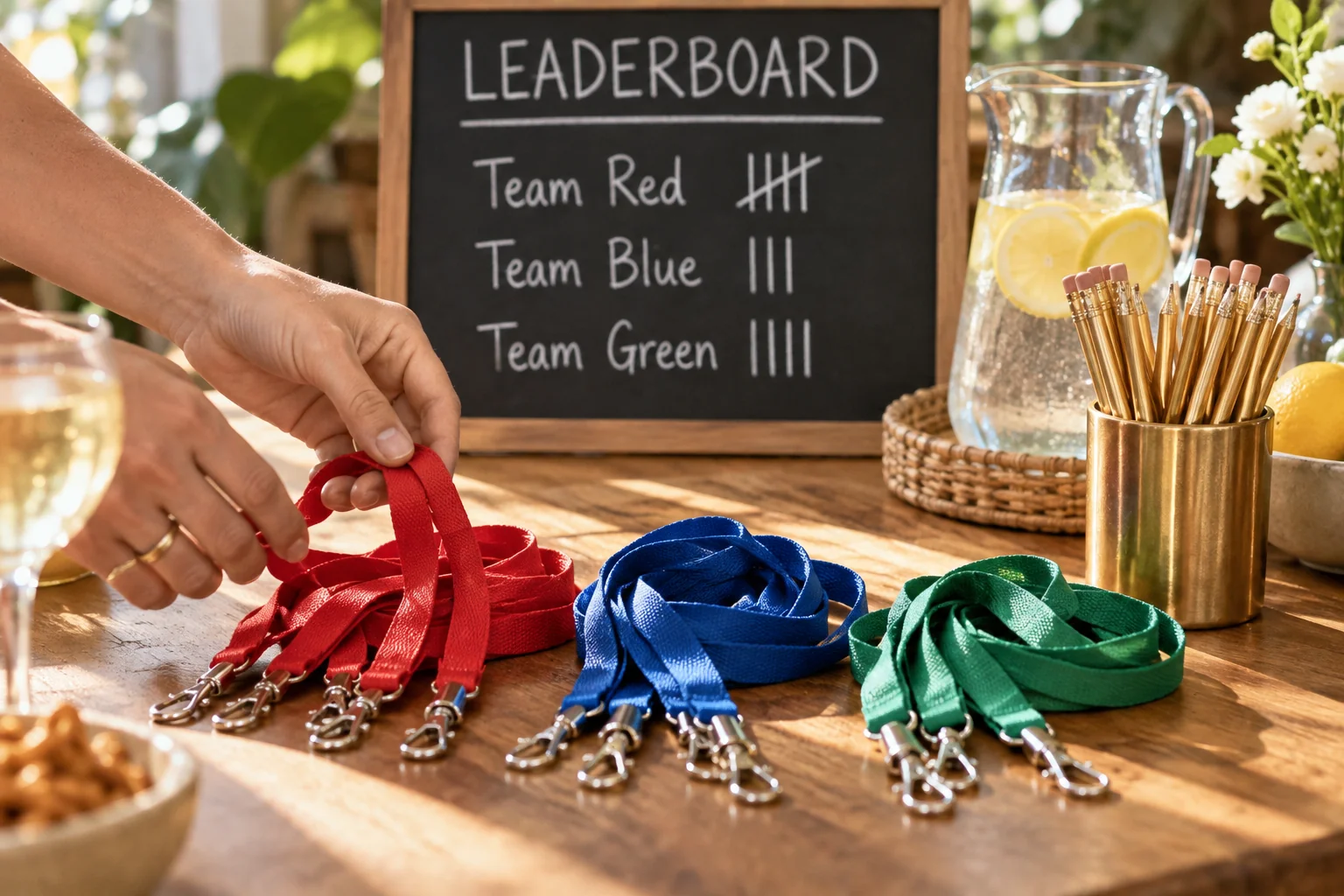
Set up a station rotation. Run 4-to-8 game stations across one 60-to-90 minute block, with teams of 4-to-8 rotating on a 7-to-10 minute timer. Each station has one mini-game (a trivia round, a charades round, a balloon-toss heat, a beanbag toss, a drawing relay), and scores add up across all stations for a final leaderboard. It handles 20-to-100 guests with room to spare, and workplace and team-building events love it. The Party Games for Large Groups guide has more.
Run a team tournament. Tournament brackets play out head-to-head over 60-to-120 minutes, with 4-to-8 teams competing in single- or double-elimination rounds of a chosen game (trivia, charades, bingo, beanbag toss). It handles 16-to-60 guests and shines at corporate retreats, college reunions, and large milestone parties. For bingo rounds inside the bracket, the Bingo Game Ideas guide covers keeping each round fair.
Try the everyone-at-once format. These handle the biggest crowds (50-to-200 guests) by running the same game at every table at once: themed-prompt bingo where every guest holds a card and you call prompts from the front, trivia where every table is a team answering on paper, and at-table charades where each table runs its own round side by side. The Christmas Party Games for Work guide covers big workplace groups.
Run a lightning-round series. String 6-to-10 short games (3-to-5 minutes each) back-to-back across a 30-to-45 minute block: name 3 things in a category, sing a song with a given word, guess the celebrity, keep the balloon up. Teams or individuals score across every round for a running leaderboard. It handles 20-to-60 guests at high-energy holiday and workplace events. The Holiday Party Games guide covers the seasonal version.
Keep workplace games inclusive. Office games need an extra check beyond regular adult events: skip alcohol-centered games, gender-divided teams, physically demanding formats that leave out mobility-limited guests, and prompt cards about personal life or relationships. Instead, run trivia (general-knowledge or company-history), low-intensity team relays, and bingo with workplace-prompt cards. The Holiday Party Ideas guide covers office-friendly picks; for remote teams and screen-based get-togethers, the Virtual Party Games guide covers online games.
Plan prizes for big groups. Give a per-team gift basket ($40-to-$120 for a winning team of 8, which splits naturally), a stack of small individual prizes ($3-to-$10 per winner), or an experience-prize raffle (tickets per game played, with 1-to-3 big prizes drawn at the end). The Ideas for White Elephant Gifts guide has more prize-swap ideas.
Pick Themed Game Formats, Murder Mystery, Scavenger Hunt, Charades
Themed formats build the whole party around one immersive activity that runs across the full 2-to-4-hour window. Five of them cover most adult and family parties: the murder-mystery dinner, the scavenger hunt, themed charades or drawing games, the trivia game show, and the escape-room-style party.
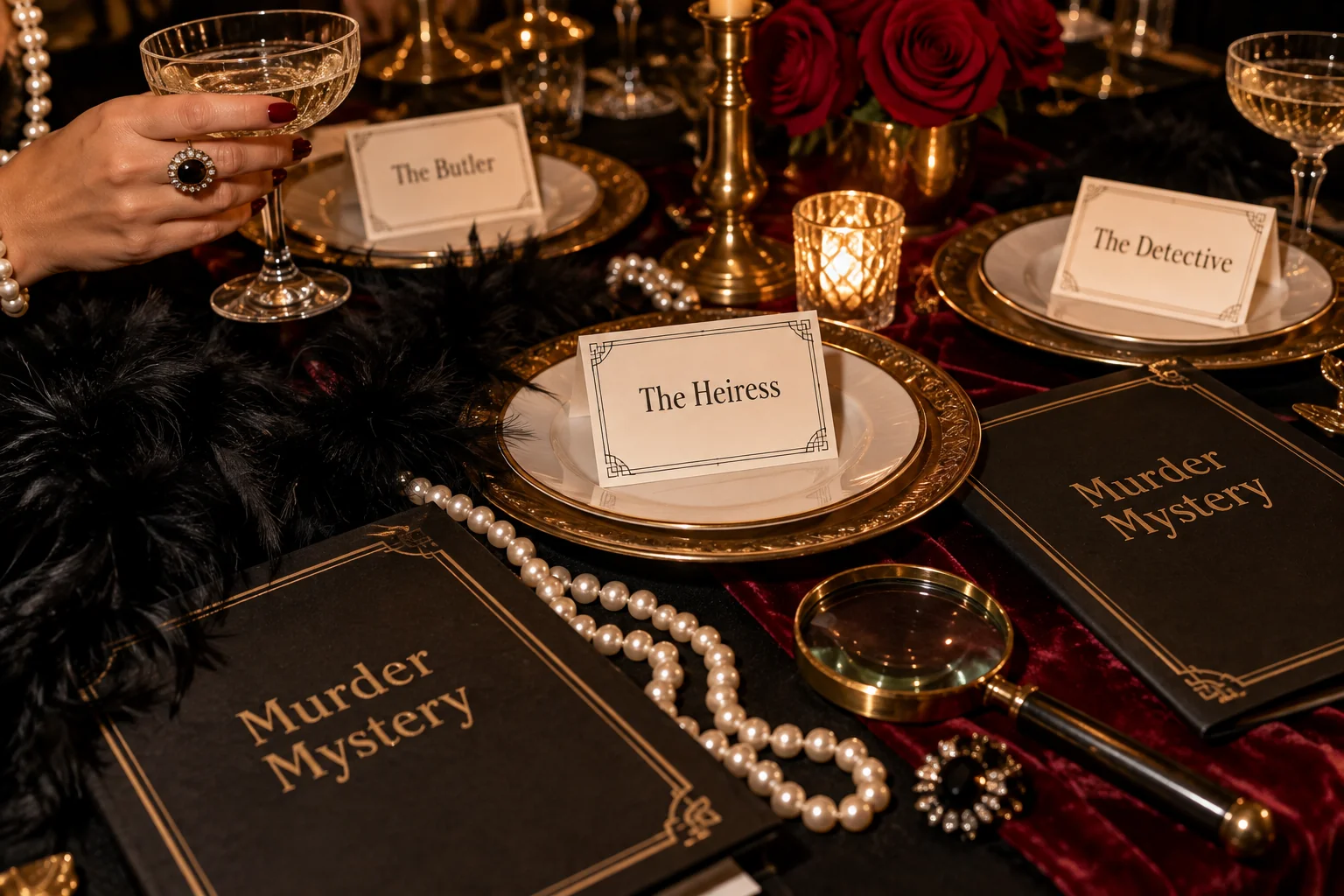
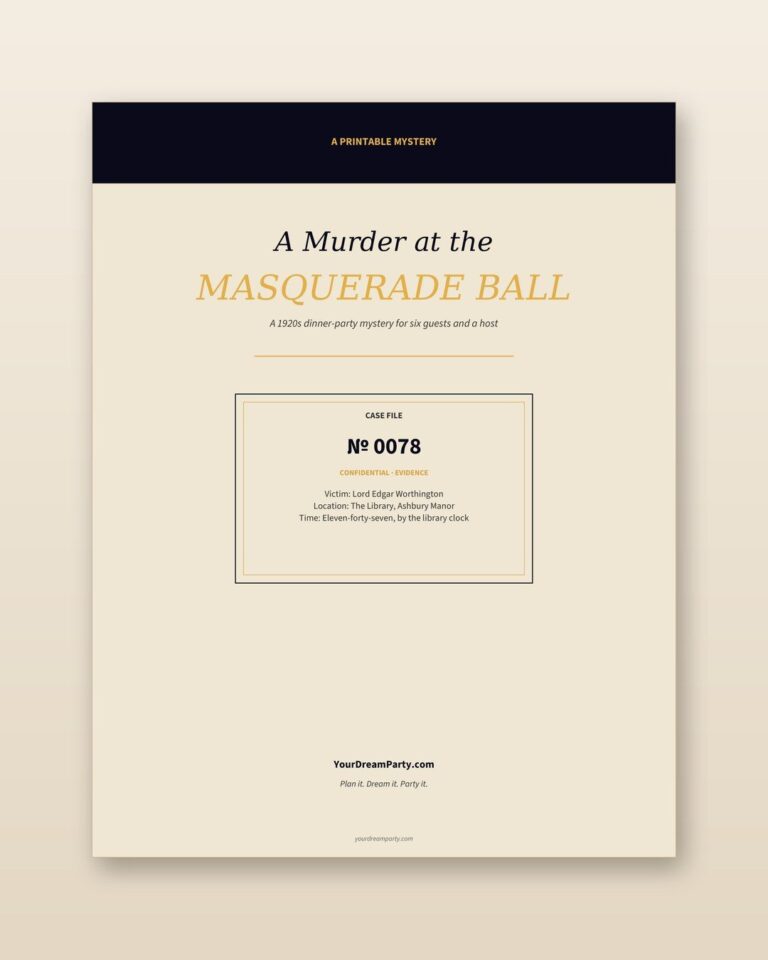
Host a murder-mystery dinner. A murder mystery is a fully scripted 2-to-3-hour dinner where each guest gets a character card with a backstory, a secret, an alibi, and a script. You run 3 rounds: introductions and alibis, the evidence reveal, and the accusation and reveal. It works for 6-to-12 guests at adult dinners. For a milestone birthday, a bachelorette weekend, or a themed cocktail night, it is a safe bet. The Murder Mystery Party Game Scenarios guide covers eras and scenarios; the free Murder Mystery Party Generator drafts a custom scenario in under 3 minutes.
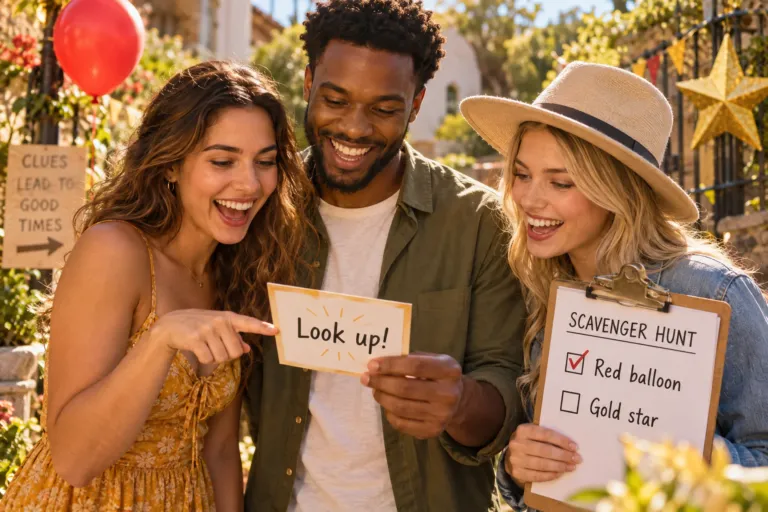
Set up a scavenger hunt. A scavenger hunt runs on a stack of printed clue cards that lead from one hiding spot to the next across the venue, each with a riddle pointing to the next, and the final spot holds a prize or the cake. Plan 30-to-60 minutes for an indoor-only hunt and 45-to-90 minutes if it spills into the yard. Scavenger hunts suit 6-to-30 guests at kids' birthdays, bachelorette weekends, and adult themed parties. The Party Scavenger Hunt and Treasure Hunt Ideas guides have more.
Play themed charades or a drawing game. Themed charades uses a category-driven prompt deck (movies of the 1990s, song lyrics, famous-couple names) for 20-to-45 minutes of play. The themed drawing game follows the same idea with sketching instead of acting. Both work for 8-to-30 guests and pair naturally with dessert and after-dinner drinks. The Charades Terms and Party Ideas guide has more prompt decks.
Run the trivia-game-show format. Buzzers, teams, a points board.
A trivia game show is a fully theatrical setup: 2 or 3 teams, a buzzer or hand-raise, a host with a microphone, and a category-and-point-value board on the wall. It works for 12-to-50 guests across a 45-to-75 minute block and was practically made for milestone events and corporate dinners. The Family Party Trivia Ideas guide covers game-show setups; the party game questions guide covers the prompts.
Set up an escape-room-style party. Escape-room parties run a puzzle-and-clue chain across a 30-to-60 minute window, where teams solve 5-to-8 puzzles in sequence to reach a final reveal (a hidden cake, a milestone toast, a guest-of-honor surprise). They work for 4-to-20 guests (split into 4-to-6-player teams for bigger events). A printable puzzle pack saves the writing, but plan 60 to 120 minutes to set the puzzles up. The Scavenger Hunt Clue Ideas guide covers puzzle design.
Pick a themed game for the season. Seasonal parties pair naturally with themed games: a white-elephant gift swap for the winter holidays, a Halloween costume-and-mystery party, a patriotic outdoor scavenger hunt in summer, and harvest-themed trivia in fall. The White Elephant Ideas, Gift Exchange Ideas, and Holiday Party Games guides cover seasonal games; the Ideas for White Elephant Gifts guide covers gift picks for the swap itself.
How the Murder Mystery Generator and Companion Tools Build the Activity Plan
The Murder Mystery Party Generator is a free tool that drafts a custom themed scenario in under 3 minutes. Enter your guest count, the era (such as 1920s speakeasy, Victorian Gothic, medieval feast, or modern noir), the tone (spooky serious, comedic, family-friendly, adult-only), your players' experience, the diets the menu has to cover, and the venue type; first-time players get one more step on how scripted the night should be. It hands back a full mystery plan: the cast (one character per player, with names, roles, motives, and secrets), the clue distribution across 3 to 5 rounds, the three-act running order, and menu styling that matches the era. Run it 10-to-14 days ahead, because the generator leaves the clue wording and the solution to you. The printable Murder Mystery Kit is the ready-to-print companion, with 21 pages of character cards, clue cards, a ballot, host instructions, and a sealed solution.
The Outdoor Cinema Setup Builder drafts a full backyard movie-night plan in under 2 minutes. Enter the outdoor space you have, your guest count, the screen you are working with, how you want guests seated, and the vibe for the night, and it returns the screen size, the projector throw distance, a lumens table read against the ambient light, a zone-by-zone setup checklist, the snack-station styling, and a weather-backup plan. Pair it with the active outdoor games above for a complete backyard evening. The Outdoor Movie Night Setup Ideas guide covers the run-of-show and the budget tiers.
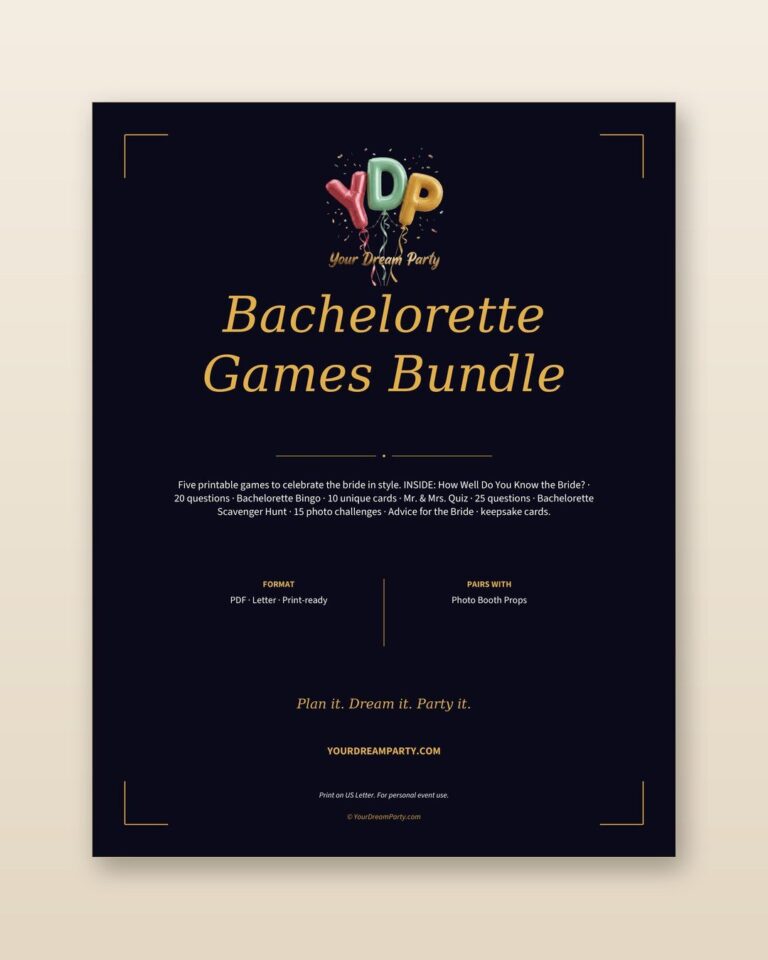
The Bachelorette Party Planner plans the whole bachelorette, from a single evening to a destination week, down to a block-by-block itinerary. Pick the party style, the group size, the per-person budget, the duration, the location type, and the bride's personality (adventurous, modest, sentimental, glam, laid-back, foodie), then type her first name, which you can skip; a travel location (destination weekend or international) adds a packing step. It returns that itinerary plus an activity list filtered to the personality you picked, with tags such as sentimental, low-key, or VIP. The printable Bachelorette Games Bundle covers the bride's big night with 5 printable games (how-well-do-you-know-the-bride, scavenger hunt, Mr-and-Mrs quiz, advice cards, bingo).
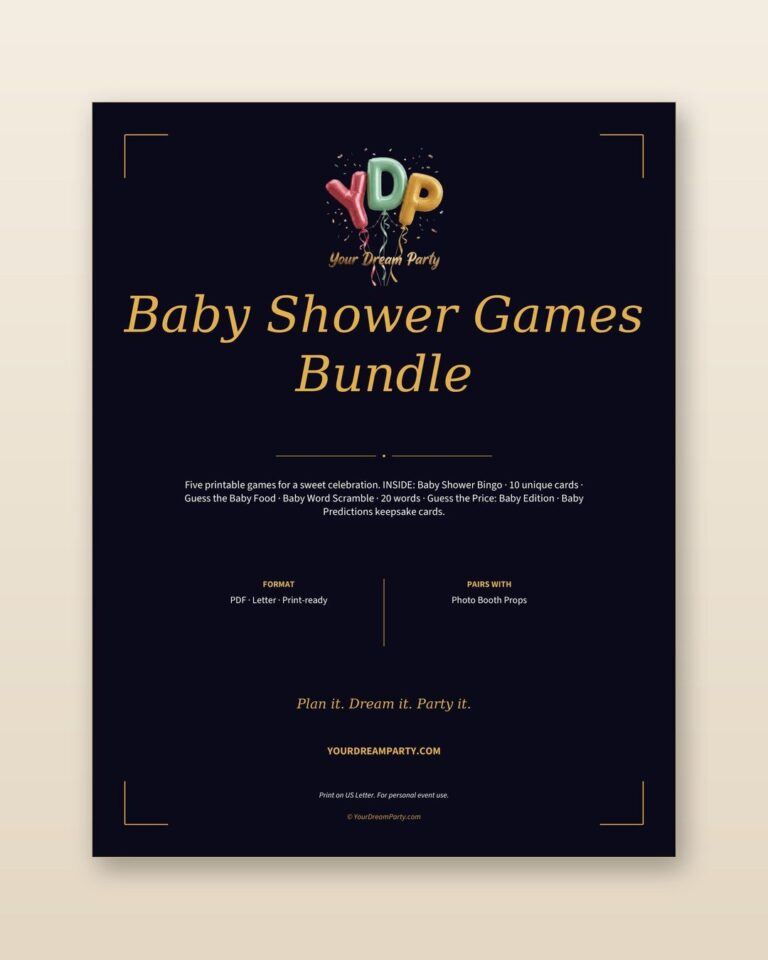
The Baby Shower & Gender Reveal Planner drafts a full baby-shower plan, games included. Pick the celebration (baby shower or gender reveal party), name the mother-to-be and set the party date, both optional, and choose the theme, the guest count, the venue, the time of day (brunch, lunch, afternoon tea, evening), and the budget tier. It returns a 12-week countdown checklist, a theme palette, 3 themed games matched to that theme, and a curated decor list; a gender reveal party adds a reveal step and a reveal-moment guide. The printable Baby Shower Games Bundle gathers the 5 baby-shower games in one ready-to-print PDF.
Reach for whichever tool fits your event: the murder-mystery generator for themed adult dinners, the bachelorette planner for weekends and nights out, the baby-shower planner for showers, and the outdoor-cinema builder for backyard movie-and-game nights. The Birthday Party Ideas guide covers birthday parties; the Kids Party Ideas guide covers kids' games; the Holiday Party Ideas guide covers seasonal games.
Frequently Asked Questions
How many party games should I plan for a 3-hour event?
Plan 2 main games plus 1 icebreaker for a 3-hour party, not 5. Cram in 6 back-to-back games and you run out of time, tire everyone out, and skip the cake and dessert. Run the icebreaker in the first 30 minutes, the main game around the 60-to-90 minute mark, and let the final hour flow on conversation or a printed conversation-card stack. It is the energy, not the clock, that sets the number.
What are the best party games for a small group of 4 to 8 guests?
Small groups of 4-to-8 guests suit table games best: two-truths-and-a-lie, themed trivia, prompt-card storytelling, tile-based word games, and small-deck card games. Skip station rotations and team tournaments that need 12-plus players to work. The how-well-do-you-know-the-guest-of-honor trivia is the strongest pick for milestone birthdays this size. Plan 1 main game across a 30-to-45 minute window rather than cramming in 3.
What are the best party games for large groups over 20?
Large groups over 20 guests do best with station rotations, team tournaments, everyone-at-once formats (where every table plays the same game), and lightning-round series. Skip 4-player card games and intimate dinner games that leave most of the room watching. Bingo, themed-prompt scavenger hunts, large-group trivia with table teams, and station-rotation carnival blocks all shine for 20-plus guests across the 60-to-90 minute main stretch.
What party games work for mixed-age groups with kids and adults?
Mixed-age groups do best with simple games that work for everyone: bingo (with picture cards for younger kids), scavenger hunts (with riddle clues pitched to the youngest reader), themed charades (with separate kid and adult prompt decks), and balloon-toss or beanbag-toss lawn games. Skip reading-heavy or pop-culture-heavy prompts that leave kids out, and skip alcohol-based games entirely. A 2-team format with one parent-and-kid pair per team keeps everyone, young and old, in the fun.
How do I run a murder-mystery party at home?
Run a 2-to-3 hour dinner with 6-to-12 guests and send invitations 10-to-14 days ahead that name each guest's character. Set the dining table with character placards, hand out character packs (backstory, secret, alibi) at arrival, and run 3 rounds (introductions and alibis, evidence reveal, accusation and reveal). The free Murder Mystery Party Generator drafts a custom era-themed scenario in under 3 minutes; the printable Murder Mystery Kit covers the host-instructions, character cards, clue cards, ballot, and reveal in one ready-to-print PDF.
What are the strongest ice-breaker games for adult cocktail parties?
Adult cocktail icebreakers work well in 5 formats: the printed bingo card with prompt squares (find someone who has traveled to 3 continents, find someone who knows the host from work), the two-truths-and-a-lie circle for groups under 20, the find-someone-who scavenger sheet collected as guests arrive, the conversation-prompt card stack on each side table, and the name-and-fact prompt at check-in. Let the occasion set the tone: formal milestones suit the printed conversation-card stack, while casual events suit two-truths-and-a-lie and find-someone-who.
Which baby shower games run on the lowest prep time?
Baby shower games with the lowest prep come in 5 formats: baby word scramble (a printable PDF with 20 scrambled baby-related words), guess-the-baby-food (10 baby-food jars labeled with stickers, and guests taste and write guesses), guess-the-price baby edition (10 baby-product photos, and guests write price guesses), the advice-for-the-baby card stack (a small card stack with prompts for written advice from each guest), and the baby predictions card (a printable card where each guest predicts the due date, weight, and hair color). The full printable Baby Shower Games Bundle gathers 4 of them, plus bingo, in one PDF to print at home.
What party games are kid-safe for ages 3 to 5?
Games for ages 3 to 5 work well with parachute color play, pin-the-element-on-the-poster (stickers, eyes closed rather than real blindfolds), the balloon-toss circle, simple musical chairs, and freeze dance. Skip real blindfolds for safety, skip elimination games that leave little kids in tears, and plan 3 games per hour to match their 5-to-10 minute attention spans.
How do I plan party games for a workplace or office event?
Workplace games need a quick inclusivity check. Skip alcohol-centered games, gender-divided teams (use Team Alpha and Team Beta), physically demanding formats that exclude mobility-limited guests, and prompt cards about personal life. Run general-knowledge or company-history trivia, low-intensity team relays, workplace-prompt bingo, station rotations, and prize raffles so every guest leaves with a small token. Plan a 45-to-60 minute game block in a 2-to-3 hour office party.
Should I award prizes for party games?
Award small-token prizes for casual games ($3-to-$10 per winner: candy, mini bottles, gift cards) and mid-range prizes for milestone games ($15-to-$30: themed gift boxes, themed mugs). Skip prizes entirely for grown-up dinners, where a little handout can feel childish and the bragging rights are prize enough. Pair every young winner with a tiny consolation token so no child leaves empty-handed. For big groups, give one gift basket to the winning team rather than lots of small individual handouts.
Are printable party games worth the cost over store-bought?
The printable game bundles here run from $12.00 for a 5-game themed bundle to $29.00 for the Party Games Mega Bundle, versus $20-to-$60 for a store-bought single-game box. Printables win on 3 counts: cost per event (one purchase covers unlimited print runs across many parties), customization (you can personalize prompts and themes to the guest of honor), and flexibility (print only the games you need and skip the rest). Store-bought games are better for a permanent home collection and family game nights, not for one-off parties.
What is the difference between an icebreaker and an anchor party game?
An icebreaker runs across the first 30 minutes as a low-key social warmup (name-and-fact prompts, find-someone-who scavenger, printed bingo cards, two-truths-and-a-lie), easing guests from check-in to first drink to first conversation. A main game is the centerpiece, around the 60-to-90 minute mark, with more prep (themed trivia, a scavenger hunt, a charades round, a murder mystery) that pulls the room into one focused activity for 30-to-60 minutes. Plan 1 icebreaker plus 2 main games for a 3-hour party.
Ready to Build Your Party Game Plan?
Two main games plus one icebreaker are all it takes, whoever is coming, however many guests, whatever the energy.
The quickest way from a blank page to a confident party-game plan is to sort who is coming, how many guests, and the energy you want first, then pick an icebreaker for arrivals and a main game for the middle of the party. The free Murder Mystery Party Generator drafts a custom themed scenario in under 3 minutes, and the Party Games Mega Bundle below gathers the printables, from baby-shower games to bachelorette games to a murder-mystery kit, in one download.
This page contains affiliate links to Amazon and other retailers. As an Amazon Associate, we earn from qualifying purchases at no extra cost to you. This helps us keep all our tools free.
Results generated by this tool are for planning and inspiration purposes only. Estimates are based on general guidelines and may vary depending on your specific circumstances. Always verify with your suppliers before making purchasing decisions.