How Does the Murder Mystery Party Generator Work?
Six short steps is all it takes, and a seventh opens if your players are first-timers. Each answer feeds a part of the plan, so what you end up with suits the evening you are actually hosting, not a generic dinner-party-plus-murder template. Plan on under 3 minutes, on a phone or laptop, and there is no signup or email wall before your result.
Step 1, group size. Pick from 4 bands (4 to 6, 7 to 12, 13 to 20, 21 to 30 guests) or type the exact head count anywhere from 4 to 30. Your group size sets how many archetype cards get dealt, how many clue rounds run, and how long the 3 acts are timed to take. A 6-guest evening deals 6 archetype cards and runs 3 clue rounds of 2; a 24-guest evening deals 24 cards, the era's own characters topped up with shared supporting roles, and runs 5 rounds of 4, across the same 3 acts.
Step 2, setting era. Pick from 8 eras (1920s speakeasy, Victorian Gothic, 1980s neon, Medieval feast, Modern noir, Pirate ship, Space station, Wild West). The era sets the costume direction, the color palette, the menu styling cues, and the characters dealt first. A 1920s speakeasy setting brings the jazz singer and the bootlegger; Victorian Gothic brings the spurned governess and the loyal butler; Modern noir brings the femme fatale and the crooked cop.
Step 3, tone. Pick from 4 tones (spooky serious, comedic, family-friendly, adult only). Your tone sets the script voice, which becomes a tone note the host reads inside Act 2. Spooky serious slows the pacing in Act 2; comedic leaves room for broad reactions and play; family-friendly keeps the stakes social and financial rather than violent; adult only allows darker stakes with a host flag on sensitive content.
Step 4, experience level. Pick from 3 brackets (first-timers, mixed, theater veterans). Choosing first-timers opens a seventh step for the hand-holding level, and your bracket sets the host note in the mechanics block: a huddle break once per act for first-timers, veteran-to-newcomer pairing for mixed, passive envelope clue drops for theater veterans.
Step 5, dietary considerations. This is the one step that takes more than a single answer: pick vegan, vegetarian, gluten-free and nut-free in any combination, or mark none and the dietary notes shrink to a single no-restrictions line. What you pick adds swap notes to the menu styling suggestions on the results page; it leaves the cast, the clues and the 3 acts untouched.
Step 6, venue. Pick your venue (home dining room, backyard or patio, restaurant private room, rented hall, boat or themed venue). Your venue adds feasibility notes to the decor checklist: battery-flicker candles and an open-flame policy check indoors, string lights and a wind-cover plan outdoors, small props and a wall-decor check in a restaurant room, oversized signage in a rented hall.
🛒 As an Amazon Associate, we earn from qualifying purchases, at no extra cost to you.
Detective Prop Set
Shop on AmazonVintage Costume Accessories
Shop on AmazonCandelabra Candleholder
Check Price on AmazonWhy the Murder Mystery Party Generator Beats a DIY Plot Draft
A blank document and a mood-board folder are where many hosts start when they write a mystery themselves, but that starting point hides real costs. Write it from scratch and you'll often pick a plot that needs more suspects than your guest list has, write character cards that overwhelm quieter guests, or skip the red herrings and give the whole thing away in the first 30 minutes. The generator works from your group size, era, tone, and experience level before a single character card prints, so the cast and the clue rounds both fit your room.
People come back to it for 5 reasons.
- One card per guest, up to 30. A plot built for 10 guests breaks when only 7 say yes; a plot built for 8 leaves 4 people with nothing to do when 12 turn up. The generator deals one archetype card per guest, starting with the era's own characters and filling any seats past them with era-neutral supporting roles, so nobody at the table is left standing around. Every card carries the same 4 lines: role, motive, secret hook, and what to wear.
- An atmosphere tied to the era, not a generic mystery vibe. Your setting era flows into one coherent palette, costume direction, and menu styling cue on the result page. A 1920s speakeasy evening brings velvet covers, brass candleholders and pearls under warm low amber, with smoked-salmon canapes and a pomegranate-and-tonic cordial; a Victorian Gothic evening turns candelabra-lit and velvet-runnered, with beef-Wellington bites and a plum-and-port reduction. The whole look feels intentional instead of pulled from a costume shop.
- Scripting that suits how much your players can improvise. A first-timer group freezes with nothing to read; a theater-veteran group chafes at reading at all. Pick first-timers and a seventh step opens where you choose full pre-written scripts, clue cards only, or improv outlines; the results then describe how that format runs at the party (they do not write the scripts for you), and the mechanics block adds a huddle break once per act.
- Spoiler-free for you, the host. The generator lays out the plot as an act-by-act arc (arrivals, clue rounds, written accusations, and how the reveal works) without naming a culprit anywhere on the page. The sealed solution is yours to write (the Printable Murder Mystery Kit is a separate mystery that arrives with its solution already written), so the page gives you suspects, motives and clue timing and leaves the last card of the evening to you.
- Decor notes for the room you are using. A home dining room picks up a battery-flicker candle rule and an open-flame policy check; a restaurant private room is told the envelopes, ledgers and any clue cards travel best and to ask the venue before dressing the walls; a rented hall is told to scale the signage up and seat the cast at one end so the room frames them.
The generator pairs neatly with the Party Theme & Vibe Finder Quiz if you want the look and vibe settled before you deal the cast, the Party Lighting & Atmosphere Designer for dialing in the candlelit, warm-tungsten setup a mystery evening tends to want, and the Party Budget Calculator for splitting the spend across food, drinks, decorations, and venue setup.
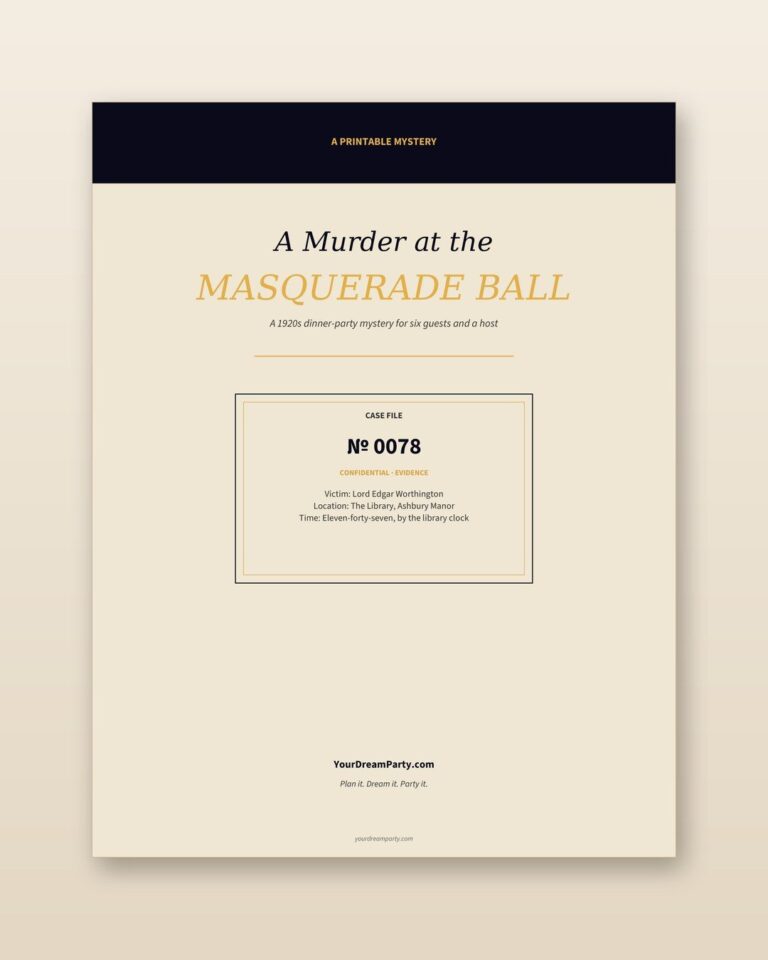
Printable Murder Mystery Kit
- A 1920s masquerade mystery for 6 guests plus a host
- 6 character cards: role, backstory, alibi, secret and what they know
- 12 clue cards over 4 rounds, 3 per round
- Host instructions with casting tips and timings
What the Murder Mystery Party Generator Builds for Your Evening
Finish the 6 steps and the results page gives you a full plan for the evening, minus the solution and the clue wording. Every piece is drawn from the choices you made and ready to act on in your planning week.
Setting and premise card. Three short paragraphs set the scene, the crime, and the hook: a smoke-filled speakeasy where the club owner is found in the back office with the night's take gone, or a gas-lit manor where the lord is slumped at the desk over a half-signed will. Use it as your quick summary when you text the casting list or fill in the helper working the door.
Character roster card. One card per guest: the era's own 7 or 8 characters are dealt first and shared supporting roles cover everyone after them, each card naming the role, the motive, the secret hook, and the costume (supporting roles point to the era dress code instead). The tool asks you to assign them by personality rather than by gender, and if a deal does not suit your guests, Deal a different cast reshuffles the grid.
Plot structure block. An act-by-act guide (setup, confrontation, reveal) showing how the evening unfolds and how the reveal works, without handing you the solution. It doubles as your prompt sheet: when each clue should drop, when each act break happens, and when the final reveal should land. The card never names a culprit; the sealed solution is yours to write, and the Printable Murder Mystery Kit is the route to a mystery with one written for you.
Atmosphere and decoration guide. A decor checklist, lighting, dress code, music vibe, and prop list built from your Step 2 era and Step 6 venue. A 1920s speakeasy at home calls for velvet table covers, brass candleholders, pearls on the centerpieces, hot-jazz instrumentals, and crystal coupes; a Victorian Gothic in a restaurant room calls for candelabras, dark velvet runners, slow strings, and a note to favor the small props and clear any wall decor with the venue. Take the list along as your shopping reference on the prop run.
Menu styling cues. Presentation only: era-themed dishes to plate. The cues stay about styling and never carry recipes or ingredient amounts, though your Step 5 dietary picks add swap notes, and a gluten-free or nut-free pick adds a labeling reminder. A 1920s speakeasy suggests deviled eggs with paprika, smoked-salmon canapes, crystal cordials mixing pomegranate and tonic, and a cheddar-brie-fig board; a Modern noir suggests a charcuterie board, a smoked-cherry-and-ginger mocktail, beef-cheek sliders, and dark-chocolate truffles.
Run-of-show timing. A timed map of the evening: minutes per act, where the clue rounds fall, when accusations open, and how long to hold the reveal (8 to 12 minutes). The timing scales with group size, so a compact table of 4 to 6 gets 90 minutes split 25/40/25 across the 3 acts, a group of 7 to 12 gets 2 to 2.5 hours split 30/70/30, and 13 or more runs about 3 hours split 45/90/45.
Printable host plan. Print Plan sends the plan sections to your browser's print dialog, for the planning binder, for handing to a helper, or as your own reference during the evening itself. The plan stays spoiler-free throughout, since no culprit is ever printed on it.
The printable kit upgrade. The Printable Murder Mystery Kit sits below the plan: a ready-to-run 1920s masquerade mystery of its own for 6 guests and a host, with host instructions, an invitation template, character cards, 12 clue cards, evidence envelope labels, accusation ballots, and the sealed solution reveal, for when you want the complete printable production set.
Use the Generator Across Common Mystery Evening Situations
A few setups come up over and over. Each takes 6 steps, or 7 when the players are first-timers, yet small differences in your answers send it somewhere new.
Pattern 1, 10 guests, 1920s speakeasy era, spooky serious tone, first-timers, home dining room. The premise opens in a smoke-filled speakeasy with the club owner found in the back office and the night's take gone, 10 cards come out of the deck, all 8 era characters plus 2 supporting roles, 4 clue rounds of 3 get scheduled, the decor list runs velvet, brass and pearls under warm low amber, a seventh step lets you pick the scripting level, and the 3 acts are timed 30/70/30 across 2 to 2.5 hours. A favorite for first-time hosts running a Friday-night dinner-party mystery.
Pattern 2, 16 guests, Victorian Gothic era, adult only tone, mixed group, restaurant private room. You land in a gas-lit manor with the lord slumped over a half-signed will; the deal gives all 16 guests a card, the era's 7 characters plus 9 supporting roles, 5 clue rounds of 4 carry the night, the decor note says the envelopes and ledgers travel best and any wall decor needs the venue's go-ahead first, the host is told to pair each newcomer with a veteran for the opening hour, and the 3 acts run about 3 hours at 45/90/45. Common for milestone birthdays or holiday-gathering mysteries in restaurant venues.
Pattern 3, 24 guests, Wild West era, comedic tone, theater veterans, rented hall. A frontier saloon on opening night, the owner behind the bar and one stack gone from the safe: the 24-card cast puts the era's 7, among them the sheriff, the gunslinger and the telegraph operator, alongside 17 supporting roles, 5 rounds of 4 clues carry the evening, the hall is told to scale the signage up and seat the cast at one end, and a veteran room can take its clues passively from envelopes left on the chairs across a 3-hour run. The go-to for veteran groups who treat the mystery as an annual tradition.
To explore other entertainment formats, the adult party games guide runs through themed-game alternatives if you are weighing a mystery against another structure, the game ideas for the family guide covers gentler interactive options, and the party games and activities hub takes in the wider world of party games.
Pick the Right Answers Before You Run a Mystery Evening
Get a few choices right up front and the mystery fits your real evening much better. Here is what to weigh before you run it.
Base the group size on likely RSVPs, not the invite list. A 12-person invite that usually brings 8 yeses is a standard-size evening, so type 8 straight into the exact-count field; the 7-to-12 band card sets the count to 10. The deal gives one card per guest, so overstating the head count leaves cards nobody is there to play. A murder mystery lives or dies on full casting.
Pick an era you can actually source the props for. A Victorian Gothic evening looks wonderful on the page but needs candelabras, dark velvet runners, gilt-framed portrait prints, and a pewter inkwell that take time to track down. If your planning window is short or the prop budget is tight, pick Modern noir or 1980s neon; those lists pare down to black tablecloths, desk lamps, cassette-tape table cards, and a wall of printed instant photos.
Fit the tone to how much your group wants to perform. Spooky serious suits people who want to get lost in the atmosphere; comedic suits people who want to laugh; family-friendly keeps the stakes social so younger guests can play; adult only gives the host room for darker stakes. A tone your group cannot lean into makes for a flat evening even when the plot is spot on.
Be honest about the experience level. Veterans chafe at read-aloud lines; first-timers freeze without them. The mixed setting splits the difference and works when 2 or 3 guests have done a mystery and the rest have not: the host note it produces pairs each first-timer with a veteran for the opening hour so the newcomers can copy the in-character energy.
Pick the venue you will be standing in, not the headline location. A restaurant room may not let you dress the walls; a backyard needs a wind-cover plan for every paper clue and string lights along the perimeter. Your pick drives the feasibility notes on the decor list, so naming the real room keeps the prop run honest.
Save the result before the casting messages go out. The printed plan is the cleanest reference for casting, for the prop-sourcing run, and for your night-of host plan. Print it for the planning binder, share the casting roster with a co-host or helper for a second opinion, and leave the sealed solution unwritten until the night itself if you want your own surprise to hold.
Frequently Asked Questions
Is the Murder Mystery Party Generator actually free?
Yes. The generator, the setting and premise card, the character roster, the spoiler-free plot structure, the atmosphere and decoration guide, the menu styling cues, the run-of-show timing, and the printable host plan are free and ask for no signup. The featured paid upgrade is the Printable Murder Mystery Kit ($17.00), a stand-alone mystery with host instructions, character cards, 12 clue cards, evidence envelope labels, accusation ballots, and one sealed solution reveal.
How many people do I need for a murder mystery party?
The generator takes 4 to 30 guests, either from the 4 quick-pick bands (4 to 6, 7 to 12, 13 to 20, 21 to 30) or typed in as an exact count that snaps back if you go outside the range. Each era opens the deal with its own characters, and shared supporting roles fill every seat after them, so each guest gets a distinct card however big the room gets.
Can I use this for a first-time group with no acting experience?
Yes. Choosing first-timers at Step 4 opens a seventh step where you set the hand-holding level, and a notes section then describes that format without producing the pages for you: full pre-written scripts with read-aloud lines per round, clue cards only with a one-page outline each, or improv outlines with a single play-this-way cue. The mechanics block also adds a huddle break once per act so anyone can ask a question out of character.
Does the generator give me the actual mystery solution?
The generator shows the plot as a spoiler-free arc, so you stay on the guest side of the puzzle. The free plan never names a culprit at all: the sealed solution is yours to invent and open at the end of Act 3. The Printable Murder Mystery Kit is where a pre-written sealed solution reveal comes as standard, written for the kit's own masquerade plot.
What setting eras does the generator cover?
Eight eras (1920s speakeasy, Victorian Gothic, 1980s neon, Medieval feast, Modern noir, Pirate ship, Space station, Wild West). Each one carries its own decor checklist, lighting and music cues, costume direction, prop list, and menu ideas. Your era also decides which characters lead the deal, so a 1920s speakeasy brings the jazz singer and the bootlegger while a Space station brings the comms officer and the stowaway.
Can I run a murder mystery party at a restaurant or rental venue?
Yes. The Step 6 venue picker covers a restaurant private room, a rented hall, and a boat or themed venue alongside the home dining room and the backyard. Your pick appends venue notes to the decor list: a restaurant room is told to stick with the small props unless the venue okays wall decor or larger pieces, a rented hall to scale the signage up and seat the cast at one end, a themed venue to lean on the atmosphere it already has.
How long does a murder mystery party usually last?
The generator scales the run-of-show by group size, and every version runs 3 acts. A compact table of 4 to 6 is timed at 90 minutes (25/40/25), a standard 7 to 12 at 2 to 2.5 hours (30/70/30), and an ensemble of 13 or more at about 3 hours (45/90/45), with 8 to 12 minutes held back for the reveal itself.
Ready to Plan a Mystery Evening?
Run the generator at the top and cast your whole evening in 6 steps: a setting and premise card, a roster sized to your group, a spoiler-free plot arc, an era-matched atmosphere guide, menu styling cues, and a printable host plan. The Printable Murder Mystery Kit below is the fully written alternative, with host instructions, character cards, 12 clue cards, evidence envelope labels, and one sealed solution reveal.
This page contains affiliate links to Amazon and other retailers. As an Amazon Associate, we earn from qualifying purchases at no extra cost to you. This helps us keep all our tools free.
Results generated by this tool are for planning and inspiration purposes only. Estimates are based on general guidelines and may vary depending on your specific circumstances. Always verify with your suppliers before making purchasing decisions.