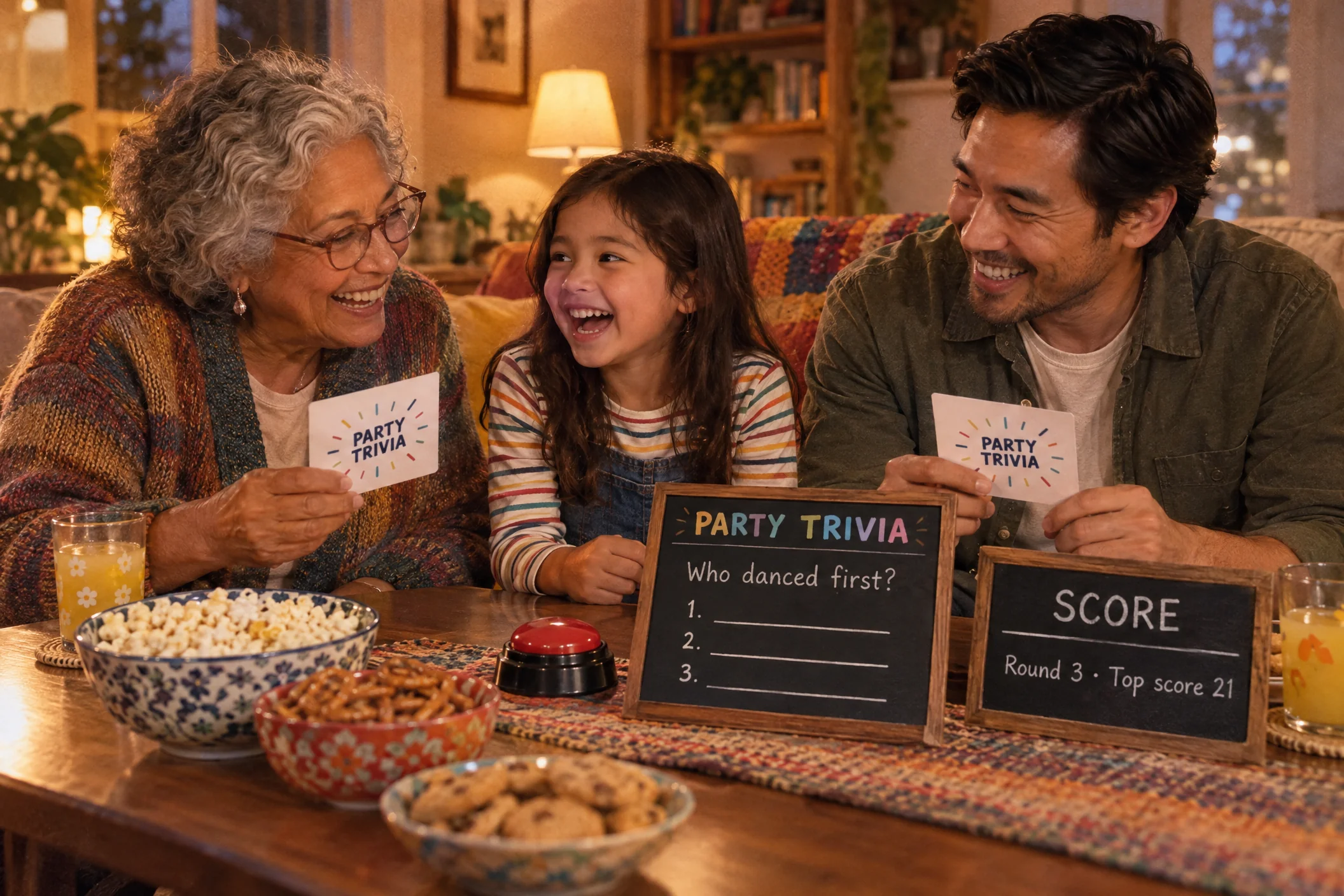
Family trivia is, at heart, an age-leveling problem more than a quiz-writing one. The hard part is keeping a 9-year-old and a grandparent in the same round without boring one or losing the other. Strong family party trivia ideas come down to 3 decisions you make before printing a single question card. Who is the round set for? Match it to the ages in the room. How much can the group take? The round count and pacing set that across a 60-to-90-minute block. What keeps everyone in to the end? Scoring and prizes, tuned to hold the kids through the final round without losing the adults to side chats. Grab a generic trivia pack off the first search result instead, and the rounds land too easy for the adults, too hard for the kids, and the scoring falls apart by halfway.
How do you plan for a 12-guest holiday weekend with kids aged 7 to 14 and 3 sets of grandparents, a 24-guest backyard summer evening with mixed-age teams, and an 18-guest indoor game night with a tween birthday in the middle? The same 3 decisions, in the same order. This guide sets out 6 family trivia formats that hold up across age mixes and group sizes, the round-and-pacing rules that keep the room engaged, how to build the question mix and scoring, the prizes and host cues that land the closing moment, the tool that builds the evening the rounds sit inside, and the Party Games and Activities guide with the full game-night rundown.
Quick Stats: 6 Trivia Formats | 3 Round Plans | Free Murder Mystery Party Generator Available
Six Family Party Trivia Formats That Set Up the Evening
Your format sets the round pacing, the team setup, and how you score across the trivia block. Name it first, then the question set, the team split, and the prizes follow. Six family trivia formats hold up across mixed-age guest lists.
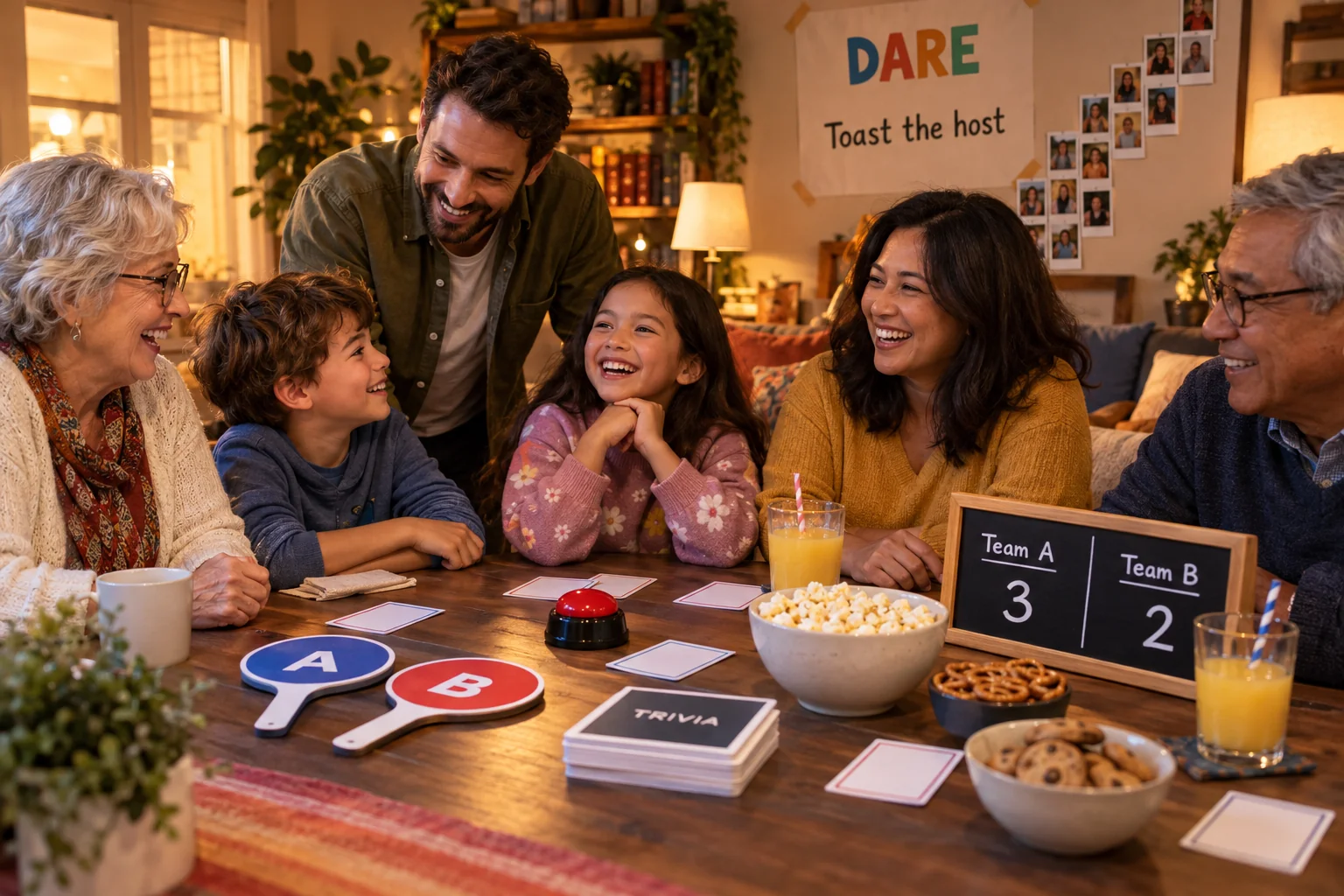
Classic team trivia with mixed-age teams. A 60-to-90-minute block with 2 to 6 teams of mixed ages, 4 to 7 rounds of 8 to 10 questions each, and a running scoreboard updated on a chalkboard or printed leader sheet. The easiest to plan, and the one that reaches the widest range of ages. Best at family reunions, holiday weekends, and birthdays where the trivia is the main event, not one activity among several.
Generation-themed rotating rounds. A 60-minute block with rounds built around each generation in the room (a pop round from the parents' teen years, a social-media-and-streaming round for the teens, a music round from the grandparents' youth, a current-events round for the adults). It lets every generation shine and keeps the room engaged from the first round to the last. The White Elephant Ideas guide covers a gift-swap game that kids and adults can play together.
Family-history trivia with scrapbook questions. A 45-to-60-minute round set built around the host's family history (childhood photos, family inside jokes, hometown landmarks, milestone dates, recipes from the family's archive), with printed photo prompts and audio clips where applicable. Made for reunions, milestone birthdays, and anniversary parties, where the trivia doubles as a storytelling moment that brings the family closer.
Holiday-themed trivia rounds. A 60-to-75-minute block built around whichever holiday is on the calendar (Thanksgiving, Christmas, Halloween, Independence Day, Easter), with rounds on holiday history, holiday music, holiday movies, and holiday traditions across regions and cultures. This one shines at extended-family holiday weekends, office parties with families invited, and any celebration where the season sets the tone.
Murder-mystery trivia hybrid. A 75-to-90-minute evening that runs trivia rounds inside a murder-mystery framework, where each correct answer unlocks a clue and the team that solves the mystery first wins. It pulls double duty as a game night and a story-driven evening for the older kids, teens, and adults all at once. The Murder Mystery Party Game Scenarios guide goes deeper on the mystery side.
Picture-and-audio multimedia trivia. A 60-minute block that runs trivia through projected images and audio clips (movie stills, album covers, sound effects, historical photos, regional landmarks) in place of read-aloud questions. Ideal for tech-comfortable hosts with a projector or large TV, mixed-age teams where visuals keep younger kids engaged, and rooms set up for everyone to see one screen.
For team-game tips that work across any of these formats, the Birthday Party Ideas hub goes broader on game night for birthday celebrations.
🛒 As an Amazon Associate, we earn from qualifying purchases, at no extra cost to you.
Match the Round Count, the Team Size, and the Pacing
The round count and pacing shape the trivia block more than the question quality does. A 12-guest evening with 9 rounds of 10 questions drags like a marathon by the third round; a 24-guest evening with 3 rounds of 6 questions feels too thin to justify the team setup. Pace it with a few simple rules.
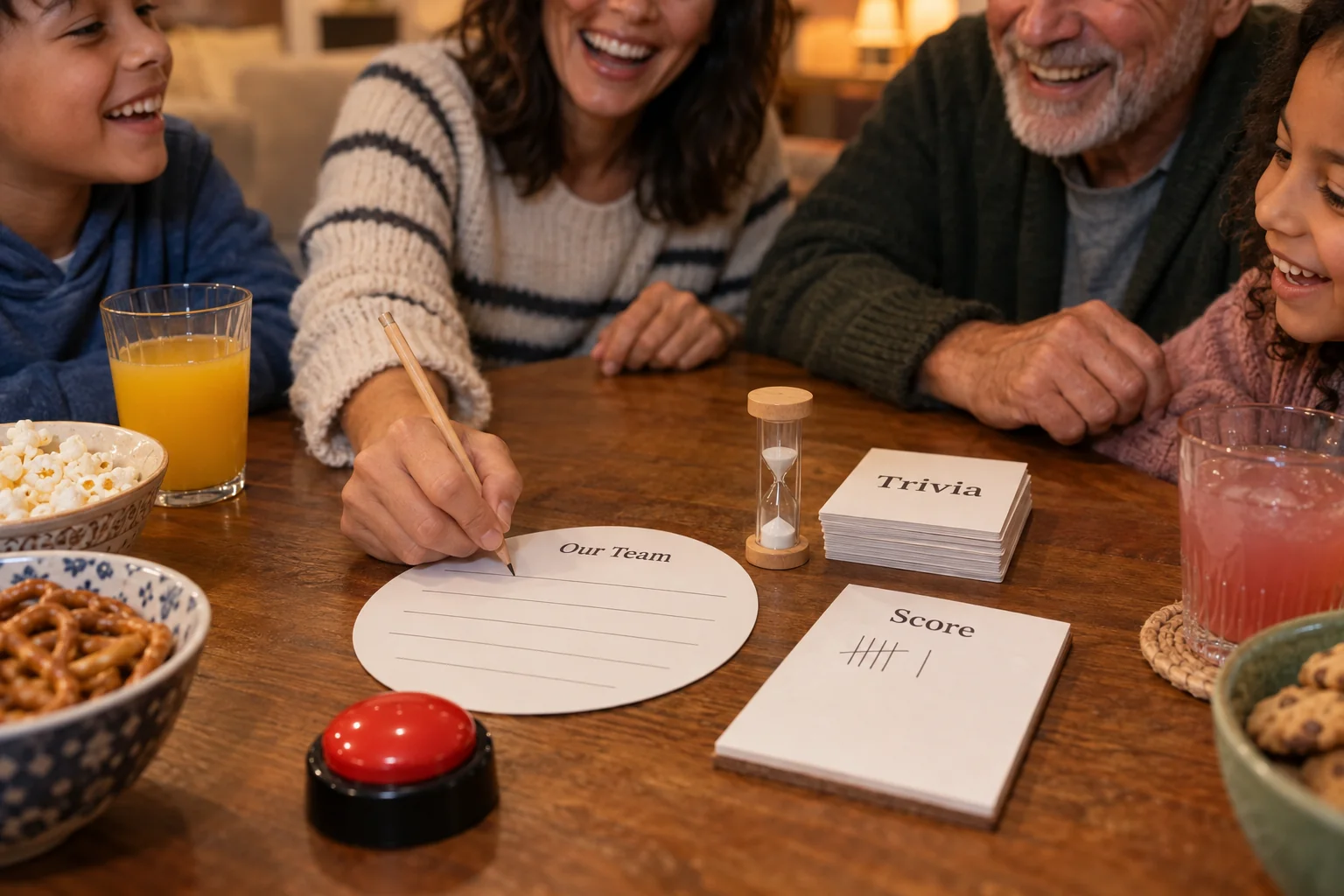
Match the round count to the guest count and the time window. A 60-minute block holds 5 rounds of 8 questions for 12 to 16 guests, or 4 rounds of 10 questions for 20 to 30 guests. A 90-minute block holds 7 rounds of 8 questions for any guest count between 12 and 30. Plan about 10 minutes per round, including the question read, the team discussion, and the score update.
Build mixed-age teams of 3 to 5 players each. Teams of 6 or more lose the quieter players to side conversations; teams of 2 or fewer struggle on the multi-category rounds. A 12-guest evening runs 3 teams of 4; a 20-guest evening runs 5 teams of 4 or 4 teams of 5; a 30-guest evening runs 6 teams of 5. Mix ages within each team so every generation has a moment to contribute on at least one round.
Plan a 5-to-7-minute opening warm-up round. A short opening round (5 to 7 visual questions, easy difficulty, no scoring) settles the room, gives latecomers a moment to join a team, and confirms the host's question-read pacing without burning the first real round. The warm-up works like the game-night equivalent of a soft-open. The One-Minute Party Game Ideas guide has 60-second station games if you want a hands-on opener instead.
Build in a halftime break for snack-and-refill. A 10-to-12-minute halftime break at the midpoint of a 90-minute block lets guests refill drinks, hit the bathroom, and stretch before the second half. A 60-minute block has room for a 5-minute one. Skip the break entirely for blocks under 50 minutes; the group holds without it. Build the halftime cue into the printed round sheet so the host does not have to call it manually.
Plan a final-round multiplier for scoring suspense. A "final-round doubles" rule (where the closing round's points count double or where teams can wager a portion of their score on a final question) keeps the lower-ranked teams competitive through the last round. Without a final-round multiplier the leader is often locked in by round 5 of 7 and the closing engagement fades. The Adult Party Games guide covers energy pacing across other party-game formats.
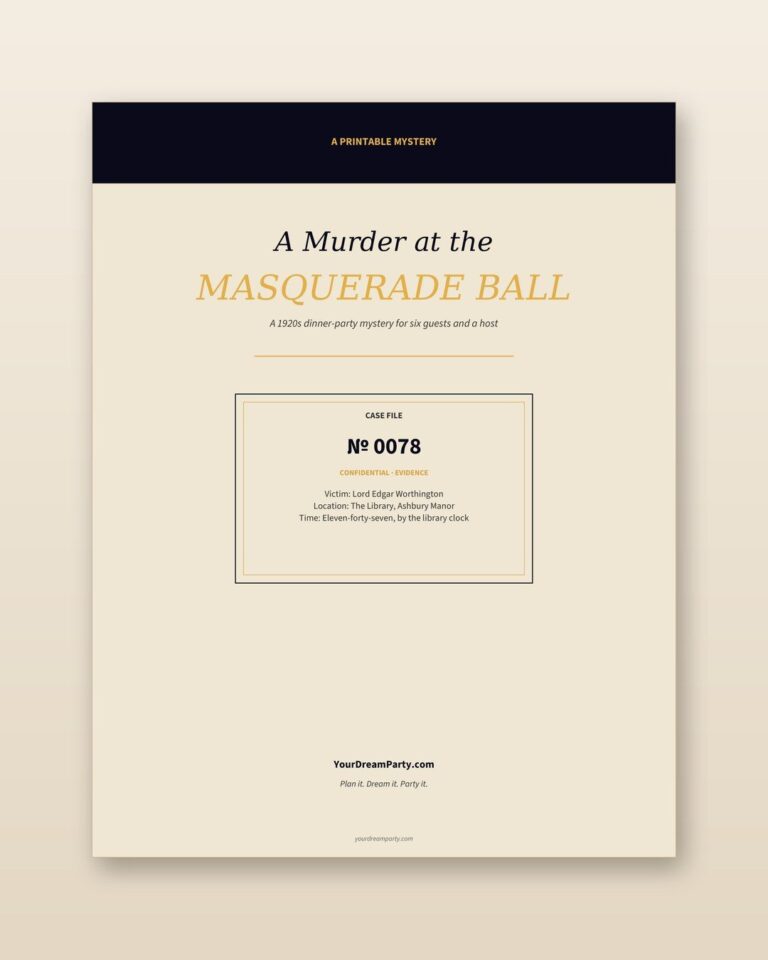
Printable Murder Mystery Kit
- A 1920s masquerade mystery for 6 guests plus a host
- 6 character cards: role, backstory, alibi, secret and what they know
- 12 clue cards over 4 rounds, 3 per round
- Host instructions with casting tips and timings
Build the Question Mix, the Scoring System, and the Round Themes
The question mix is what separates a trivia evening that looks polished from one that looks thrown together. A round that stays at one difficulty the whole way loses the kids on the third question and the adults on the eighth. Start with the mix, then the scoring, then the round themes.
Mix difficulty levels across each round. Build each round with 2 easy questions, 4 medium questions, and 2 hard questions in that order. The easy opening gives every team a confident start, the medium middle carries the round's energy, and the closing hard questions create the scoring spread that keeps the leaderboard interesting. A round at a single difficulty falls flat no matter how strong the individual questions are.
Run 1 point per question, and make the final question of each round worth 2. A flat scoring system works cleanly across mixed-age teams and avoids the math that derails a casual evening. The 2-point final question in each round (and 4 points on the closing round's final question with the final-round multiplier) creates upset potential that keeps engagement high through the closing minutes.
Plan 4 to 7 round themes across the evening. Strong round-theme combinations for family settings include movies-and-TV (broad), music-by-decade (rotates across generations), pop-culture-this-week (tests current-events knowledge), geography-and-landmarks (family-history-friendly), food-and-drink (multi-generational), sports-and-outdoor (works across genders), and a wildcard "host's choice" round that shows the host's personality. A party game questions round, built on survey-style answers instead of single-fact questions, works well as that wildcard across mixed-age teams. Skip rounds on politics, religion, and personal finance.
Build a no-search honesty rule with a clear announcement. Phone-checking on the question is a common trivia-night derailer. Announce the no-search policy at the warm-up round, build the rule into the printed round sheet, and put a "phones in the basket" sign at each team table. The Carnival Game Ideas guide covers how tickets and prizes keep kids' booth games fair.
Match your question-reading pace to the room's energy. Read each question twice (once at normal pace, once slower with key terms emphasized), pause 45 seconds for team discussion, then call the answer time. The 45-second pause is the sweet spot for mixed-age teams; shorter loses the kids' input, longer loses the room's energy.
Plan the Prizes, the Host Cues, and the Closing Round
Prizes and host cues are what land the emotional payoff at the end of the night. A prize that looks cheap kills the closing-round suspense; a host who runs the answer reveals with no showmanship loses the room in the second half. These choices close out the night.
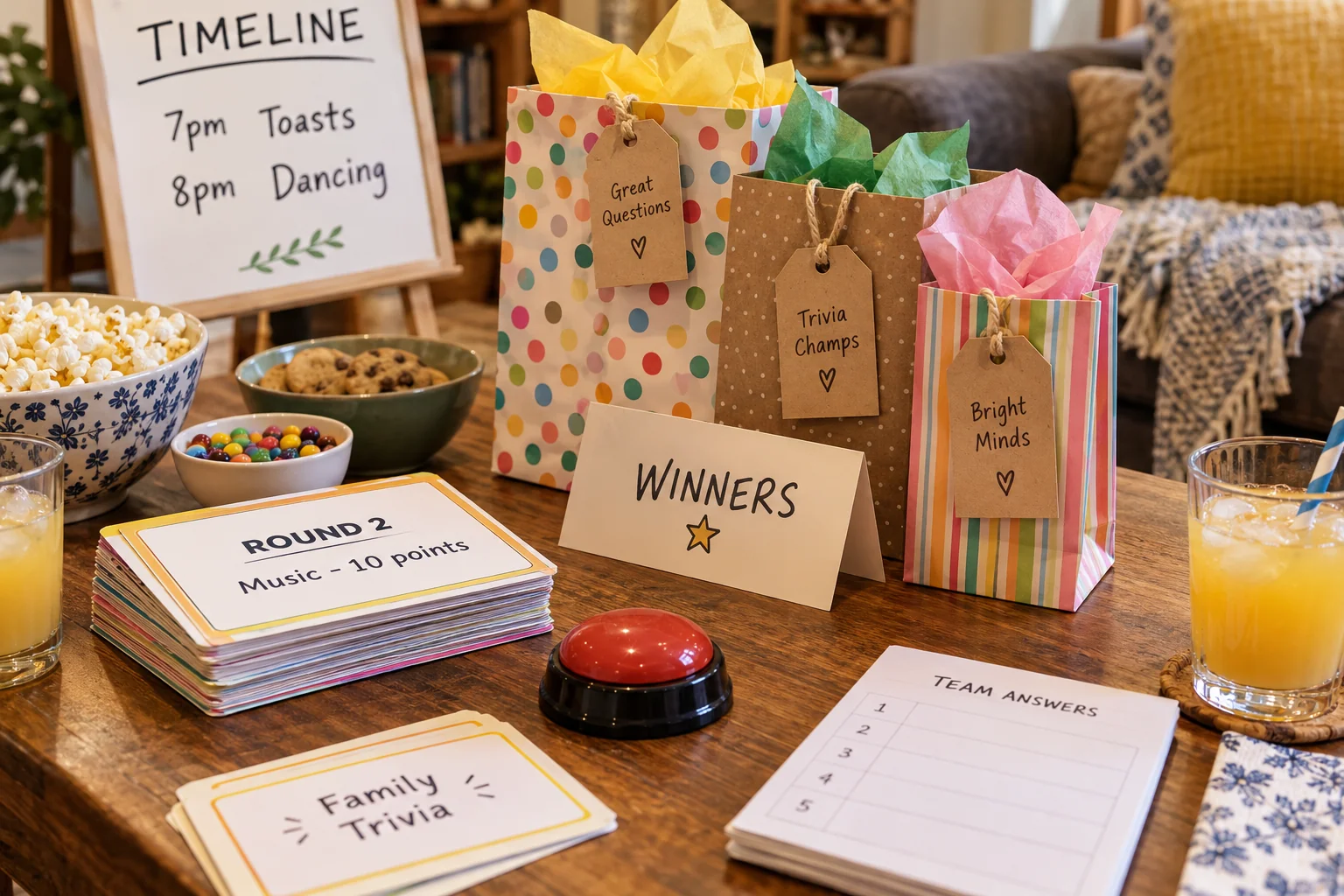
Plan a 3-level prize setup (winning team, runner-up, last place). A first-place prize (a printed champion certificate plus a meaningful keepsake like a custom mug set or a family-photo print), a runner-up prize (a small thank-you box of snacks or printable thank-you cards), and a consolation prize for the last-place team (a printed certificate with a humor-driven title) cover every team. That 3-level setup keeps engagement high right to the end, because every team has a closing moment.
Build a one-page printed round sheet for the host. A single printed sheet with each round's title, question count, answer key, scoring multipliers, and halftime-break cue keeps the host on cue without flipping through stacks of paper between rounds. Print one for the host and one as a master backup; skip per-team printed round sheets in favor of paddle-and-pencil setups for cost and clutter reasons. The Charades Terms and Party Ideas guide covers the timer and hand signals that keep a hosted round moving.
Stage a closing-round reveal moment with the final scores. Hold the final round's scoring until the host has read every team's running total in reverse order, building suspense to the winning team's reveal. The pace of that reveal is what lands the emotional high point; running the final tally as a quiet update loses the closing-round energy.
Plan an audience-participation tiebreaker mechanic. A tiebreaker (a single estimation question, a buzzer-style first-answer-wins, or a head-to-head final wager) handles the 2-team tie cleanly. Build the tiebreaker question into the round sheet ahead of time; improvising at the party comes off as the host losing control of the closing moment.
Take a team-photo moment at the prize handout. A team photo at the prize handout (with the winning team holding the printed certificate) gives you something to post and the family a photo to keep. The Kids Party Ideas hub covers photo moments for kids' celebrations.
How Does the Murder Mystery Party Generator Build the Mystery Half?
The Murder Mystery Party Generator is a free planner of 6 or 7 steps that builds a murder mystery evening from your group size, setting era, tone, player experience, dietary needs and venue. Picking the setting era is step 2, and the era decides the cast, the premise and the decor language the hybrid's trivia rounds have to sit beside. Plan them separately and the trivia and the mystery fight for the same evening; settling the three-act shape first gives your trivia rounds something to sit inside.
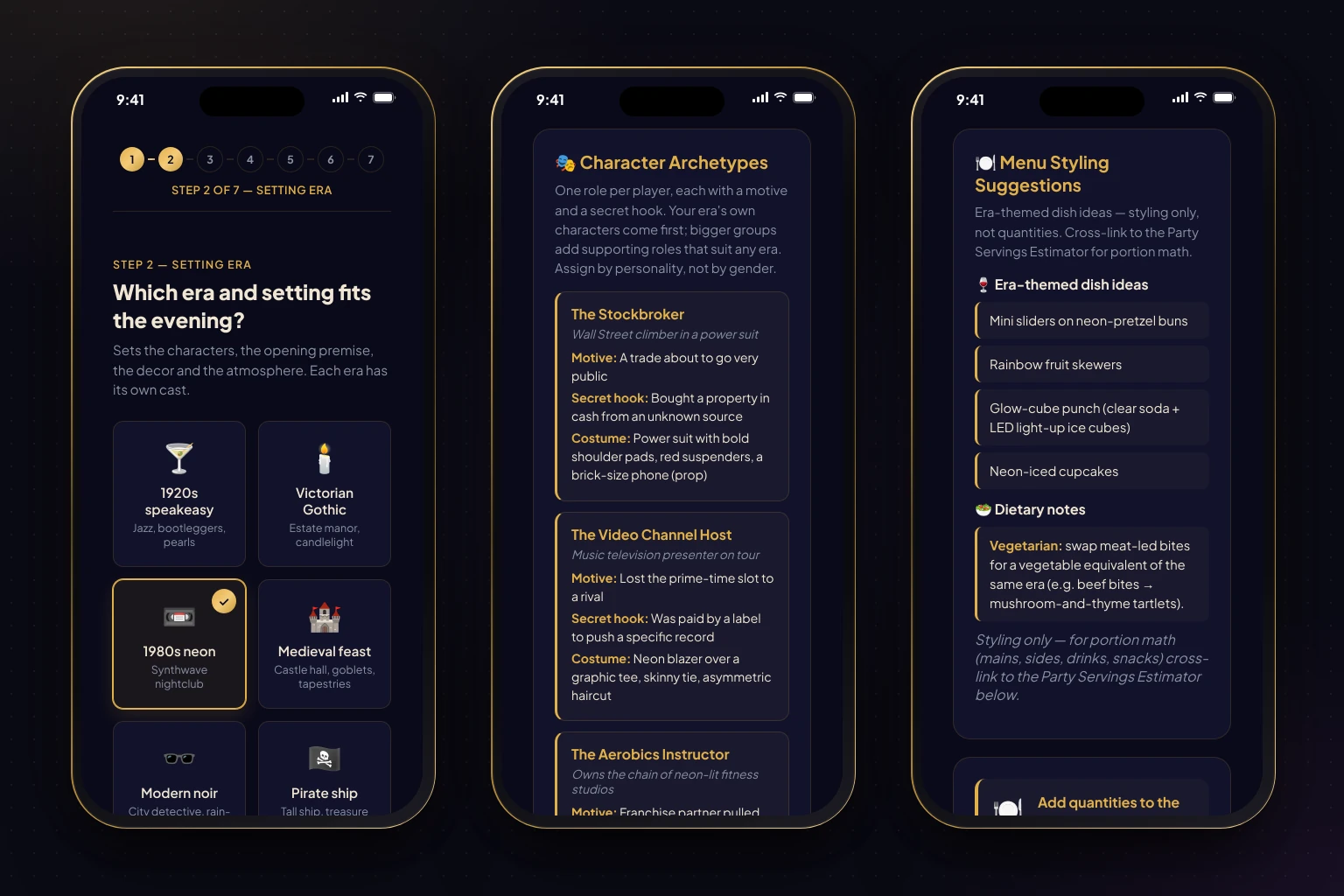
Enter the group size, the setting era (1920s speakeasy, Victorian Gothic, 1980s neon, modern noir and 4 more), the tone you want (spooky-serious, comedic, family-friendly, adult-only), how experienced the players are, any diets to plan around, and the venue; pick First-timers and it also asks how scripted the evening should be. What comes back is a cast with one named role per player (the era's own characters come first), a three-act plot guide, the game mechanics that govern clue distribution and accusation rounds, and a decor-and-atmosphere plan with notes for your venue. It also carries the dietary flags through to the menu styling, since a mixed table needs those callouts made in advance.
It also works for grown-up nights: pair the generator with the Bachelorette Party Planner, which builds the itinerary and a personality-matched activity shortlist for the bride's weekend. The Outdoor Cinema Setup Builder sizes the screen and the projector throw distance and hands you a stereo speaker-placement note if you run the picture-and-audio format outside.
Frequently Asked Questions
How long should a family party trivia evening run?
Plan the trivia block at 60 to 90 minutes for most family settings. A 60-minute block runs 5 rounds for 12 to 16 guests; a 90-minute block runs 7 rounds for 12 to 30 guests. Blocks over 100 minutes lose pacing through the second half and leave the kids fatigued before the closing round.
How many people do I need for a family trivia night?
Plan a minimum of 8 guests across 2 teams of 4 for it to feel like a real competition. A 12-to-20-guest count runs the smoothest with 3 to 5 teams of 4. Above 30 guests the round set needs a second host or a printed-answer-submission system in place of a read-aloud format. The Family Outdoor Party Games guide covers splitting a big group across outdoor game stations.
What trivia categories work best for mixed-age family teams?
Strong category mixes for mixed-age teams include movies-and-TV, music-by-decade, geography-and-landmarks, food-and-drink, sports-and-outdoor, and a "host's choice" wildcard. Skip categories that skew heavily to one generation (current social-media trends for adult-heavy groups, historical events older than the youngest guest's parents) unless paired with a buffer category that covers the other generation.
How do I make trivia fair across kids and adults on the same team?
Mix ages within each team (instead of splitting kids and adults into separate teams), build a question mix that rotates difficulty across every round, and run a generation-themed rotating-round format where each round spotlights a different generation's strengths. Skip handicap scoring rules that adjust points by age; they come across as condescending to the kids and remove the closing-round suspense.
Should the trivia questions be printed or read aloud?
Both. Read each question aloud twice and project or print a backup card for teams with hearing-difficulty members or for the picture-and-audio multimedia format. Skip team-by-team printed question sheets that let teams pre-read; the read-aloud pace is half of what keeps the trivia evening moving.
What prizes work best for family party trivia nights?
A 3-level prize setup (winning team, runner-up, a consolation prize for last place) works best across most family settings. Strong winning-team prizes include a custom family-photo print, a printed champion certificate with the date and the family name, a coordinated mug set with the family-tradition crest, or a small keepsake gift the winning team can split. Skip cash prizes and gift cards in family settings.
Can I run family trivia outside, at a park, or on the porch?
Yes, with 2 adjustments. Build a wind-proof backup for the question cards (laminated round sheets, weighted scoring pads, a printed answer key clipped to the host's clipboard) and shift the multimedia-trivia format to read-aloud if the outdoor space does not support a projector. The Festival Party Game Ideas guide covers outdoor-game logistics.
How do I handle a team that is dominating every round?
Build a final-round multiplier into the scoring system (final round counts double, or teams can wager points), plan rotating-difficulty rounds so the dominant team's strength does not carry the whole evening, and include at least one round outside the dominant team's strong subjects (a music round if they are strong on history, a movie round if they are strong on geography). Changing the structure like this is fairer than handicap rules at the team level.
Ready to Plan the Family Trivia Night?
One format choice sets up everything after it: the round count, the question mix, the scoring system, and the prizes. The free Murder Mystery Party Generator builds the premise, the cast, the three-act plot guide and the clue mechanics for the mystery half, and the Party Games Mega Bundle below adds 50 printable trivia question cards alongside the icebreaker and kids activity packs.
This page contains affiliate links to Amazon and other retailers. As an Amazon Associate, we earn from qualifying purchases at no extra cost to you. This helps us keep all our tools free.
Results are for planning and inspiration purposes only. Always verify with your suppliers before purchasing.