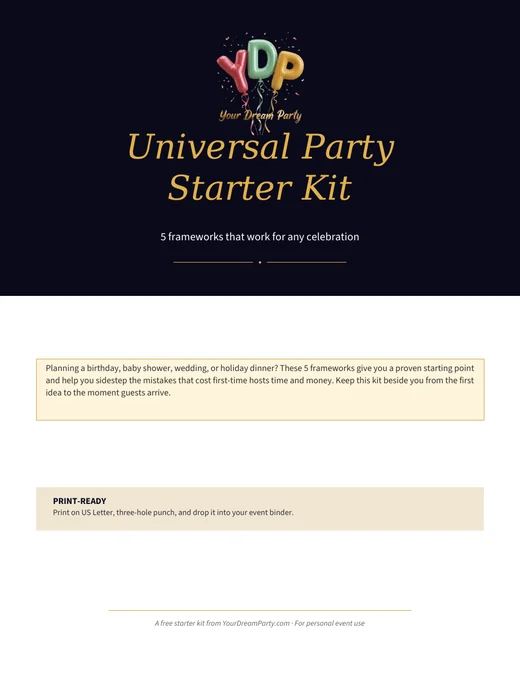
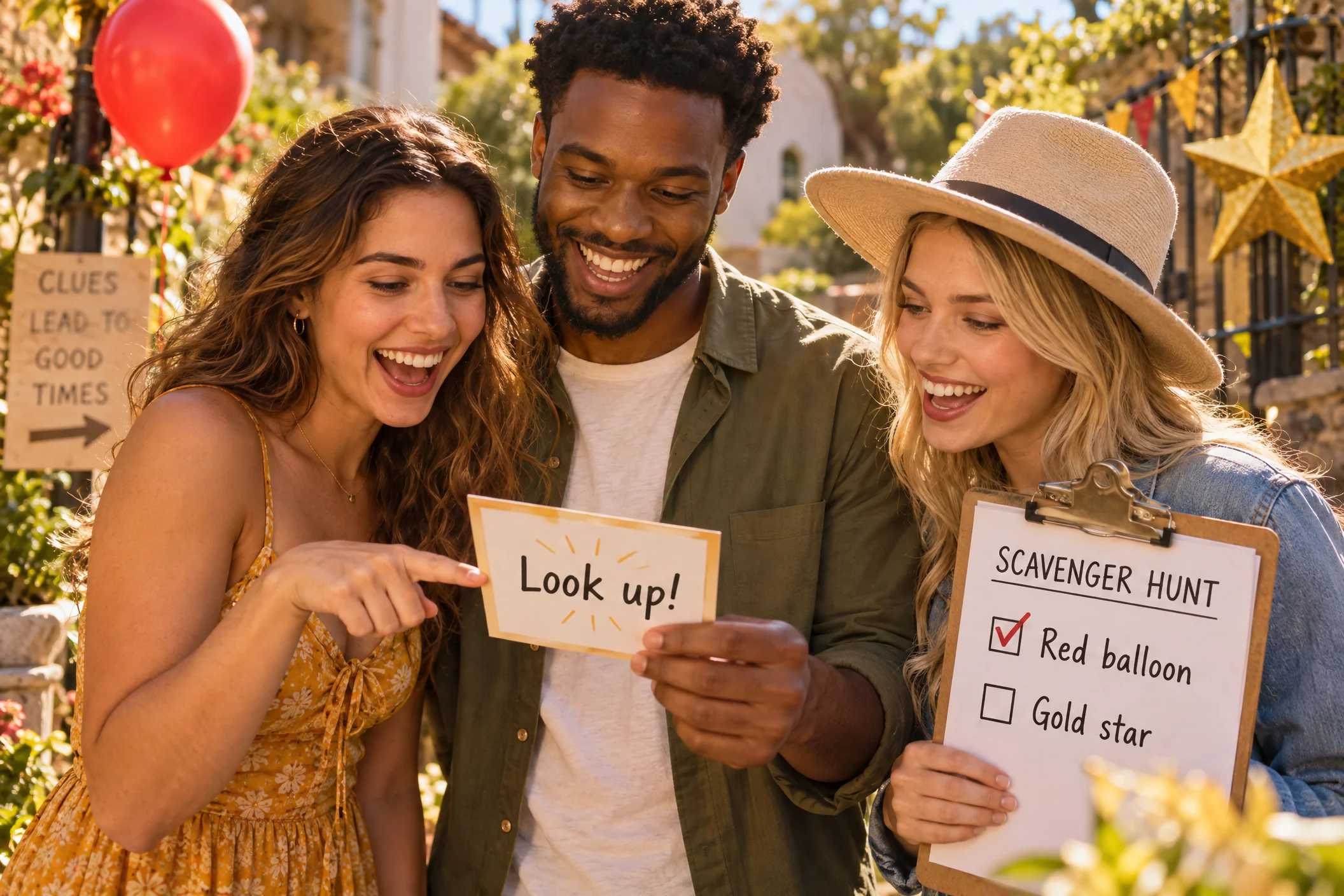
Pitch the clues too hard and the guest who hates riddles stalls at hour 2; pitch them too easy and your sharpest friend clears the whole track in 11 minutes. A strong party scavenger hunt lives in the gap between, and you find it by answering 3 questions early. Can the room actually run this format? Can the youngest and the oldest guest both clear the clue track? And will the prize be worth photographing at the end? Grab a generic clue list off an inspiration board and the hunt splits the room. Build it in the right order and it feels polished from the first clue card to the final prize reveal.
The scale swings hard from one party to the next: 12 kids hunting a backyard at an 8th birthday, adults working a clue track across a downtown loft, a bachelorette crew threading 3 city venues over a weekend. The same 3 questions sit under all of them. Seven party scavenger hunt formats work at any age and group size, and each one needs clue-writing that keeps every guest in play and a prize structure that earns the closing photos. A free tool plans a mystery game night around your venue and guest count, and the Party Games and Activities guide holds the wider activity plan.
Quick Stats: 7 Hunt Formats | 5 Clue-Writing Rules | Free Murder Mystery Generator Available
Seven Party Scavenger Hunt Formats That Shape a Game Block
Your format shapes how guests move through the venue, how long the game lasts, and what shows up in the photo gallery the next morning. Settle it before you write a single clue. Any age group and any venue has a format below that suits it, 7 in all.
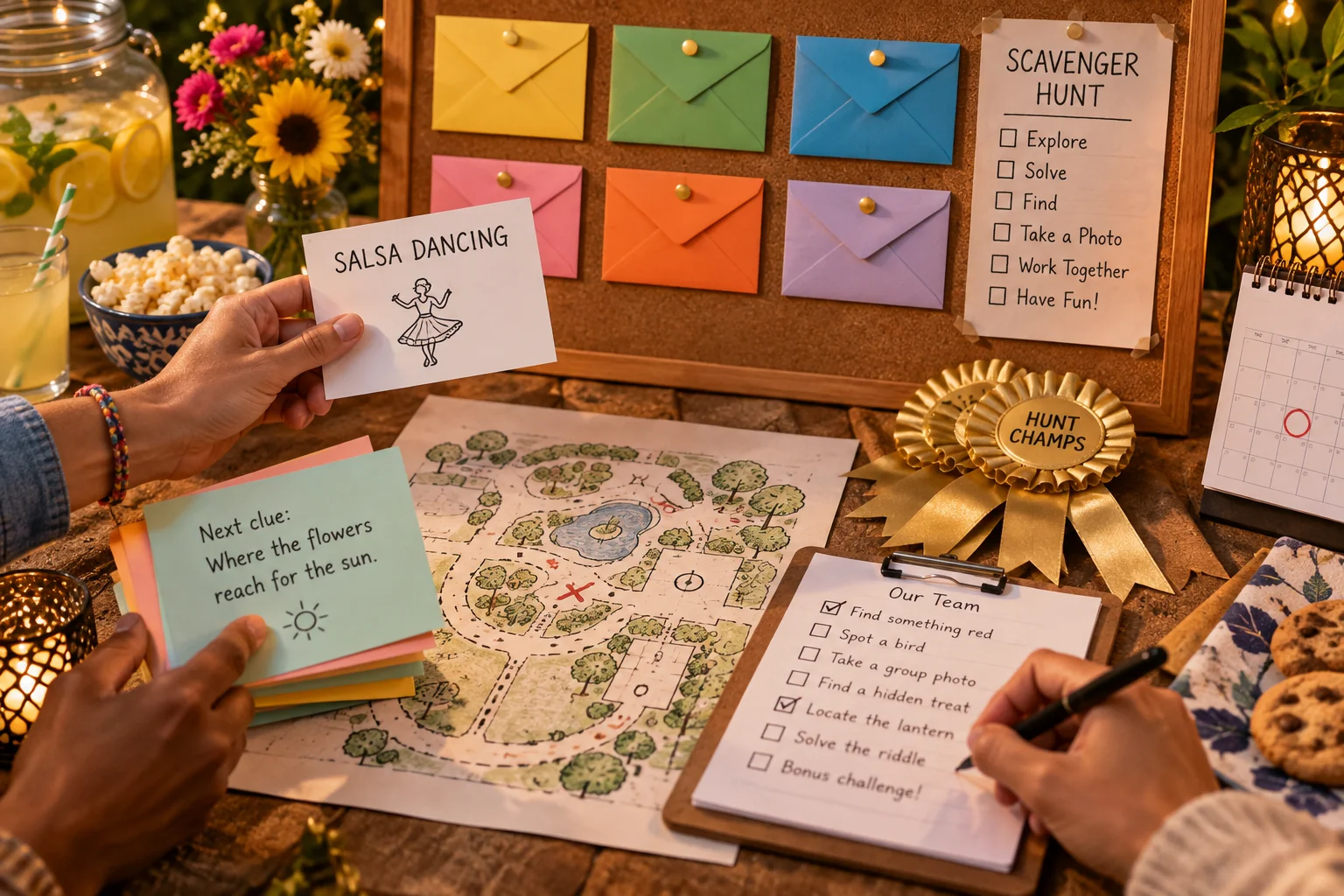
Classic rhyming-clue treasure hunt. A linear track of 8 to 12 clue cards, each one rhyming a location at the next stop, with a final prize at the closing clue. The workhorse format for kids' birthday parties, family reunions, and any group that wants a single shared finish line. Runs cleanest at 8 to 25 guests in a single venue (home, backyard, rented hall).
Photo scavenger hunt with a phone camera. A printed list of 15 to 25 photographable prompts (a guest in a hat, 3 people pointing at the sky, a selfie with a server), scored by team. Run it at adult cocktail parties, college reunions, and 30th to 50th birthdays of 12 to 40 guests where the photo gallery is half the point.
Riddle-and-puzzle escape-style hunt. A sequence of 5 to 8 self-contained puzzles (a cipher, a lock-and-key combination, a word ladder, a hidden-message reveal) leading to a single locked box at the finish. To raise the stakes for seasoned solvers, add a meta-clue: 1 letter from each puzzle's answer, read in order, spells the word that opens the box. Strongest at adult dinner parties, corporate team events, and milestone birthdays for 6 to 18 guests who want depth over breadth.
GPS city scavenger hunt. A weekend-scaled hunt across 4 to 7 outdoor locations using GPS coordinates or photo landmarks, with each stop unlocking the next via a printed pass or a phone scan. Suited to bachelorette weekends, group anniversary trips, and adult birthdays of 8 to 20 guests happy to walk or drive between stops.
Themed costume scavenger hunt. A list of 10 to 15 props or wardrobe pieces guests collect or trade with the other teams (a corporate logo pen, a colored ribbon, a postcard from a specific neighborhood), with a costume-completion judge at the end. Sweet 16 birthdays, college send-off parties, and Halloween cocktail evenings of 14 to 30 guests all take to this one.
Single-room indoor scavenger hunt for younger kids. A 6 to 10 prompt list of objects already in the room (something red, something fluffy, something starting with B), each marked off as found. Pitch it at 4th to 8th birthday parties with 8 to 16 guests, indoor venues only, and a 20 to 30-minute play window that ends before the cake cut.
Group team-relay scavenger hunt. Two to four teams of 4 to 8 guests each, racing through the same clue track with staggered start times, scored by speed plus accuracy. Best for large adult gatherings of 25 to 30 guests where a single start would bottleneck. Past 30 guests, split the group across 2 routes and bring every team back for one shared final-prize round. The Adult Party Games guide covers trivia and charades blocks that sit before or after the hunt.
🛒 As an Amazon Associate, we earn from qualifying purchases, at no extra cost to you.
Scavenger Hunt Games
Shop on AmazonScavenger Hunt Cards
Check Price on AmazonScavenger Hunt Activity Kit
See on AmazonWrite Clue Cards That Every Guest Can Clear
Your clues are what turn the party scavenger hunt into the night's best memory, or what stall it at the second card. The best tracks manage 3 things at once. Every clue is solvable by the youngest guest in the room, every clue has one unambiguous answer, and every clue has a detail you can tweak the morning of the party without rewriting the track. Five habits separate a track that flows from one that stalls.
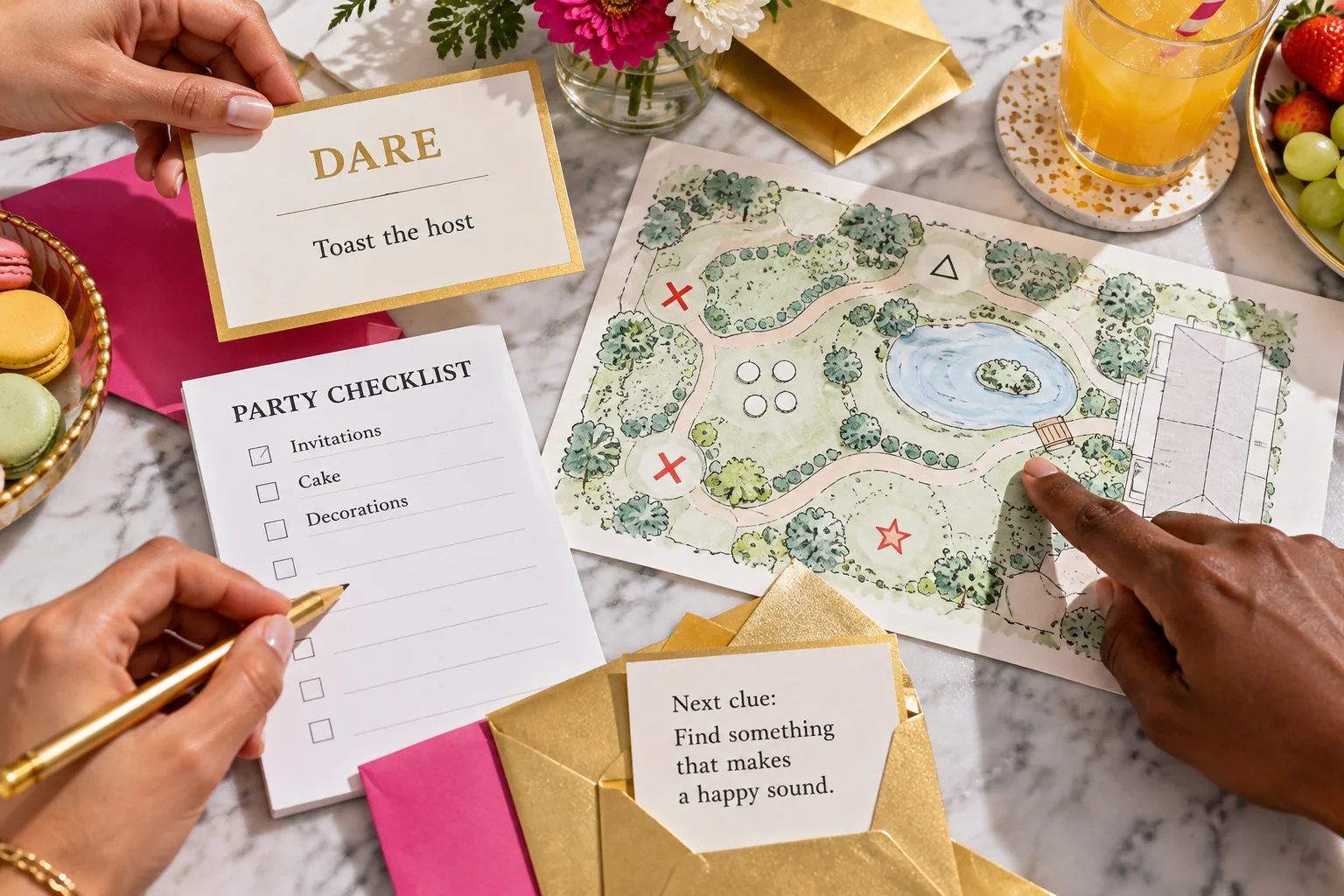
Write to the youngest reading age in the room. Check the guest list first, pitch the reading level a year below your youngest guest, and let the older ones drive the solving without stranding anybody.
Lock one answer per clue. Vague clues ("somewhere you sit") produce 3 guesses and an argument. Specific clues ("the only black-leather sofa in the living room") move teams from card to card cleanly. The Game Ideas for the Family guide matches games to each age group.
Build a hint into every third clue. A team that stalls at clue 5 of 12 loses the rest of the hunt. Plant a hint at every third stop, sealed in an envelope marked "open if stuck for more than 4 minutes," so the team can rescue itself without you stepping in.
Vary the clue mechanic across the track. A 12-card track of 12 rhyming riddles gets dull by card 6. Mix it up: 5 rhyming riddles, 2 photo-based clues, 2 object-swap clues, 2 location-only clues, and 1 final puzzle.
Write the final clue as a celebration, not a riddle. A line like "You found us, the prize is on the kitchen island, ring the bell" beats a tenth cryptic clue that frustrates the team at the finish. The Party Trivia Ideas guide ends its trivia night on a staged score reveal for the same reason.
Every clue card should fit on a single 4-inch by 6-inch index card, with the clue text at 18 to 20 point and the card number in a corner.
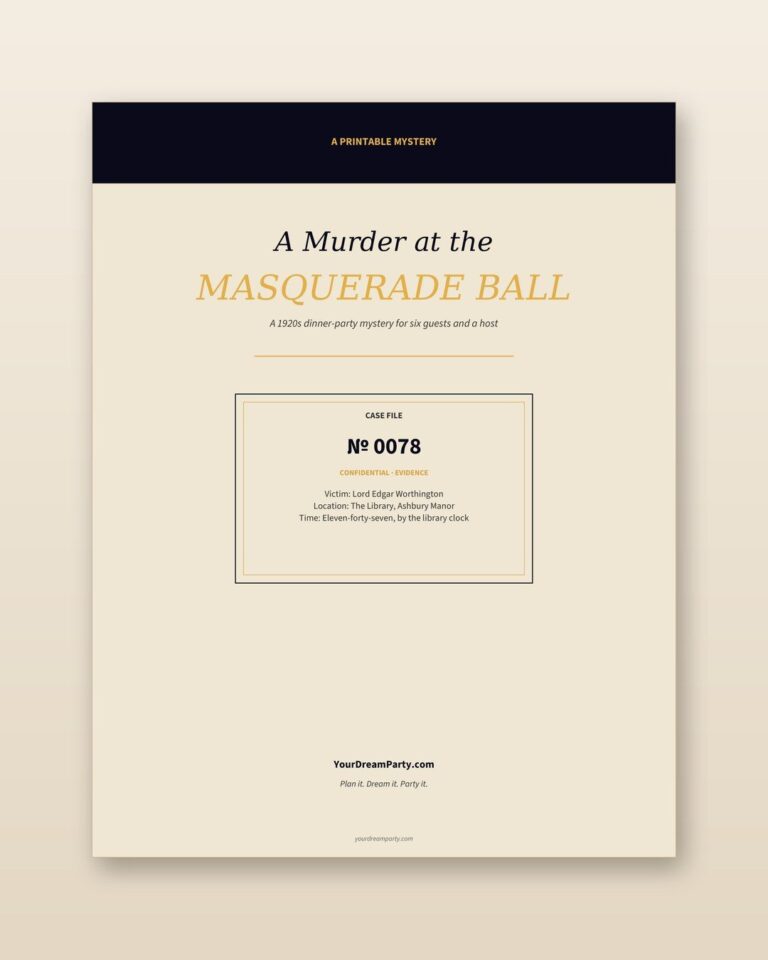
Printable Murder Mystery Kit
- A 1920s masquerade mystery for 6 guests plus a host
- 6 character cards: role, backstory, alibi, secret and what they know
- 12 clue cards over 4 rounds, 3 per round
- Host instructions with casting tips and timings
Pair the Scavenger Hunt to the Audience and the Venue
A party scavenger hunt fails in the same few ways every time. The format does not suit the guests, the track is the wrong length for the venue, or the game peaks at the wrong moment in the evening. Get the 5 pairings below right and the hunt fits the room it is in.
Match the format to how your guests like to solve things. Kids under 8 do best with single-room object-find hunts. Kids 8 to 12 run rhyming-clue treasure hunts. Tweens and teens from 12 to 16 run riddle-and-puzzle escape-style or themed costume hunts. Adults run photo, GPS city, or escape-style hunts. The Birthday Party Scavenger Hunt guide covers the birthday-specific track build, and the Kids Party Games guide matches games, hunts included, to the age range.
Size the track to the space you have. A 12-card hunt in a single 1,400-square-foot apartment turns into a traffic jam. Plan one clue per 200 to 350 square feet of indoor space, one clue per garden zone for backyards, and one clue per outdoor block for city hunts.
Give the hunt the right slice of the evening. A 90-minute kids' birthday party gives the hunt 30 to 40 minutes maximum. A 4-hour adult cocktail party can afford 60 to 75 minutes. Plan the hunt to end at 60 percent of the remaining event window, not at 90 percent, so the closing photos and cake cut have room to breathe. Set the end time up front, with a recall signal (a whistle, a bell, a group text) to bring every team back.
Build the teams around who already knows who. Mixed-age family groups play best as one shared team. Friend groups with tight sub-groups want 2 to 4 teams. A room where people are meeting for the first time needs teams of 4 to 6, assigned in advance. The Birthday Party Games and Activities guide sizes teams for milestone parties.
Plan one supervised station, not 3 unsupervised stops. Leave hidden clues unwatched and some of them will be found, moved, or pocketed by early arrivers before the game starts. Run a single start you monitor yourself, then pre-place and re-check the clues at every later stop, and you fix that without shadowing the team all night. Give each team a rule card and a boundary map: roads and streams marked do-not-cross, off-limits rooms blocked by a chair. The Outdoor Party Games guide covers backyard active-game blocks that run before or after a hunt.
Build a Prize and Favor Structure That Earns the Closing Photos
The prize is what makes the party scavenger hunt memorable instead of forgettable. A hunt with no prize is an errand. A hunt with one enormous prize gets too serious for the youngest team. Making the prize worth winning comes down to 5 decisions.
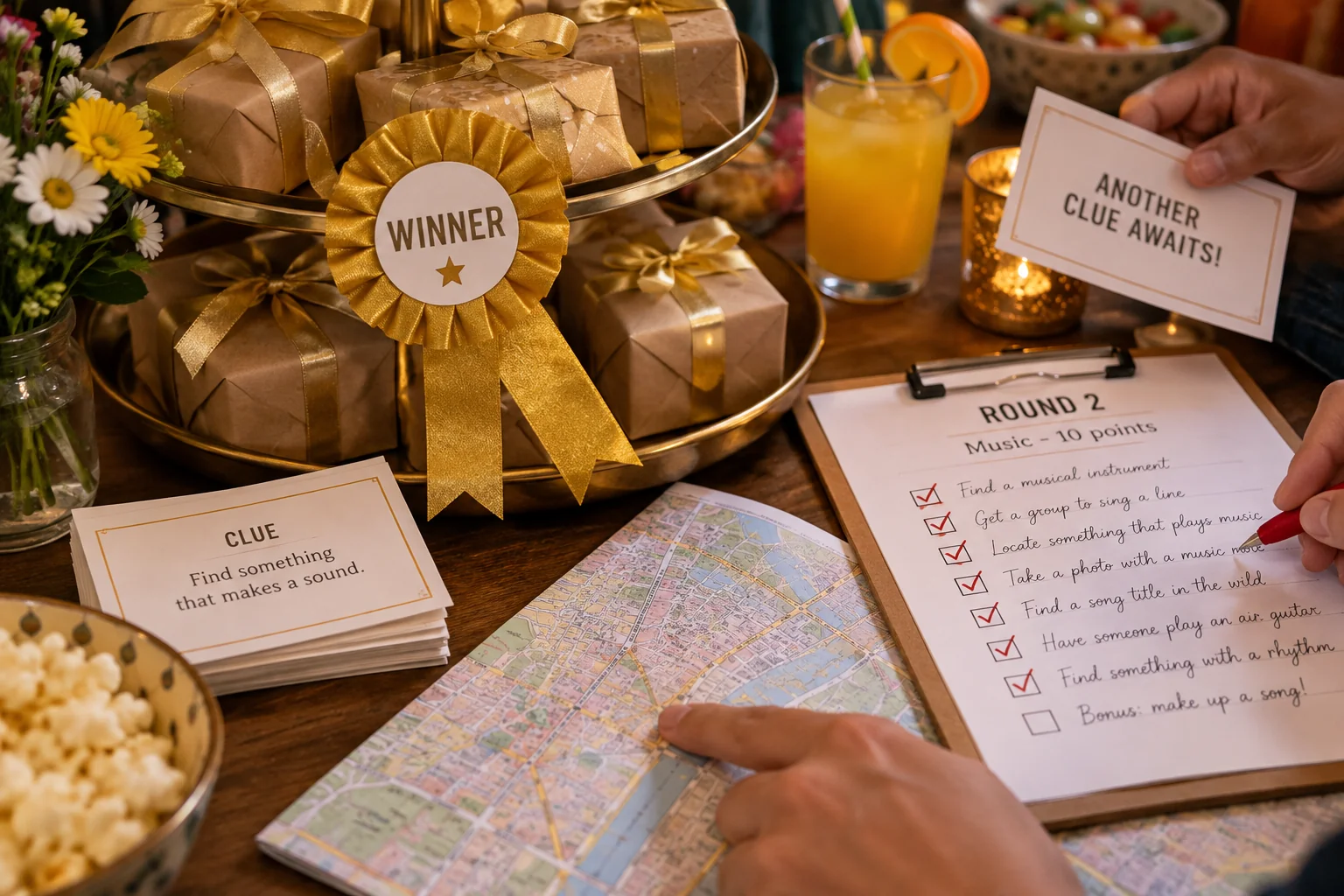
Plan a team prize plus a participation favor for every guest. The winning team gets one shared prize (a wrapped basket of branded snacks, a custom group portrait, a gift card for each team member). Every other guest gets a participation favor (a custom medal, a printed certificate, a small wrapped candy). The split removes the loser-team energy that drags down the closing 20 minutes.
Size the prize to the time it took to win. A 25-minute kids' hunt earns a $5 to $12 team prize. A 60-minute adult photo hunt earns a $30 to $80 team prize. A 4-hour bachelorette GPS hunt earns a $100+ team prize. Go much bigger than that and the prize feels out of proportion to the game.
Reveal the prize at a single closing moment, not card-by-card. Hand out participation favors at the same moment as the team prize reveal. Make one announcement, let the team pose with the prize, and have someone ready to catch the reaction.
Pair the prize with a take-home photo print. A printed group photo from the hunt (an instant-camera snapshot, a phone-printed 4-inch by 6-inch card, a custom postcard with the team name) is the one favor every guest actually keeps. The Kids Birthday Party Favors guide has more favor ideas for kids' parties.
Do not play in your own hunt. Run it instead, and hand a second pair of eyes to a co-host or an older guest who can spot a stalled team without breaking the mood.
How Does the Murder Mystery Party Generator Plan the Game Night?
The Murder Mystery Party Generator is a free tool of 6 or 7 steps for adult and family game nights, and it builds a whole mystery evening around your guest count, your setting era, and the tone you want. The venue is step 6. It takes the space you named and layers the right constraints onto the decor plan, from open-flame rules to wind cover. Pick a theme off a mood board and the venue mismatch usually shows up around hour 1. The generator catches it before a single prop gets bought.
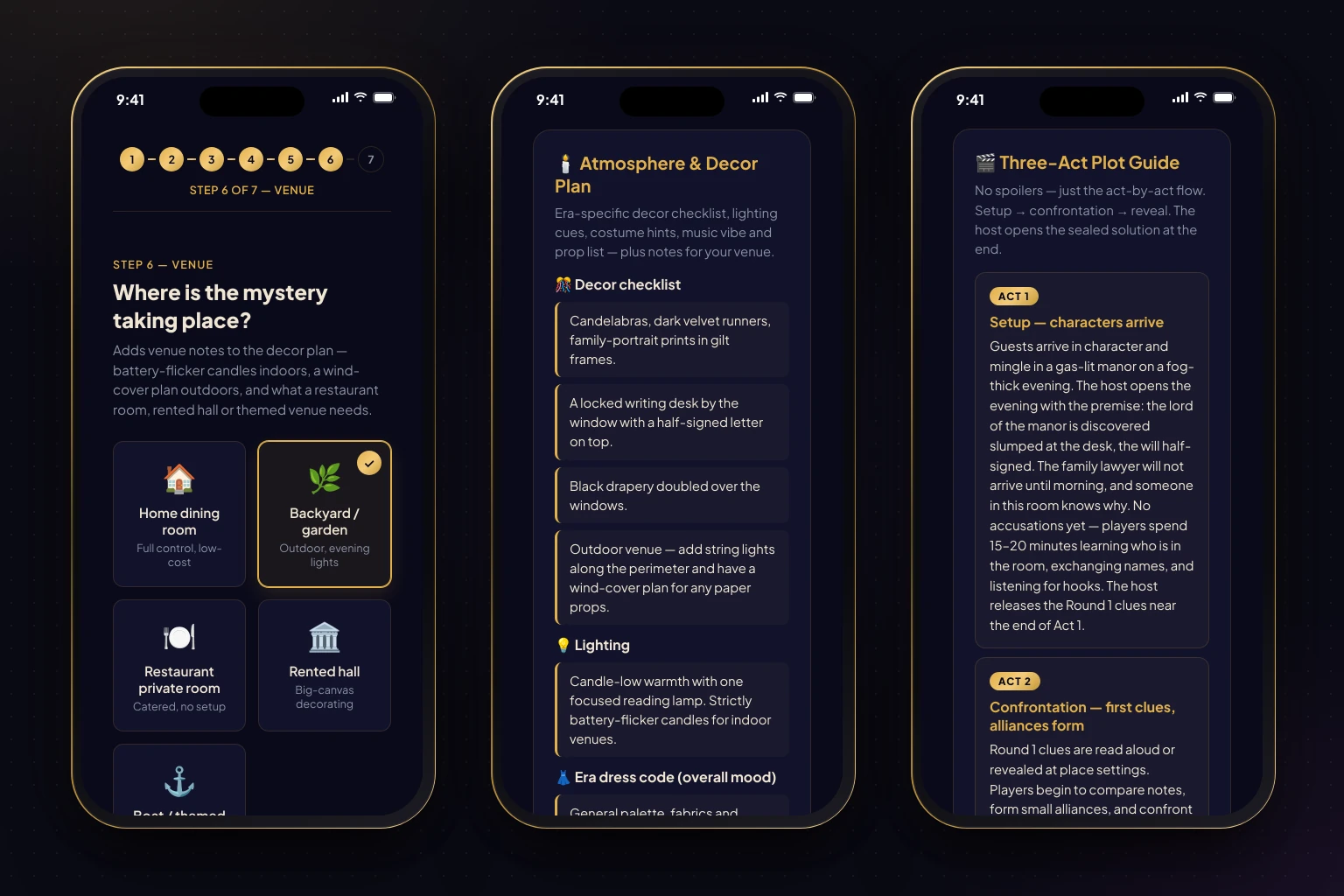
Tell it the guest count (4 to 30), the setting era (1920s speakeasy, Victorian Gothic, modern noir, Wild West, and 4 more), the tone, how experienced your players are, any dietary needs, and the venue (home dining room, backyard, restaurant private room, rented hall, themed venue). It returns a premise, a cast led by the era's own characters with a motive and a secret on every card, a three-act plot guide, a decor and lighting plan, and a clue-round schedule sized to the group. Mark your players as first-timers and you get a seventh step that sets how scripted the evening runs, which is the call most people get wrong on a first mystery night.
Frequently Asked Questions
How long should a party scavenger hunt take to run?
Plan the hunt at 25 to 40 minutes for kids' parties, 45 to 75 minutes for adult cocktail events, and 2 to 6 hours for weekend-scaled GPS hunts across a city. A hunt still running past the 60 percent mark of the event window squeezes the cake cut, the closing photos, and the dessert-table reveal. Build a 10-minute buffer at the end for the team prize and the participation favors.
How many clue cards does a party scavenger hunt need?
A 25-minute kids' hunt runs cleanly on 8 to 10 clue cards across a single venue. A 60-minute adult photo hunt needs 15 to 25 prompts. A 4-hour bachelorette GPS hunt across a city runs on 4 to 7 stops, each with its own multi-step puzzle. Plan one clue per 200 to 350 square feet of indoor space, then adjust for the space you actually have.
What age can kids start playing party scavenger hunts?
Kids start solving single-room object-find hunts at 4 to 5, rhyming-clue treasure hunts at 7 to 8, and riddle-and-puzzle escape-style hunts at 10 to 12. Below age 4, the hunt format turns confusing instead of fun; replace it with a basket-find treasure hunt where the prize is a shared basket of wrapped favors with no small parts. The Kids Birthday Party Games guide covers the classic party games beyond the hunt.
What materials do I need to run a party scavenger hunt?
A basic hunt needs printed clue cards (a home printer covers it), envelopes for the hints, a wrapped team prize, participation favors, a phone for the photos, and one person running it who is not playing. A GPS city hunt adds a printed pass for each team and a phone with GPS.
Can I run a scavenger hunt at a venue that is not my home?
Yes, with 2 qualifiers. The venue manager needs to approve the clue placement, especially in restaurants, hotels, and museum-style venues. Clue cards need to come away without damage (freestanding card holders, folded table tents, clips), since most venues do not allow tacks or adhesive. The Kids Party Venues guide covers what venues usually let you put up.
What if guests refuse to participate in the scavenger hunt?
Build an opt-out station with a labeled drink or snack tray and a quiet activity (a short adult crossword puzzle, a printed dot-to-dot, a single jigsaw puzzle). Some adults never want a structured game, and there is no talking them into one. The opt-out station lets them stay comfortable without dampening the players.
Ready to Lock the Party Scavenger Hunt?
Format comes first. Whichever of the 7 you pick, the clue track, the prize, and the teams all take their shape from it. The free Murder Mystery Party Generator settles the cast, the plot outline, and the clue rounds in 6 or 7 steps. The Printable Murder Mystery Kit below is a full game night that sits neatly before or after a hunt.
This page contains affiliate links to Amazon and other retailers. As an Amazon Associate, we earn from qualifying purchases at no extra cost to you. This helps us keep all our tools free.
Results are for planning and inspiration purposes only. Always verify with your suppliers before purchasing.