How Does the Outdoor Cinema Setup Builder Work?
The builder runs 5 short steps, and the space you pick first shapes the screen and seating choices that follow, so the final plan fits the venue type and the screening evening you are actually hosting, not a generic backyard setup. The full session takes under 2 minutes on a phone or laptop, with no signup or email gate before the result.
Step 1, venue type. Pick where you are setting up: a backyard, a driveway or patio, a public park, a rooftop, a beach, a pool deck, or an indoor large room. The choice drives screen feasibility, the extra lighting and weather notes you get back, and whether the weather-backup section appears at all, since an indoor room does not need one.
Step 2, viewer count. Enter a headcount between 4 and 50, either from the preset chips or as an exact number. This single count drives the seating quantities, the recommended screen size, and the projector throw distance behind it.
Step 3, screen setup. Pick what you are projecting onto: an inflatable screen, a DIY white sheet, a wall, a portable pull-up, or a TV on wheels. Each projector screen starts from a typical throw ratio, so the builder can work out how far back the projector needs to sit: inflatable at 1.5, DIY sheet at 1.8, wall projection at 2.0, portable pull-up at 1.6. An optional field under the cards takes your own projector's ratio, from 0.3 to 3.0, in place of the typical one. Pick the TV and the throw math drops out entirely, because there is no projector to place.
Step 4, seating style. Pick how guests will sit: blankets and pillows, bean bags, lawn chairs, pool floats (offered only on a pool deck), a mixed casual spread, or hammocks and swings. The builder sizes the quantities off your viewer count and the style together, so the mixed option is the one that splits the room across blankets and chairs rather than assuming everyone sits the same way.
Step 5, vibe. Pick the night you are running: family with kids, date night, friends hangout, themed, Halloween scary, or holiday cozy. Alongside the venue, the vibe sets the ambient-light tier the lumens recommendation works from, so a date night and a family screening in the same backyard do not come back with the same lumens row highlighted.
🛒 As an Amazon Associate, we earn from qualifying purchases, at no extra cost to you.
Portable Outdoor Projector
See on AmazonInflatable Projector Screen
See on AmazonOutdoor Bluetooth Speaker
Check Price on AmazonUse the Outdoor Cinema Setup Builder Before the Equipment Order
A one-tap Amazon order for an outdoor projector is a common starting point for a backyard movie night, and it has hidden costs. Hosts often pick a projector by price-and-rating instead of by lumens-and-throw, then learn at 8:15 pm on the screening evening that the picture washes out in twilight or that the seating arc sits beyond audio coverage. The builder settles the projector tier, screen size, seating distances, and audio plan before the cart opens, so the equipment purchase is a sized list rather than a guess.
Four reasons hosts run the builder before the equipment buy.
- Lumens sized to the night you describe. The builder reads your venue and your vibe together to place the evening on an ambient-light tier, then marks that tier in its lumens table: 2,000 to 3,000 ANSI at full dark, 3,000 to 4,000 at dusk, 3,500 to 5,000 with porch or room lights nearby, and 5,000-plus where the space cannot be darkened at all, a row that also says to consider rescheduling. Buying to the wattage on the box instead is how a picture that looked cinematic in the store washes out on movie night.
- Throw ratio matched to the screen you actually own. Every projector screen setup carries a default ratio, so the builder has a fixed figure to work from, not a number to guess at: an inflatable runs 1.5, a DIY sheet 1.8, a wall 2.0, a portable pull-up 1.6. The builder does that arithmetic against your viewer count and hands back the distance, which is a measurement people often discover is wrong once the guests are already seated; if your own projector's ratio differs, type it into the optional Step 3 field and the distance is worked from it instead.
- Seating quantities sized to the style, not one count for all. Blankets, bean bags, lawn chairs, pool floats, hammocks and the mixed spread all take different room, and the builder counts each style its own way from the headcount. Pick the style at Step 4 and the builder sizes the quantities off it and your headcount together, so a 20-person blanket night and a 20-person lawn-chair night come back with different counts to buy.
- A weather call already inside the plan. Every outdoor venue gets a backup section: check the forecast 24 hours and 2 hours out, treat wind over 15 mph as fatal to an inflatable screen, keep a tarp and bungee cords for the projector or TV, pre-mark the indoor fallback room, and set a go/no-go call an hour before guests arrive. Rooftops and beaches pick up an extra wind warning, a public park a permit-rescheduling note. It only disappears if you told the builder you are indoors.
The builder pairs naturally with the Party Lighting & Atmosphere Designer for the string-light and lantern layer around the edge of the yard, the Party Servings Estimator for the snack and drink counts that run alongside the screening, and the Party Planning Timeline for the weeks-out milestone countdown that leads up to the screening night.
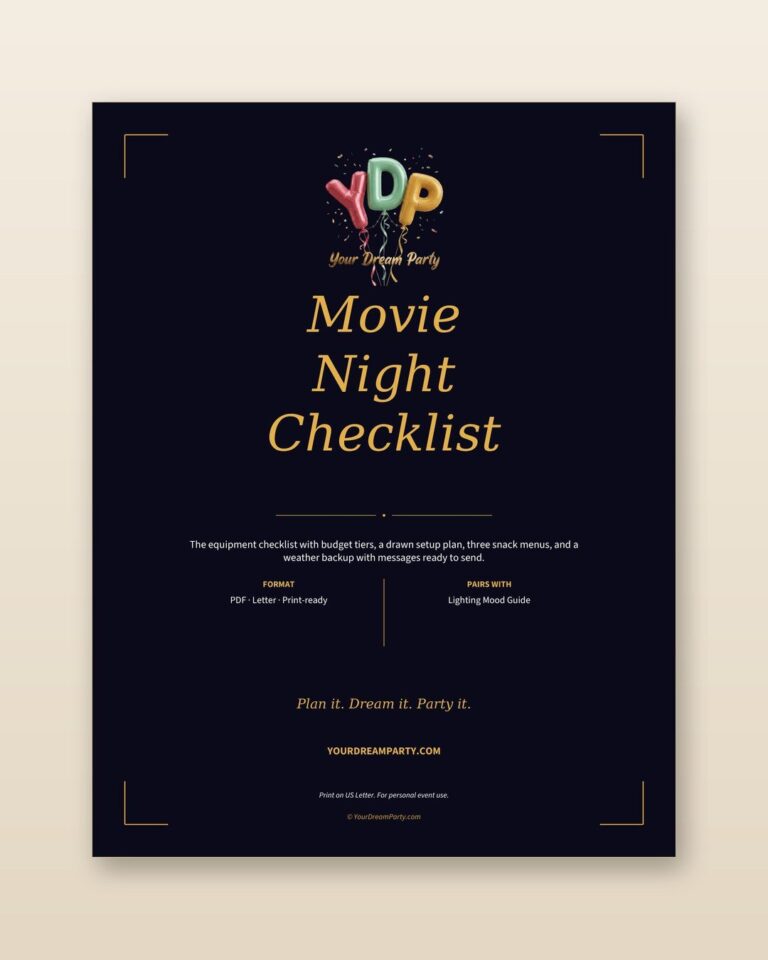
Movie Night Checklist
- 7 pieces of kit and 3 budget tiers
- 2 backyard layouts drawn from above: 4-6 and 12-20 viewers
- Screen, seating, sound and snack placement
- 6 snack station formats
What the Outdoor Cinema Setup Builder Puts Together for Your Screening
The results page returns a full cinema setup plan from your 5 answers. Each part sets up one next step: the equipment purchase, the yard prep, or the day-of layout.
Setup checklist by zone. The plan broken into the 4 zones you actually work in (screen, seating, snack and tech), each with its own checklist and a tip. It is the running order for the afternoon, so the screen goes up before the seating goes down and the cables get taped before anyone walks the path.
Projector and sound distance guide. The screen width worked from your viewer count, the throw distance worked from your screen's typical ratio or your projector's own, and the speaker placement to match, with a lumens table underneath: 2,000 to 3,000 ANSI at full dark, 3,000 to 4,000 at dusk, 3,500 to 5,000 with porch or room lights nearby, and 5,000-plus where the space cannot be darkened, with the row for your venue and vibe highlighted. This is the block that turns "somewhere around there" into a measurement you can pace out before the guests arrive.
Lighting guide. Warm string lights around the perimeter, fairy lights along the snack table, the overhead lights and the porch lights or lamps off once the movie starts, and low lights along the route to the snacks and bathrooms, plus a candle or uplight line for date night, holiday cozy or Halloween and a safety line for a pool deck or rooftop.
Snack station styling. The snack zone treated as its own setup rather than a table you put chips on: a styling line and a short list of ideas pitched at the vibe you picked, with no per-guest portions.
Weather backup plan. For every venue except an indoor room: the forecast checks at 24 hours and 2 hours out, the 15 mph wind limit that rules out an inflatable screen, the tarp and bungee cords for the electronics, the indoor fallback room to pre-mark, and a go/no-go call time an hour before guests arrive. Rooftops and beaches add a wind warning; a public park adds a permit note about rescheduling inside 24 hours.
When Should You Run the Outdoor Cinema Setup Builder?
Three typical setups follow. Each one runs the same 5 steps, but the result changes because your inputs reshape the gear list.
Pattern 1, 12 viewers, backyard, DIY white sheet, blankets and pillows, family-with-kids vibe. The builder works the throw distance off the sheet's 1.8 ratio, sizes the screen to 12 viewers, counts 6 blankets and 14 pillows, puts the evening on the dusk tier at 3,000 to 4,000 ANSI, and returns the 4 zone checklists plus the full weather backup, because a backyard is an outdoor venue.
Pattern 2, 25 viewers, driveway or patio, inflatable screen, mixed casual seating, friends-hangout vibe. For this one the inflatable's 1.5 ratio sets a shorter throw than the sheet would, the mixed seating splits the 25 across blankets and chairs rather than assuming one or the other, and the weather section carries the 15 mph wind limit, which matters more here than anywhere because an inflatable is the screen most exposed to it.
Pattern 3, 40 viewers, rooftop, portable pull-up screen, lawn chairs, date-night vibe. Here the pull-up's 1.6 ratio sets the throw, the chair count comes to 42 with a spare pair for the hosts, and the date-night vibe pushes the evening onto the full-dark tier at 2,000 to 3,000 ANSI. The rooftop adds its own wind warning on top of the standard backup plan, telling you to ballast every screen support with sandbags or water weights and weight the projector tripod.
For the wider hosting context, the holiday party ideas hub covers entertaining across the seasons, and the outdoor movie night setup ideas guide handles the screening-evening styling and the snack-bar layout.
Pick the Right Answers Before You Open the Outdoor Cinema Setup Builder
A few inputs sharpen the plan. Run through these before you start so the builder works from your real numbers.
Pick the venue type that matches the surface, not the zip code. A driveway and a lawn get the same plan from the builder, but a rooftop, a beach and a public park each pull their own warning into the weather section and hide or gray out a screen that cannot work there. The venue also settles whether you get a weather backup at all, so picking indoor large room for a covered patio quietly removes the section you most needed.
Pick the vibe for the light, not only the mood. The vibe pairs with the venue to set the ambient-light tier, so date night and Halloween scary push the evening toward full dark while a family screening sits at dusk. If you are starting earlier than the vibe implies, read the highlighted lumens row as a floor and buy up a tier, because the tool is reading the room you described rather than a clock.
Pick the screen setup you have time to put up. An inflatable needs a few minutes and a quiet inflator running all evening; a DIY sheet needs tensioning so it does not ripple; a pull-up needs level ground. They also carry different typical throw ratios, from 1.5 to 2.0, so unless you enter your own projector's ratio, switching screens late moves the projector as well as the setup time.
Pick the seating style you will actually have on hand. The builder sizes quantities off the style, so choosing lawn chairs when half the room will end up on blankets gives you a chair count you cannot fill and a blanket count of zero. Where the room genuinely splits, mixed casual is the option that expects it.
Save the plan before the equipment order goes in. The printed setup guide, with its shopping list outline, turns into the one document for the rental counter, the Amazon search, or the helper handling pickup. Print it for the planning binder; email the plan, or paste the Copy All text, to the partner handling the projector buy or the helper running the yard setup; keep the emailed copy on the phone for the day-of setup sequence and the weather decision check.
Frequently Asked Questions
Is the Outdoor Cinema Setup Builder actually free?
Yes. The builder, the setup checklist by zone, the projector and sound distance guide, the lighting guide, the snack station styling, and the weather backup plan cost nothing and require no signup. The optional upgrade is the Movie Night Checklist PDF ($7.00).
How many lumens do I need for an outdoor projector?
Lumens scale to how much light is left in the space. The builder lists 4 tiers and highlights the one your venue and vibe point to: 2,000 to 3,000 ANSI at full dark with no streetlights, 3,000 to 4,000 at dusk, 3,500 to 5,000 with porch or room lights nearby, and 5,000-plus where the space cannot be darkened at all, a row marked to consider rescheduling that no combination of answers ever selects.
What size screen do I need for an outdoor movie night?
The builder works the screen width from your viewer count, then pairs it with the typical throw ratio of the screen setup you picked, or with your own projector's ratio if you enter one at Step 3, to give the projector distance behind it. That is why the screen question and the distance question are answered together on the result rather than one at a time: on the typical ratio, change the screen and the distance moves with it.
Which screen setup should I pick?
The builder offers 5 screen setups, and the practical difference between them is setup effort against throw ratio. An inflatable goes up in minutes but runs an inflator all evening and sits at a 1.5 ratio; a DIY white sheet is the cheapest and sits at 1.8, so the projector goes farther back; projecting on a wall runs 2.0 and needs no screen at all; a portable pull-up runs 1.6 and wants level ground; a TV on wheels skips the projector throw math entirely.
Do I need a separate speaker, or is the projector speaker enough?
The builder gives you speaker placement alongside the projector distance rather than a coverage calculation, so treat the choice as yours and the placement as its answer. As a rule of thumb, a built-in projector speaker only carries a handful of guests sitting close; anything larger wants a separate speaker, placed as the distance guide sets out.
When should I cancel an outdoor screening for rain?
The builder's weather backup plan gives you the sequence: check the forecast 24 hours out and again 2 hours out, and set your own go/no-go call an hour before guests arrive, then text the decision to everyone. It also names the hard limit that is easy to miss, wind above 15 mph, which cancels an inflatable screen regardless of rain. Keep a tarp and bungee cords on hand for a sudden shower and pre-mark the indoor fallback room ahead of time.
Ready to Set Up the Backyard Cinema?
Give the Outdoor Cinema Setup Builder 5 answers about the space and the night and it returns a setup checklist across the screen, seating, snack and tech zones, a projector and sound distance guide with the lumens your ambient tier needs, a lighting guide, snack station styling, and, for any outdoor space, a weather backup plan. The Movie Night Checklist PDF below adds a night-of checklist you can print for the clipboard.
This page contains affiliate links to Amazon and other retailers. As an Amazon Associate, we earn from qualifying purchases at no extra cost to you. This helps us keep all our tools free.
Results generated by this tool are for planning and inspiration purposes only. Estimates are based on general guidelines and may vary depending on your specific circumstances. Always verify with your suppliers before making purchasing decisions.