Adult party games change shape depending on the room. A dinner-party round played over dessert and coffee is one thing. A backyard game that has to fill a slow late afternoon is another. A game night where the games are the whole point is different again. Before you shuffle a single deck, settle 3 things. How lively is the room? A seated dinner and a backyard cookout are not the same crowd. Who is playing, and will you run one big group or split into teams? And how long do you need the games to last? Most run 90 to 150 minutes. Skip all that and you will end up pulling a boxed game off the closet shelf. It runs too long for a dinner, or too thin for a game night, and the room drifts into side conversations by the third round.
An 8-guest dinner winding through dessert and coffee wants a different lineup than a 16-guest backyard cookout. A 20-guest game night built entirely around the games is different again. The same 3 questions get you there each time. Start with the 6 adult party game formats that work across guest counts and event types. Pacing and rotation come next, then host cues and scoring, then the props that separate a considered evening from an improvised one. There is a free tool at the end that drafts a murder-mystery plan, and the Party Games and Activities guide covers all of it.
Quick Stats: 6 Game-Night Formats | 3 Round Mixes | Free Murder Mystery Generator Available
Six Adult Party Game Formats That Make the Evening Work
Your format sets the rhythm of the rounds, whether people play in teams or alone, and what props you need on the table. Settle it before anything else, against your guest count, how lively you want the night, and how long you have. These 6 adult party game formats work at dinner parties, game nights, and gatherings built around something else.
Conversation-starter and icebreaker games. Give yourself 30 to 45 minutes of prompts: printed question cards, "two truths and a lie" rotations, "this-or-that" decks, or "fishbowl" name pulls. Run them through the cocktail hour or across the seated dinner. Nothing to plan, and nothing to buy. It shines when half the room has never met, which is why it works at mixed-couples dinners and any gathering where your circles are meeting each other for the first time.
Team trivia and quiz-night format. Set up teams of 3 to 5 players and run 5 to 7 rounds of 8 to 10 questions over 60 to 90 minutes. Mix the difficulty, and keep a running scoreboard on a chalkboard or a printed leader sheet. Best for 12 to 30 guests, for mixed-age adult gatherings, and for birthdays where you want the games to give the evening a shape. If your crowd spans a few generations, Family Party Trivia Ideas mixes the rounds differently.
Murder-mystery and role-play formats. Hand out printed character roles and spend 90 to 120 minutes working through clues until the room solves the mystery together. Set it in a 1920s speakeasy, a 1980s cocktail party, a 1950s supper club, or a present-day corporate retreat. Worth it when your friends will actually commit to the costume. It also turns a milestone birthday into one continuous story instead of a series of separate activities.
Card-and-board game-night rotation. Pick 3 or 4 games of middling complexity: a strategy game, a party-card game, something quick, something with deduction. Rotate every 30 minutes across 90 to 150 minutes, mixing team play with individual. Ideal if you already own the games and your friend group knows each other well. Family Card Game Ideas goes deeper on pacing a card-led evening.
Active outdoor and lawn-games format. Spread oversized lawn dice, cornhole, giant stacking blocks, ring toss, bocce, and ladder golf across a backyard or a park pavilion. Run it for 60 to 120 minutes with set rounds and a leaderboard or a bracket. Save it for the warm months, from late spring through early fall. At a cookout it does double work, filling the afternoon and giving people somewhere to be. More on the outdoor side lives in Family Outdoor Party Games.
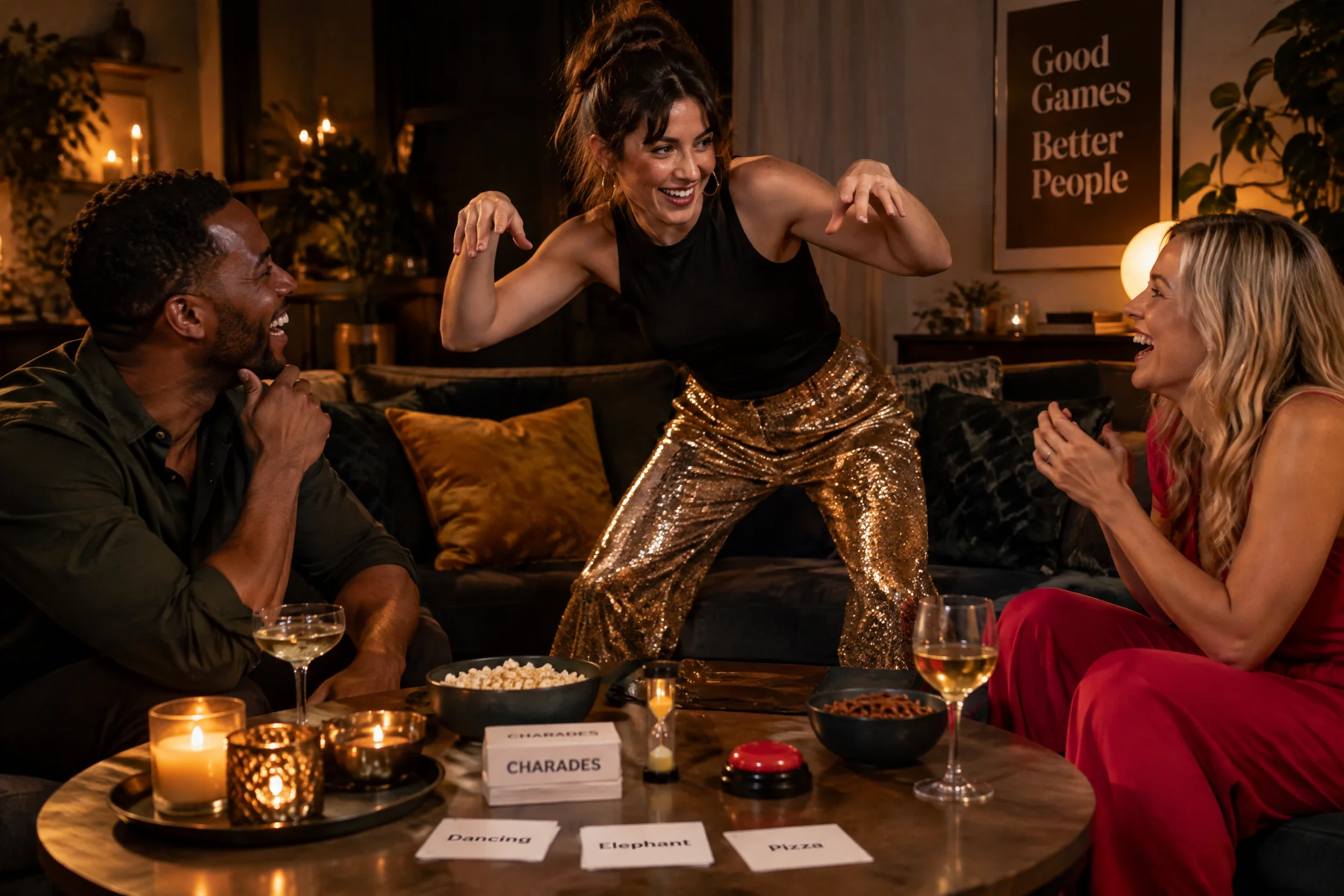
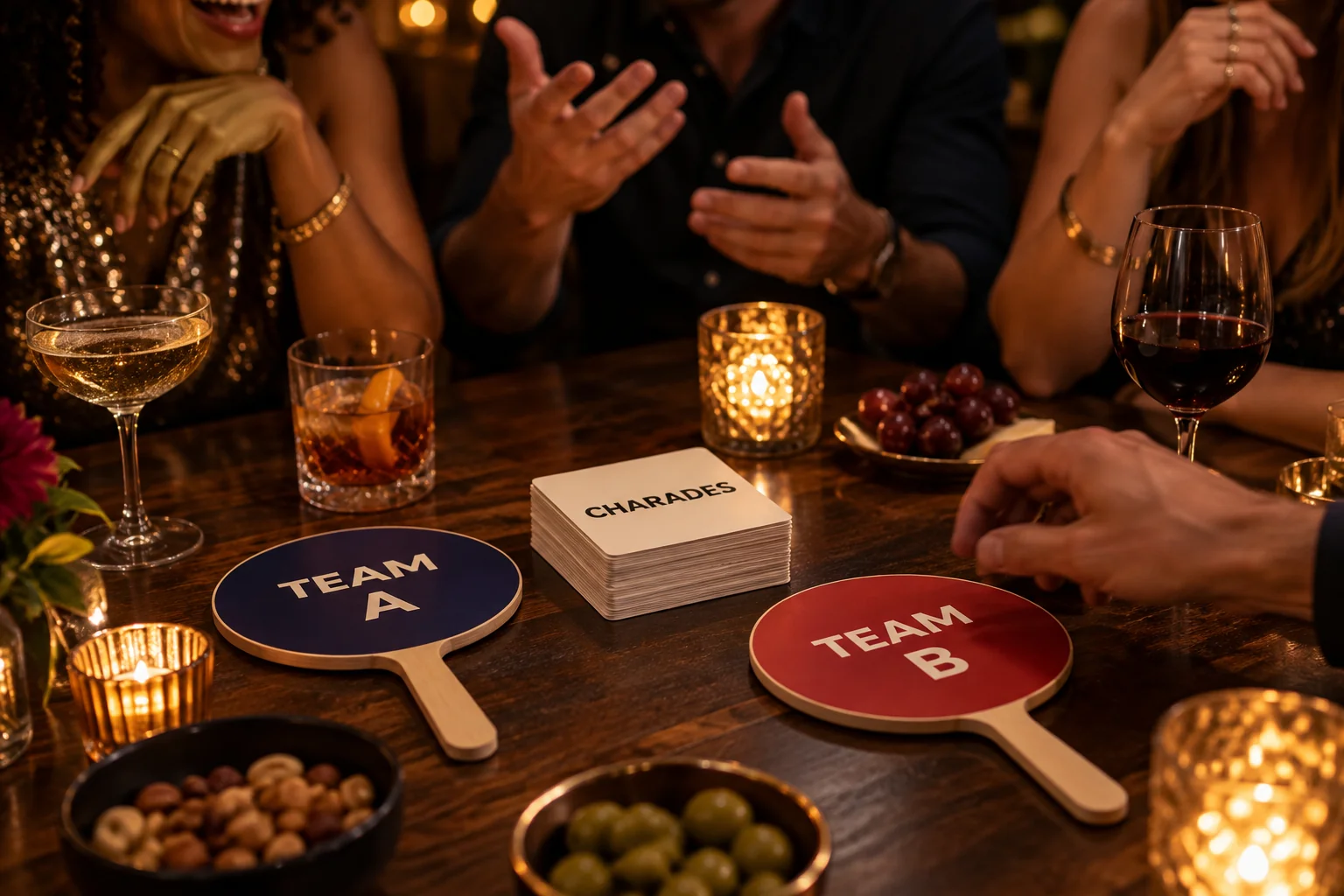
Charades-and-sketching classic format. Run 45 to 75 minutes of acting and drawing games: charades, draw-and-guess, "who am I", "guess the song". You need 2 to 4 mixed-couple teams, a printed prompt deck, and a timer. Everyone from your niece to your father-in-law can play this one, and it stretches to fit almost any group size. Bring it out after dessert, or wherever a birthday needs its social center of gravity.
Planning around a bride? The Bachelorette Party Ideas hub themes the games to her.
🛒 As an Amazon Associate, we earn from qualifying purchases, at no extra cost to you.
Party Games Game Props
Shop on AmazonParty Games Dice Sets
Shop on AmazonParty Games Icebreakers
Shop on AmazonMatch the Round Count, the Team Size, and the Clock
How many rounds you run, and how long you run them, matters more than which games you pick. Give 12 dinner guests 7 rounds and it feels like a marathon by the third game. Give 20 game-night guests only 2 rounds and you have barely justified setting up teams. Aim for the middle.
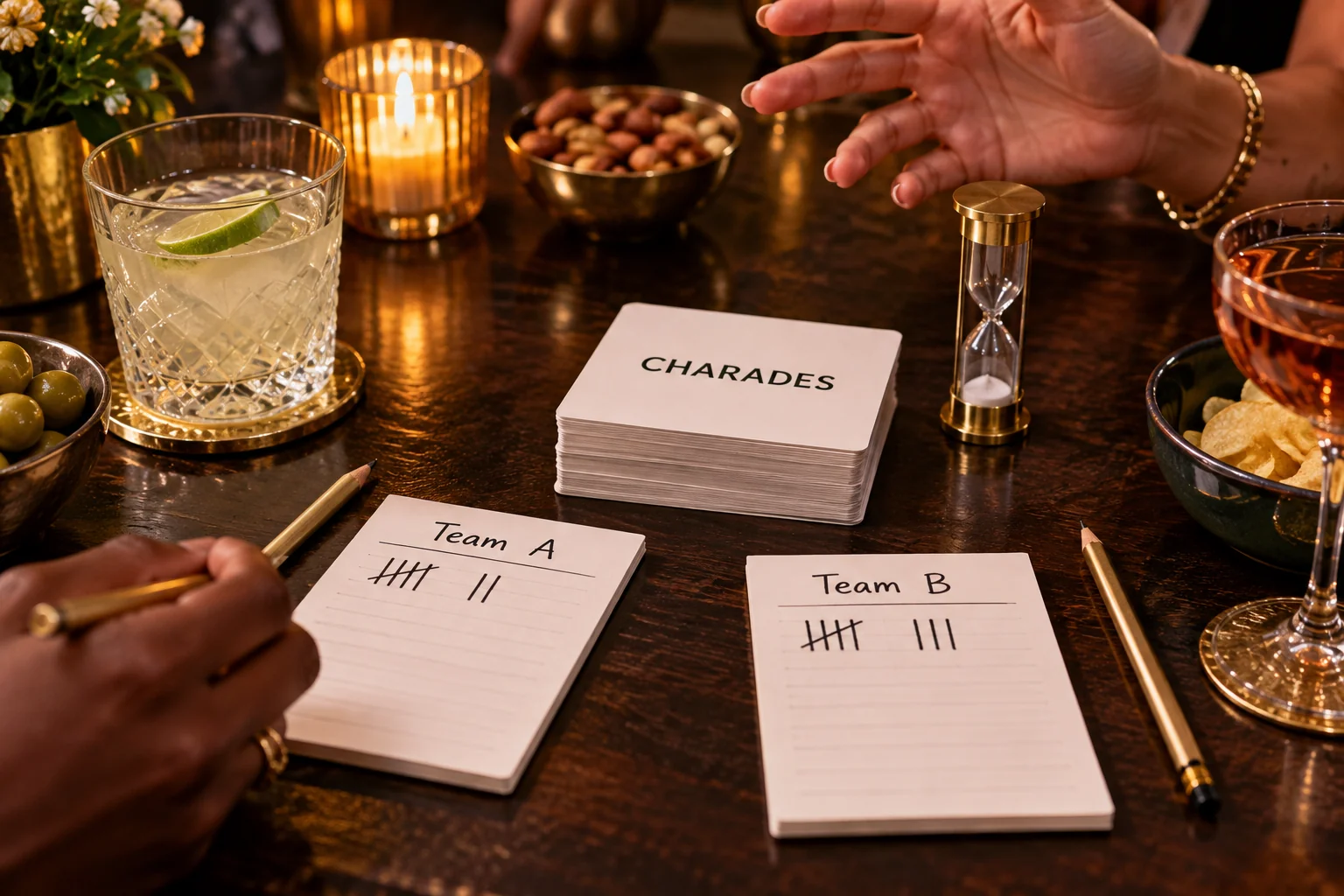
Let the player count and the clock set your rounds. In 60 minutes you can run 4 rounds of 8 questions for 8 to 12 guests, or 3 rounds of 10 questions for 16 to 24. Stretch to 90 minutes and 6 rounds of 8 questions works for anywhere from 12 to 24 guests. Budget 12 to 15 minutes per round, which covers reading the questions aloud, letting teams talk, and updating the score.
Build mixed-couple teams of 3 to 5 players each. Teams of 6 or more lose the quieter players to side conversations; teams of 2 or fewer struggle on multi-category rounds and on charades-or-sketching formats. A 12-guest evening runs 3 teams of 4; a 20-guest evening runs 5 teams of 4 or 4 teams of 5; a 28-guest evening runs 7 teams of 4. For a crowd of 30 to 60, keep teams at 3 to 5 and run a scavenger clue trail or 60-second challenge rounds, repeated team by team. Split couples across different teams, and the whole room ends up talking to each other.
Open with 5 to 7 minutes of warm-up questions. Run 5 to 7 easy questions with no scoring and everyone playing alone. It settles the room, lets late arrivals slip in, and gives you a feel for your own reading pace before anything counts. Think of it as the cocktail hour of the game night. For a room full of strangers, Party Ice Breakers opens things up further.
Take a 10 to 12 minute halftime. Halfway through a 60 or 90 minute session, let everyone refill a drink, find the bathroom, and stretch. Under 50 minutes, skip it; the energy carries itself. Print the halftime cue onto your round sheet so you are not deciding mid-round whether to call it.
Make the last round worth double. Either the closing round counts twice, or teams wager part of their score on a final question. Either way, the teams at the bottom still have a path to the top. Without it, the leader is decided by round 4 of 6, and everyone else stops caring.
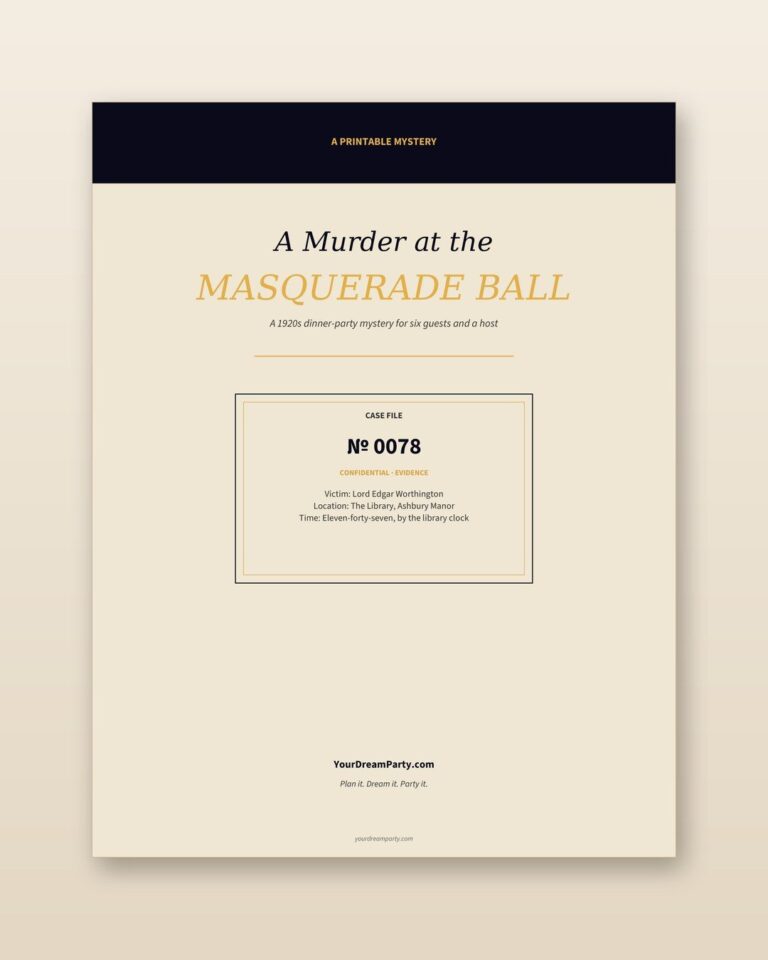
Printable Murder Mystery Kit
- A 1920s masquerade mystery for 6 guests plus a host
- 6 character cards: role, backstory, alibi, secret and what they know
- 12 clue cards over 4 rounds, 3 per round
- Host instructions with casting tips and timings
Plan the Prompt Mix, the Scoring System, and the Host Cues
Your questions and your scoring are what separate a polished game night from a thrown-together one. Pitch every question at the same level and you lose the casual players by the third one and the competitive players by the seventh. Get the mix right and everyone stays in it. Build the questions first, then the scoring, then your own cues.
Mix easy and hard questions inside every round. Build each round as 2 easy, 4 to 6 medium, then 2 hard, in that order. The easy opening lets every team start confident. The medium middle carries the energy. The hard finish opens up the scoring gap that keeps the leaderboard worth watching. Keep every question at one level and the round falls flat, however sharp the questions are.
Run 1 point per prompt with a 2-point bonus on each round's final prompt. Flat scoring is easy to follow and keeps the math from derailing the evening. That 2-point bonus on each round's last question, and 4 points on the closing round, leaves room for an upset right until the end. Skip weighted scoring tiers. Your guests will notice you have overplanned this.
Spread the evening across 5, 6, or 7 themed rounds. Themes that reliably land: 90s pop culture, music by decade, movies and TV, geography and landmarks, food and drink, sports, and a wildcard "host's choice" round. Leave politics, religion, and personal finance out of it.
Announce a no-phones policy, and put out a basket. Nothing derails an adult game night faster than someone quietly looking up the answer. Say it during the warm-up round, print it on the round sheet, and put a "phones in the basket" card on every team table. Giving people somewhere to put the phone works better than asking them to be honest.
Read to the room, not at it. Read each question twice, once at normal speed and once slower with the key words emphasized. Then give teams 45 seconds to talk before you call time. Any shorter and the quieter players never get a word in. Any longer and the room starts to wander.
Pick the Props, the Prizes, and the Closing Moment
Props and prizes are the last thing you decide and the first thing your guests notice. Cheap prizes drain the suspense out of the closing round. Thin props leave the whole evening looking improvised. Both are easy to get right, and neither costs much.
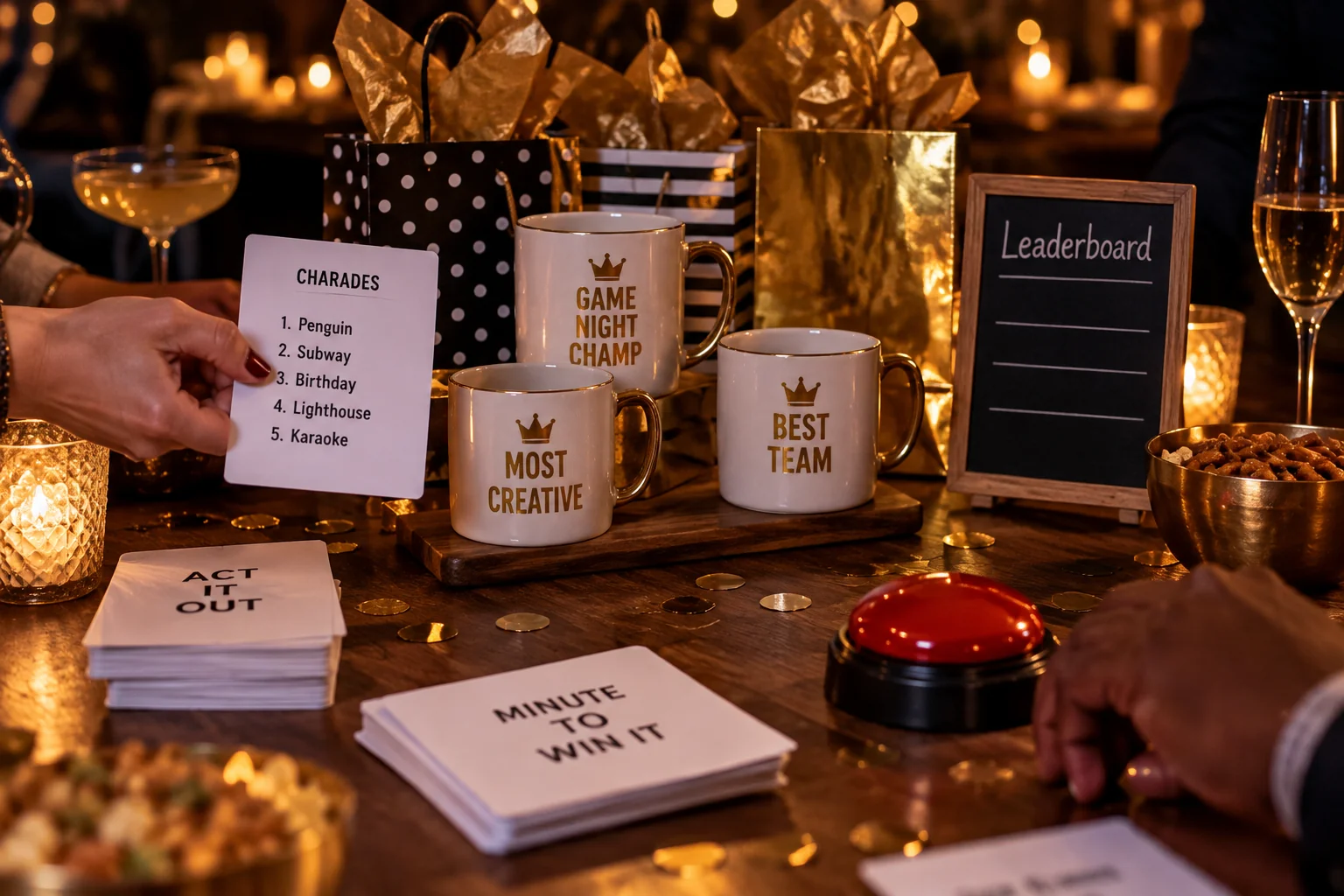
Give out 3 prizes: winner, runner-up, and last place. First place gets a curated mug set, an engraved trophy, or a printed certificate with a keepsake worth keeping. Runner-up gets a small thank-you box or a certificate. Last place gets a joke consolation prize, with a certificate titled to make them laugh. With prizes for first, second, and last, nobody checks out early.
Keep everything in one tote, packed and ready. Round sheets, scoring pads, prize certificates, a chalkboard for the leaderboard, the phone basket, pencils, paddles or buzzers, a stopwatch. Pack it once and it is ready for every game night after this one. There is no need to shop for each event, because the same props work across most of these formats.
Print yourself one sheet with everything on it. Each round's title, how many questions, the answer key, the scoring, and the halftime cue, all on a single page. You will never be shuffling paper between rounds. Print a second copy as a backup. Charades Terms and Party Ideas walks through the signals and timing that keep charades moving.
Stage the final reveal. Read the running totals from last place up to first before you score the final round. Done that way, the winner arrives as a genuine cliffhanger, and it becomes the moment people remember. Read the tally out as a quiet update and the whole finish deflates.
Decide the tiebreaker before you need it. One estimation question, a first-to-buzz answer, or a head-to-head wager will settle a 2-team tie. Write it onto the round sheet in advance. Improvise it on the night and you look like you have lost the thread at the worst possible moment. Hosting something that is not games-led? Party Decoration Ideas styles the rest of it.
Where Does the Murder Mystery Generator Fit in a Game Night?
The Murder Mystery Party Generator is free, runs in 6 or 7 steps, and plans one of the 6 formats above from the arrivals to the reveal: the murder mystery. Step 2 is where you choose the era, and the era carries through to the cast, the premise and the decor. Plan from a single image on an inspiration board and the mystery gets bolted onto whatever else the night holds. Build the mystery first and the other games slot in around its 3 acts.
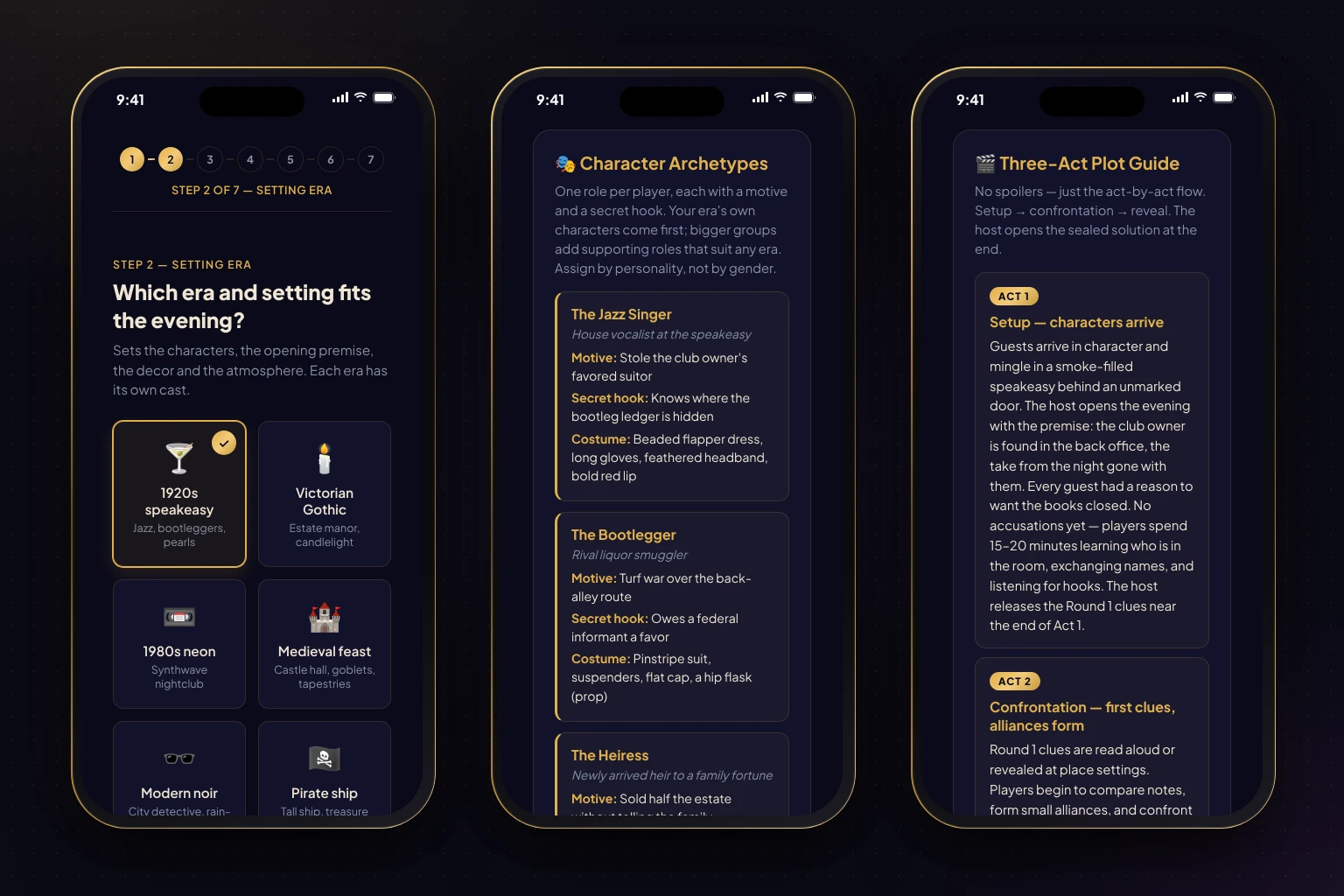
Give it the number of players (4 to 30), the setting (a 1920s speakeasy, Victorian Gothic, 1980s neon, modern noir and 4 more), the tone, how experienced the group is, any dietary needs and where you are playing. It returns the premise and a cast with one character per player, the era's own roles first, each with a motive and a secret. Then come a 3-act plot guide, a clue distribution that runs from 3 to 5 rounds as the group grows, an atmosphere and decor plan, and menu styling for the era. The clues themselves and the solution are yours to invent. The plan times the mystery at 90 minutes for a compact group and longer for a bigger cast, so in a mixed game night it takes the main slot, with quicker rounds before and after it.
Planning a bachelorette? The Bachelorette Party Planner builds the weekend around the bride, and its block-by-block itinerary has an anchor-activity slot where a game night fits. For a summer evening outdoors, the Outdoor Cinema Setup Builder works out the screen size, the projector throw distance and the speaker spacing, the setup a picture-and-audio round runs on. And the Baby Shower & Gender Reveal Planner returns 3 themed games with materials and rules for a shower.
Frequently Asked Questions
How many games should I plan for an adult party?
Plan 3 to 4 games across 90 to 150 minutes, plus a 5 to 7 minute warm-up that does not count toward the total. Over dessert and coffee at a dinner party, 2 games is plenty. A full game night takes 4 comfortably. Go past 5 and the room starts to flag.
How long should an adult game night last?
Most game nights run 90 to 150 minutes. A 60-minute trivia block fits 4 rounds for 8 to 12 guests, and 90 minutes fits 6 rounds for 12 to 24. At 150 minutes, a full game night holds 3 to 4 games. Push past 180 minutes and the second half sags, leaving everyone tired before the last round.
What adult party games work best for mixed-couple groups?
Team trivia, charades, draw-and-guess, "who am I", "two truths and a lie" rotations, "this-or-that" decks, and printed conversation-starter cards all work well. Split couples across different teams and the room mixes itself. Avoid anything that runs on one couple's inside jokes, because everyone else will feel shut out.
How do I handle a guest who does not want to play?
Make the games opt-in, never mandatory. Offer them a job instead: refilling drinks, keeping score, or pulling the charades prompts. Set up a quiet corner near the action where they can sit out and still feel part of it. A one-line note in the invitation about the games gives everyone fair warning.
What are the best prizes for adult party games?
Three prizes work best: one for the winners, one for the runners-up, and a joke prize for last place. For the winning team, try a curated mug set, a small wine or coffee-bean bundle, an engraved trophy, or a printed champion certificate dated and signed by you. Skip cash and gift cards among friends. It turns the night into a transaction.
Can I play adult party games at a dinner party?
Yes. Slot them between dessert and coffee, in the last 60 to 90 minutes of the evening. Stick to games that need almost nothing on the table: conversation-starter cards, "two truths and a lie", a quick printed trivia round. A murder mystery or a full charades setup will take over the dinner instead of finishing it. Game Ideas for the Family has more for the dinner-table slot.
How do I keep games fair across competitive and casual players?
Mix the difficulty inside each round (2 easy, 4 to 6 medium, 2 hard), shuffle the teams so the strong players are spread out, and double the final round so the casual teams stay in range to the end. Do not hand out handicap points by skill. Your guests will find it patronizing, and it kills the suspense anyway.
What supplies do I need for an adult game night?
Pack one tote and keep it packed: printed round sheets, scoring pads, pencils, a stopwatch, paddles or buzzers for team play, the phone basket, a chalkboard or printed leaderboard, prize certificates, and the prizes themselves. Every game night after this one starts with you picking up the tote, not shopping.
Ready to Plan the Adult Game Night?
A polished game night and a thrown-together one differ mostly in what you decide first. Settle the format against your guest count, and the rounds, the scoring, the props, and the prizes all have something to hang on. The free Murder Mystery Party Generator plans the mystery slot act by act. The Party Games Mega Bundle below prints 3 game sets and 3 bonus packs in one download, from a 1920s murder mystery kit for 6 guests to 50 party trivia cards with an answer key and 30 adult icebreaker cards.
This page contains affiliate links to Amazon and other retailers. As an Amazon Associate, we earn from qualifying purchases at no extra cost to you. This helps us keep all our tools free.
Results are for planning and inspiration purposes only. Always verify with your suppliers before purchasing.