Quick answer
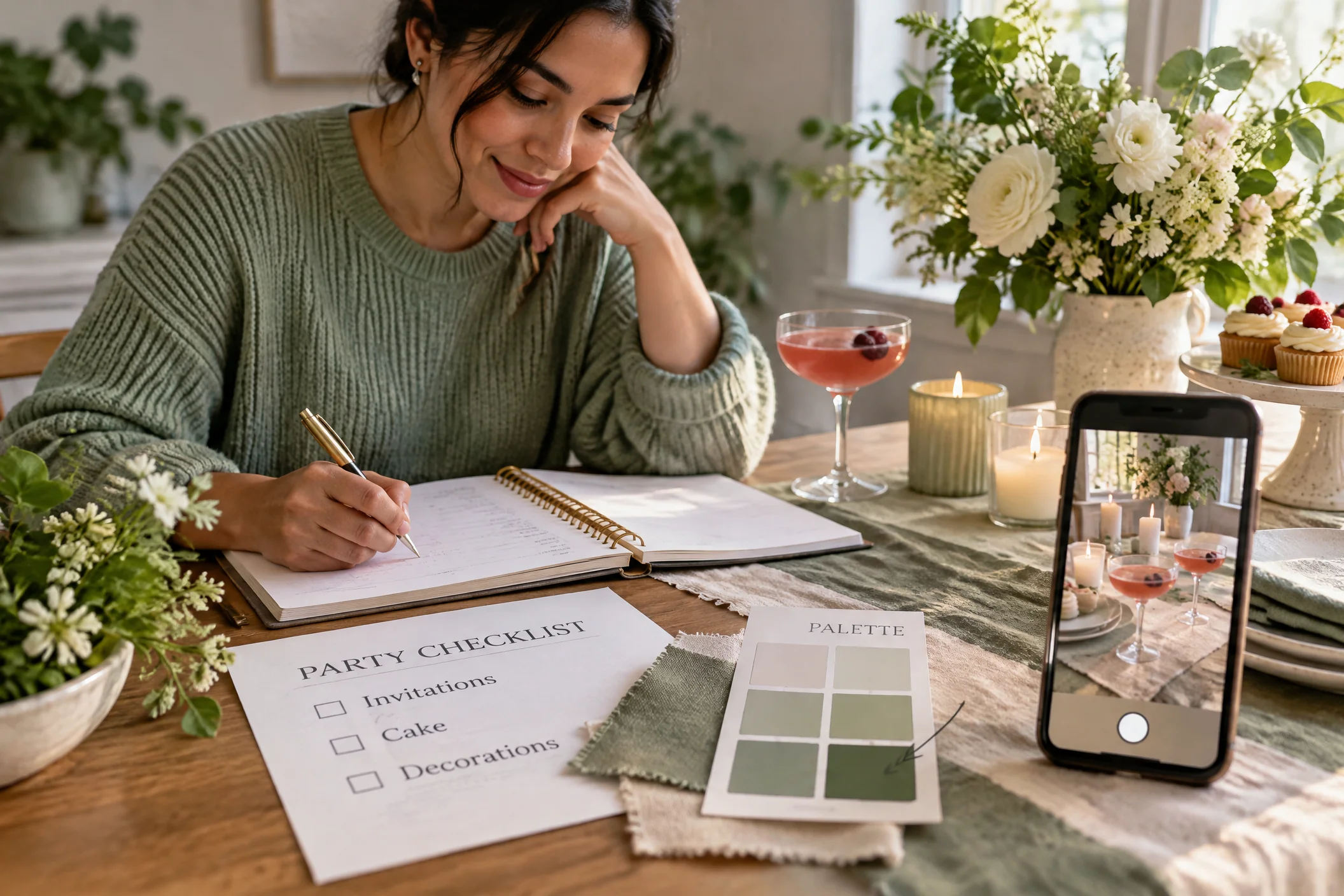
Party planning comes down to 7 decisions, in order: the headcount, the budget, the timeline, the guest list, the venue, the food and drink plan, and the day-of run sheet. Lock the first three 6 to 8 weeks out, the next two at 4 to 6 weeks, the last two over the final 2 to 3 weeks for a calm 3-hour event.
Party planning is about order before it is about taste. The 7 decisions named in the Quick Answer above happen in the same sequence, whatever you are hosting.
Hosts who skip the first 3 decisions (count, budget, timeline) and jump straight to decor end up over budget, short on time, and short on plates, because the big decisions never settled before the shopping started. The fix is to build the plan in layers: the foundation first, held steady, with the styling added on top.
The running order holds whatever the event. A 14-guest 30th birthday at home, a 30-guest baby shower at a rented hall, an 18-guest wedding reception at a restaurant, a 50-guest graduation backyard cookout, or a 10-guest cocktail evening on a 6-week runway all follow the same sequence. This guide steps through the decisions in order, then adds vendor coordination and how budget tiers shift by event type. The free Party Budget Calculator and Party Planning Timeline at the close handle the heaviest decisions in under 4 minutes, and the Party Planning Checklist Guide guide carries the week-by-week tasks.
- 6 to 8Week Lead Time for a Calm Mid-Size Event
- 40Percent of the Budget Lands on Food and Drink
- 3-HourSweet-Spot Event Window for Most Adult Formats
🛒 As an Amazon Associate, we earn from qualifying purchases, at no extra cost to you.
Party Planning Checklist Binder
Shop on AmazonParty Planning Planner Notebook
Shop on AmazonParty Planning Labels
Shop on AmazonParty Planning Calendar
Shop on AmazonParty Planning Organizer
Shop on AmazonParty Planning Supplies
Shop on AmazonWhere Should Party Planning Actually Start?
Three foundation decisions steady everything that follows: the sourcing, the decor, and the food. So party planning starts there. Settle the headcount, the budget, and the timeline in one sitting, then the venue, vendor, and decor decisions build on that core without circling back. Six rules cover the planning across every event format.
Follow the 7 decisions in order. Every party plan moves through the same 7 decisions, in the order listed at the top of this page. Skip one, or take them out of order, and you usually end up redoing work before the event arrives.
Start with the headcount. The headcount drives every other decision. A 14-guest dinner needs a different venue, food order, plate count, and drink quantity than a 50-guest cookout. Settle the headcount upfront as a range (firm count plus a 10 percent cushion for late RSVPs) before anything else lands on the budget sheet. Per-guest quantity math for favors sits in the Party Favor Quantity Guide guide.
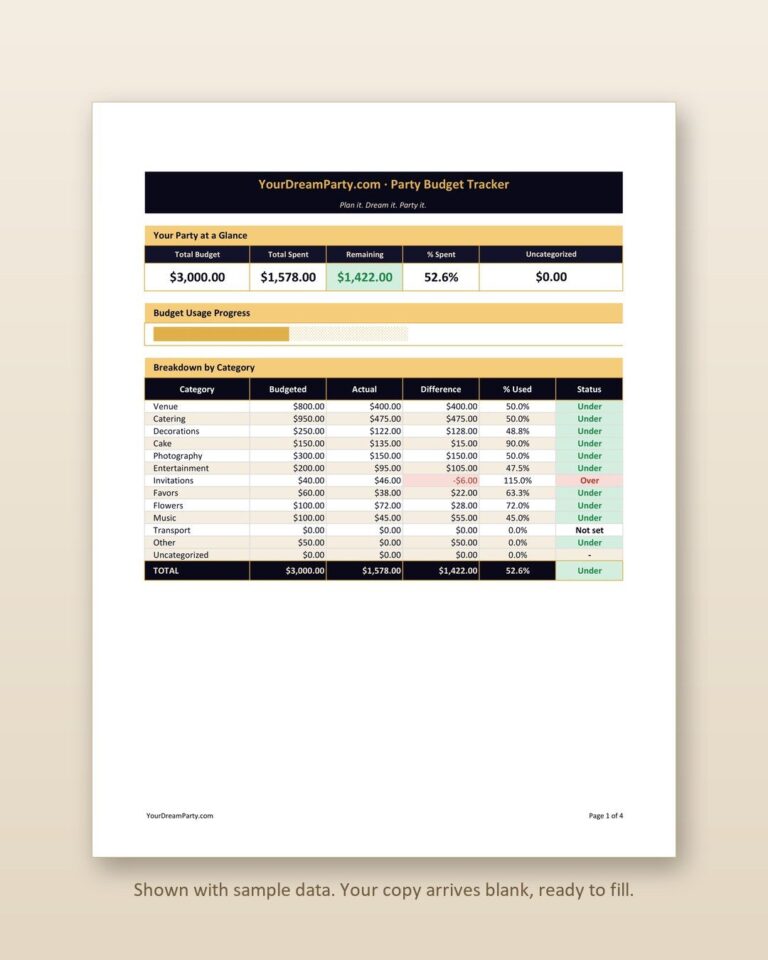
Break the budget into 6 categories. A clean budget splits across 6 categories: food and drink (40 percent), venue or rental (20 percent), decor (15 percent), entertainment (10 percent), favors and stationery (8 percent), and contingency (7 percent). Hosts who plan without a category split overspend on decor and come up short on food, because the split never got settled. The free Party Budget Calculator sizes its own per-category envelope from headcount and budget tier.
Give yourself enough lead time. A 6-to-8-week runway is the calm window for a mid-size adult event. Under 4 weeks forces express shipping on rentals, a smaller vendor pool, and rushed RSVPs. Over 12 weeks, the plan tends to drift and grow past what you set out to do. Match the lead time to the event: simple home gatherings work on 3-to-4 weeks, milestone events on 6-to-8 weeks, large milestones on 12-to-16 weeks, and weddings on 4-to-12 months. For the per-week checklist split, see the Party Planning Checklist Guide guide.
Match the venue to the format. Three venue formats cover most party hosting: the at-home format (your own space, 8-to-24 guests for adult formats), the rented hall or restaurant private room (20-to-60 guests for milestone events), and the outdoor or backyard format (10-to-50 guests, weather permitting). Confirm the venue 4 to 6 weeks ahead for weekend slots. For the paperwork behind any format, the Party Planning Templates guide lays out the 5 documents most hosts lean on.
Hold back a contingency. Reserve 5 to 10 percent of the budget for last-minute rentals, vendor upgrades, weather-driven shifts, or RSVP swings. Plan to the dollar with nothing held back, and you end up either dropping a finishing touch late or scrambling for cash on the day. Budget discipline gets a fuller treatment in the Party Budget Tips guide.
How Do You Set the Party Budget Before Sourcing?
After headcount, the budget is the single biggest decision, because it sets the ceiling for everything else. Five budget frameworks cover most party hosting across event types and budgets.
Size the total budget from your headcount. Per-guest math is the fastest way to right-size the total budget. Adult cocktail evenings run $40 to $80 per guest at home and $90 to $180 per guest at a venue; seated dinners run $70 to $150 per guest at home and $150 to $300 per guest at a venue; kid birthday parties run $20 to $60 per guest depending on age and format. Multiply the per-guest figure by headcount, then add 5 to 10 percent for contingency.
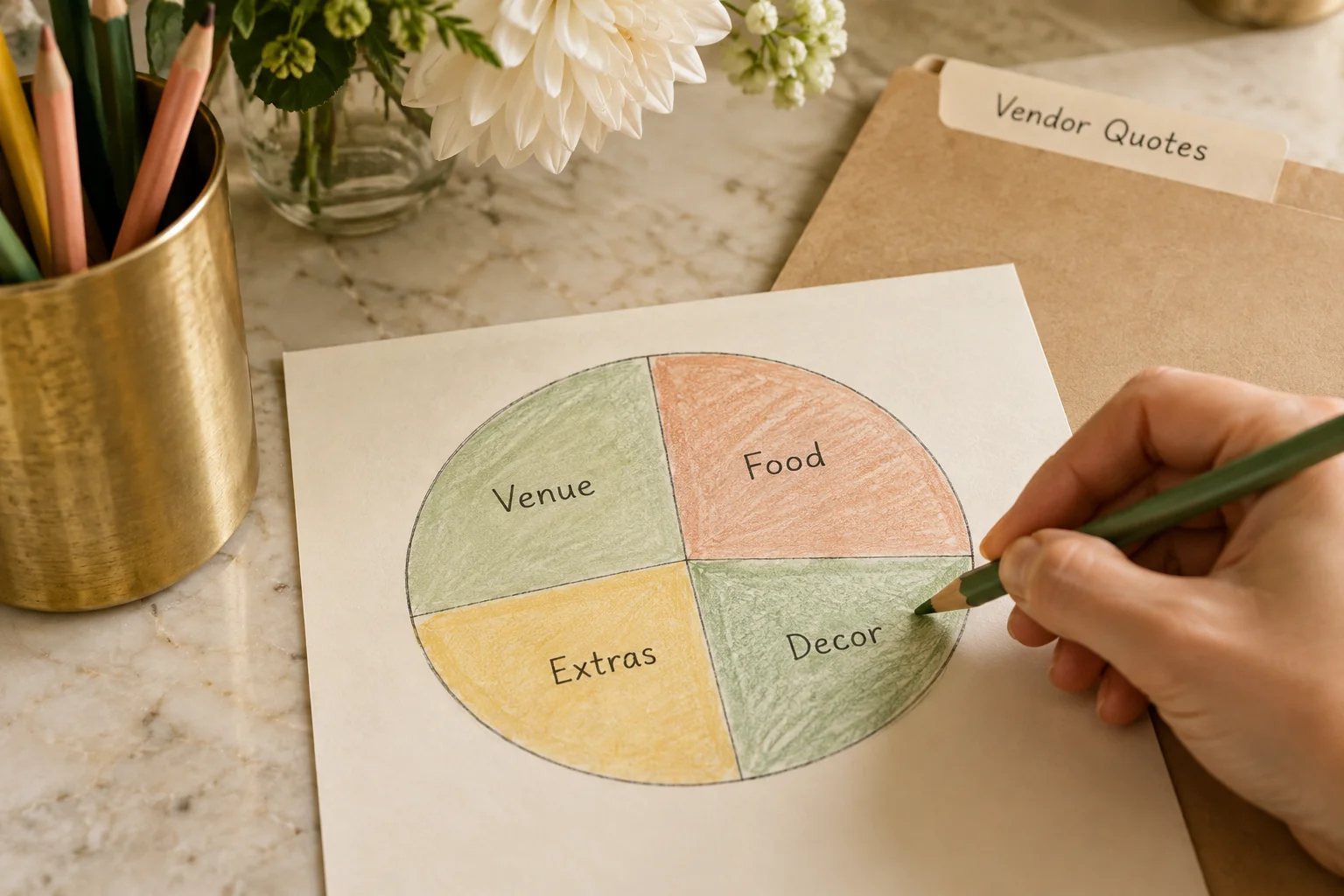
Split the budget across 6 categories. Food and drink takes the largest share at 40 percent of the total budget across most adult event formats. Venue or rental takes 20 percent for venue-format events (drops to under 5 percent at home). Decor takes 15 percent, entertainment (music, photographer, games) takes 10 percent, favors and stationery (invitations, signage, take-home tokens) takes 8 percent, and contingency holds the final 7 percent. Kid parties shift the split: the entertainment band rises to 20 percent (clowns, characters, activity rentals) and food drops to 30 percent. The free Party Budget Calculator returns a per-category envelope of its own, priced per guest from your headcount and a budget tier, in under 2 minutes.
Pick the right budget tier for the format. Three tiers cover most party planning: entry ($) covers a casual at-home party for under 20 guests at $490 to $640, mid ($$) covers a styled milestone event at home for 30 guests at $1,165 to $1,490, and premium ($$$) covers a venue-hosted milestone or a small wedding for 50 guests in a rented hall at $3,980 to $5,085. Each figure comes from the Party Budget Calculator, run for 3 to 4 hours, from scratch, with food as the priority, on its Budget-Friendly, Mid-Range and Premium tiers; for another guest count, venue or run time, run your own on the tier that fits. Weigh the milestone before picking the tier: a 40th birthday justifies premium, while a casual 25th at entry tier still feels like a polished Friday-night hosting. The Printable Party Planners guide sizes the printed set to the event, from 3 sheets for a small party to the full binder.
Build the vendor-quote spreadsheet. Once the category budgets are set, request 2-to-3 quotes per vendor category (caterer, venue, photographer, florist, rental house) so your plan lands inside the budget. Log every quote with the line items, the deposit amount, the cancellation policy, and the response time. A single quote gives no read on the market, which is how over-paying slips into a category unnoticed. The Party Planning Templates guide covers the budget sheet those quotes feed.
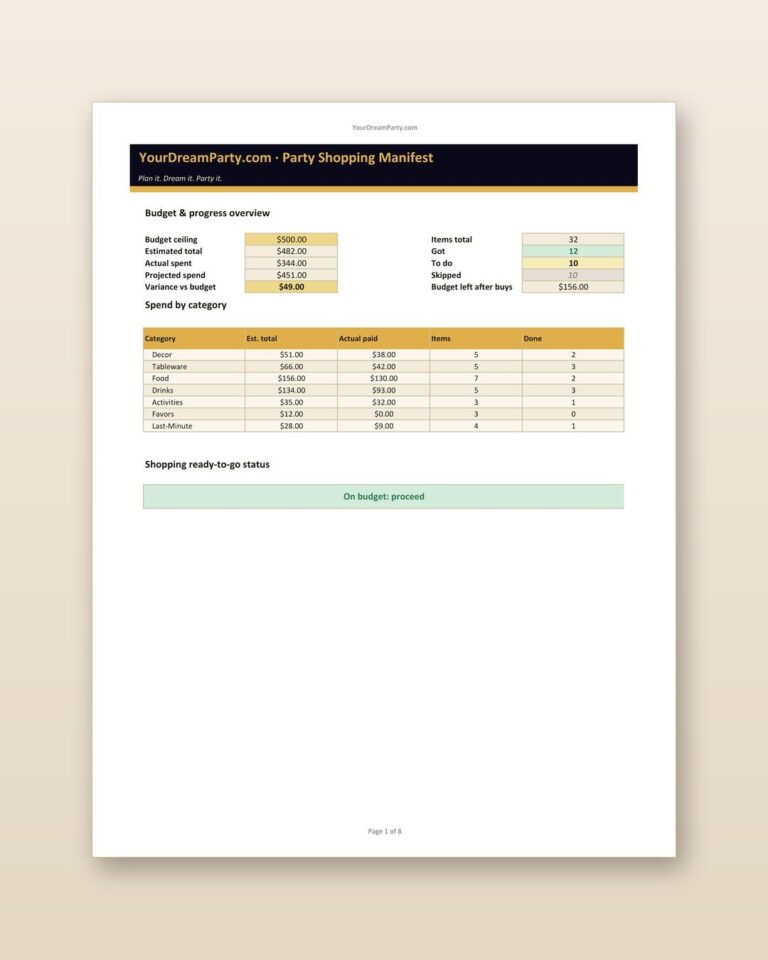
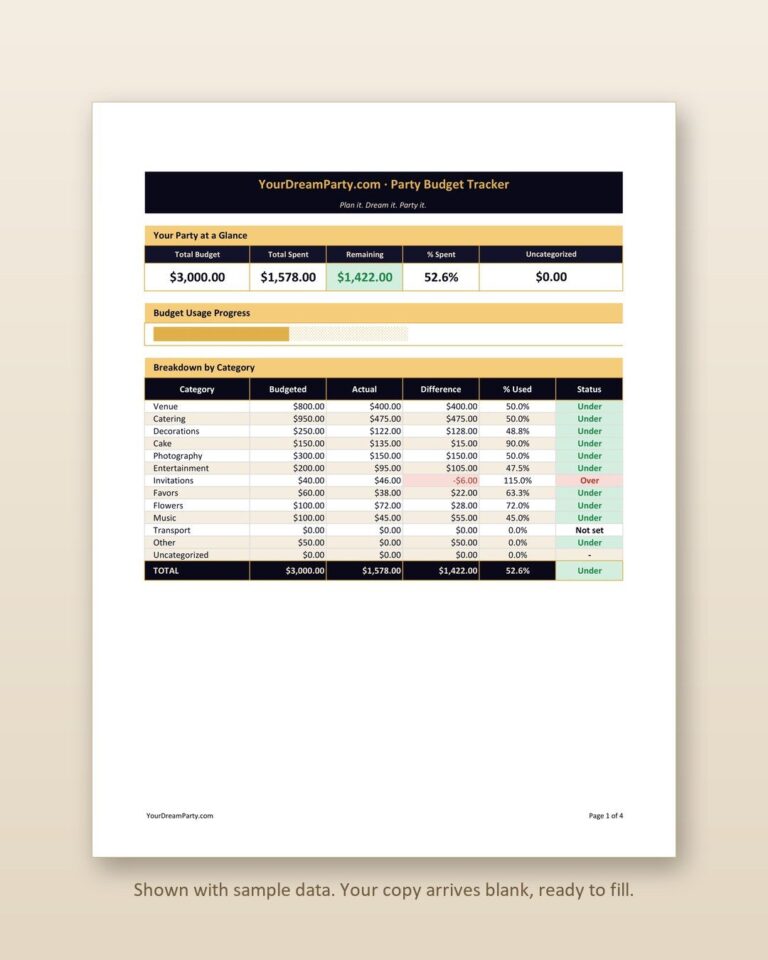
Track the spend against the envelope weekly. Set a weekly check-in (15 minutes) against the category envelopes from week 6 through day-of. Update the budget tracker after each booking and adjust the remaining envelopes if one category overspends. The Party Budget Tips guide covers spend discipline; the Birthday Party Ideas guide covers birthday-specific budgeting.
Build the Party Planning Timeline From 8 Weeks to Day-Of
The timeline sets the rhythm for the whole plan. The plan splits across 4 phases, the foundation phase (weeks 8 to 6 out, headcount, budget, save-the-dates), the sourcing phase (weeks 5 to 3 out, venue, vendor bookings, invitations), the execution phase (weeks 2 to 1 out, RSVP confirmations, supply order, menu lock), and the day-of phase (24 hours, hour-by-hour run sheet).
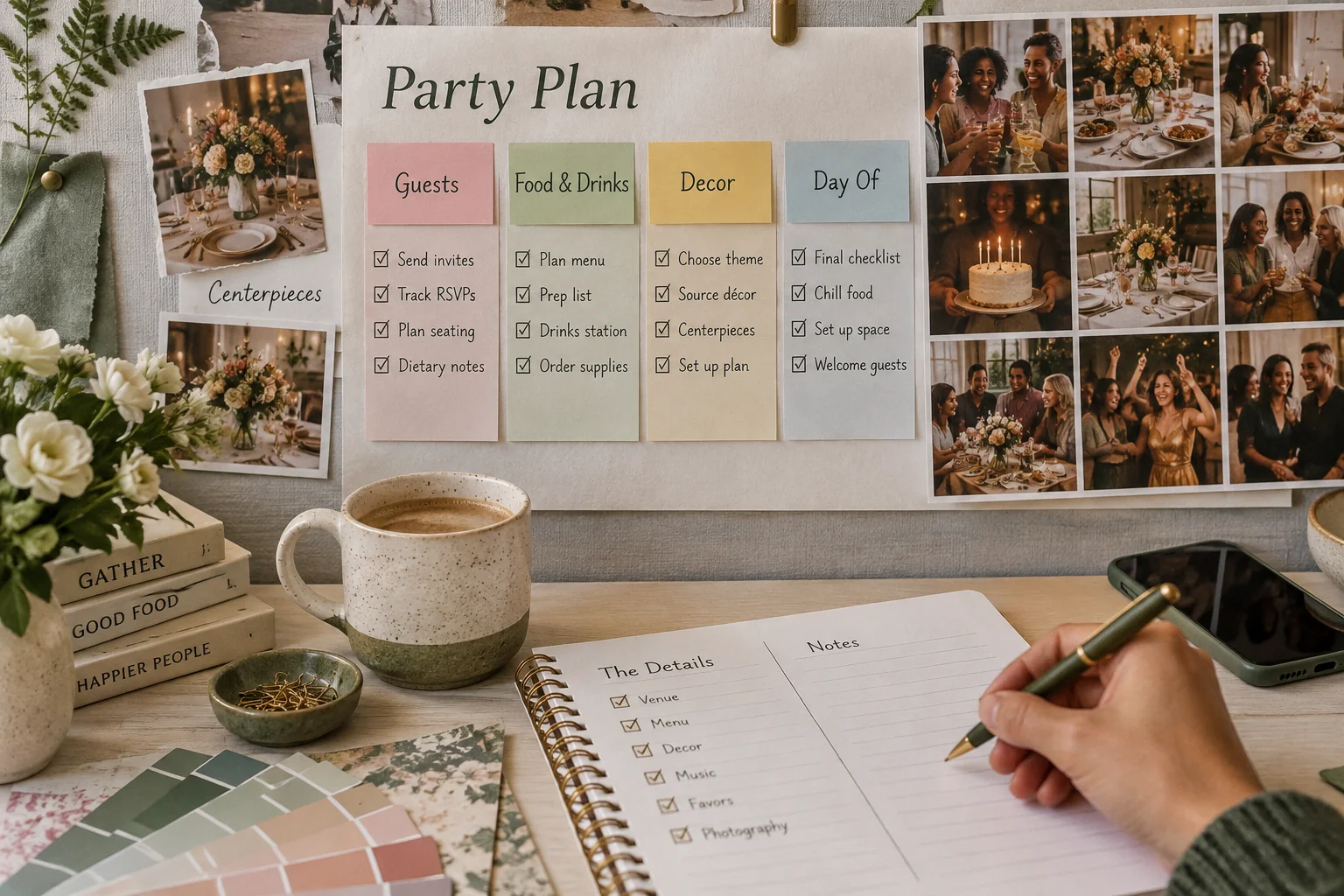
Foundation phase, weeks 8 to 6. Settle the headcount band, the budget envelope, the date, and the venue shortlist in the first 2 weeks of planning. Send save-the-dates by week 6 out for milestone events (skip for casual events under 30 guests). The free Party Planning Timeline returns a custom checklist tied to the event date and format, from 4 quick answers.
Sourcing phase, weeks 5 to 3. Book the venue, the caterer, the photographer, the florist, and any rental items (linens, china, chairs, marquee letters). Send invitations by week 4 out for adult formats (weddings mail theirs at the 8-week mark). Lock the decor palette and the activity plan against the venue and headcount. Order non-perishable supplies (balloons, paper goods, signage, favors) by week 3 out so palette-matched items arrive in time.
Execution phase, weeks 2 to 1. Confirm RSVPs by week 2 out (chase non-responders with a soft follow-up). Finalize the seating chart for seated dinners over 14 guests. Place the food order with the caterer or grocery list with the host. Print or pick up signage, menus, and place cards. Confirm vendor arrival times and pickup logistics. Lock the day-of run sheet by 5 days out.
Final week, day-of minus 7 to day-of minus 1. Pick up perishable florals 1 to 2 days ahead. Confirm vendor arrival windows. Inflate balloons within 24 hours of the event. Set up the venue or home space the morning of or evening before. Walk the venue with the day-of coordinator (host, family member, or hired coordinator) for a final layout check.
Day-of, hour-by-hour run sheet. Build a 4-to-6 hour run sheet that covers setup arrival, guest arrival window, food service, milestone moments (cake cut, speeches, photo set), entertainment, and send-off. The free Day-of Hour-by-Hour Timeline drafts a run sheet from 5 quick answers; the master per-week breakdown lives in the Party Planning Checklist Guide guide.
Adjust the runway for the event format. Compress to 3-to-4 weeks for casual at-home gatherings under 20 guests; expand to 12 to 16 weeks for large graduation parties over 50 guests and venue-hosted milestone birthdays. The Wedding Reception Ideas guide walks the wedding-specific 4-to-12-month runway.
Manage the Guest List and RSVP Tracker
The guest list and RSVP plan is what keeps your headcount accurate, and every later decision rides on it. Five sub-decisions cover most guest lists: the initial list build, the invitation send, the RSVP capture method, the dietary and accessibility data, and the seating or table plan.
Build the initial guest list. Start the list 6 to 8 weeks out with a draft band (target headcount plus 15 percent to account for declines). Group the list into tiers, tier 1 must-invite (immediate family, closest friends), tier 2 should-invite (extended family, close colleagues), and tier 3 optional-invite (broader social circle). If the venue capacity sets the headcount ceiling, drop tier 3 first. When you reach the invitation copy itself, the Invitation Wording Examples guide has wording for every format.
Pick the invitation send format. Three formats carry most party invitations, the printed paper invitation (mailed 4 to 6 weeks ahead for milestone events and 8 weeks ahead for weddings), the digital invitation (sent by email or through an online invitation service for casual events and modern milestone formats), and the group text or message (acceptable for small at-home gatherings under 12 guests). Always include the event name, date, time, venue address, RSVP deadline, RSVP method, and any dress code or dietary-flag prompt. The Birthday Party Invitation Ideas and Party Invitation Template Ideas guides cover the design-and-template shortlists.
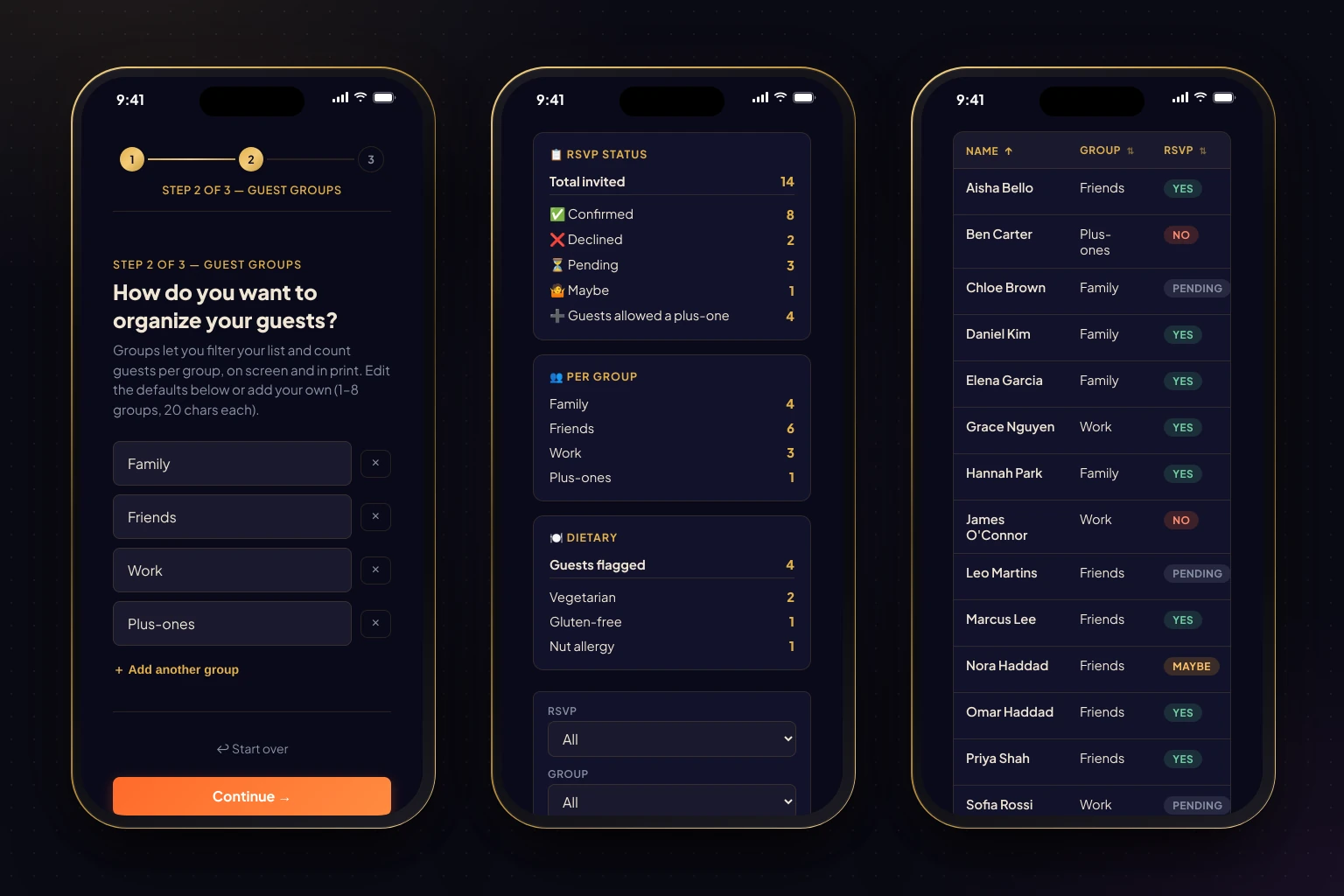
Set the RSVP deadline and capture method. Set the RSVP deadline 2 to 3 weeks before the event (4 weeks for weddings). Pick one capture method (digital form, dedicated email address, RSVP card, or text response) and stick with it. Chase non-responders with a soft follow-up 1 week before the deadline. The free Guest List & RSVP Tracker handles the dashboard view of confirmed, declined, and pending guests, with live counts and a one-click printable summary.
Capture dietary and accessibility data on RSVP. Add 3 optional fields to the RSVP form, dietary needs (vegetarian, vegan, gluten-free, nut-free, halal, kosher, dairy-free), accessibility needs (mobility, hearing, vision, seating), and plus-one details (name, dietary needs). Always check for food allergies before serving and label each dish with its ingredient list. Pass the dietary summary to the caterer 1 to 2 weeks ahead.
Plan the seating or table layout. For seated dinners over 14 guests, build a seating chart that groups guests by relationship, conversation potential, and accessibility needs. Use the Charcuterie & Tablescape Designer to style the tabletop itself, from layout zones to palette and props. Place a printed seating chart at the entryway and small place cards at each setting. For cocktail-format events, skip the seating chart and rely on natural mingling zones (bar, food station, photo corner).
Plan for late RSVPs and walk-ins. A few replies always land after the deadline, and an unannounced plus-one or two tends to walk in; order about 10 percent more food and rentals than the firm headcount so neither catches you short.
Lock the Venue, Layout, and Capacity
The venue and layout set the physical space that every styling, food, and traffic-flow decision has to work within. Six format-and-layout decisions cover most party planning.
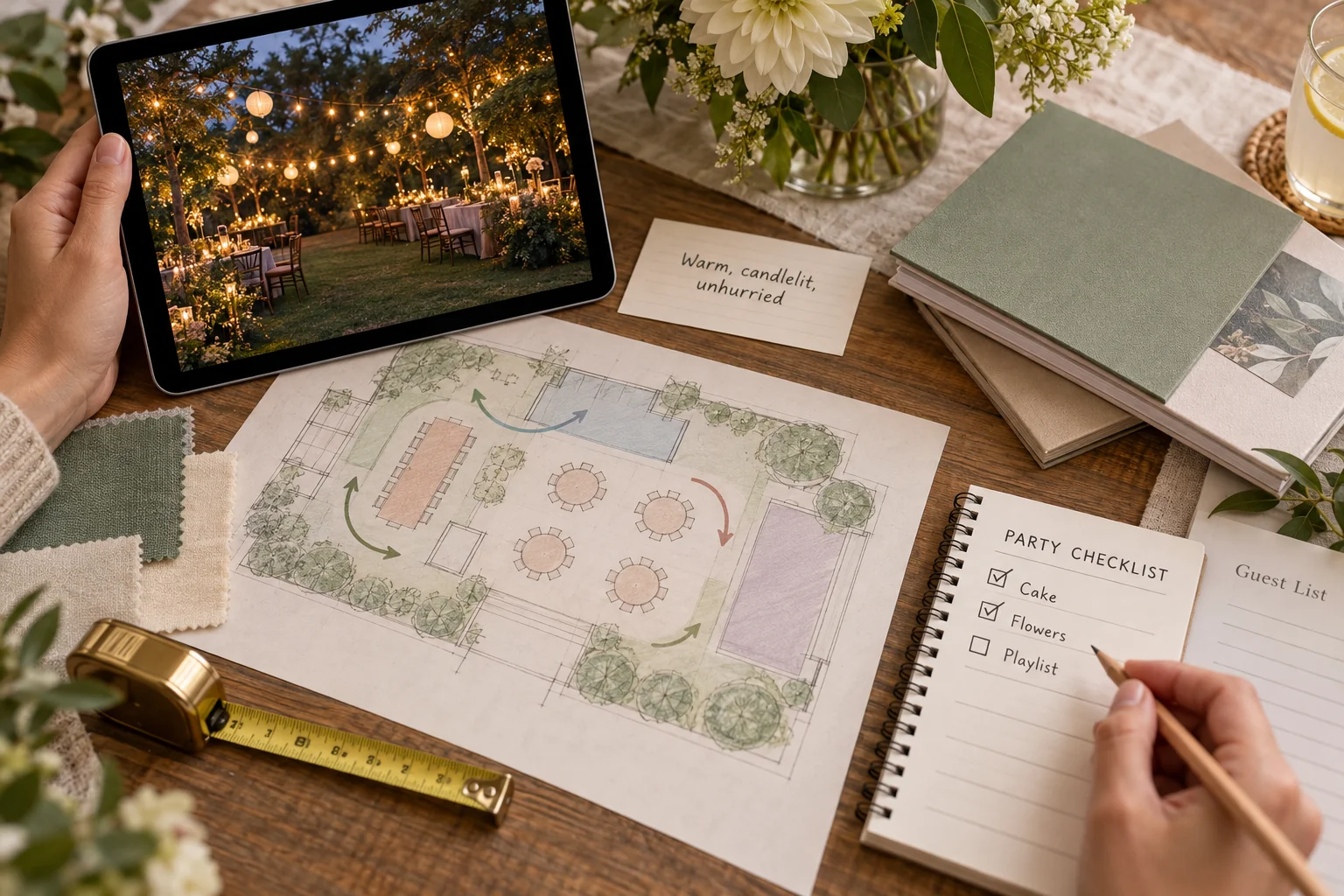
Pick the venue format. Three formats cover most party hosting, the at-home format (host's own space, 8 to 24 guests for adult formats, no rental cost but limited capacity and bathroom load), the rented venue (private room at a restaurant, banquet hall, event space, or community center, 20 to 60 guests with full-service options), and the outdoor format (backyard, park, beach, or rooftop, 10 to 50 guests, weather-contingent). If the celebration happens over a screen, the Virtual Party Planning guide handles the online-event format.
Right-size the capacity. Confirm the venue's max capacity before booking, then plan to comfort-capacity, a rule of thumb of 60 to 70 percent of that max. In a 50-capacity venue, that means seating a dinner for 30 to 35, or running a cocktail format at 40 to 45. Crowded venues feel rushed; right-sized venues feel calm and styled. The tropical-format outdoor version of this brief belongs to the Luau Party Ideas guide.
Plan the zone layout. Most party layouts break into 6 areas: the entryway and welcome spot, the main gathering or seating area, the bar or drink station, the food or buffet station, the photo or activity corner, and the bathroom or coat area. Allow 12 to 15 square feet per guest for cocktail formats and 18 to 22 square feet per guest for seated dinners. For the take-home bags by the door, the Party Gift Bag Ideas, From Keepsakes to Treats guide covers what goes inside.
Confirm the venue rental policy. Request the venue contract 4 to 6 weeks before the event and confirm the rental window (typically 5 to 8 hours), the setup and breakdown time, the corkage and outside-vendor policy, the parking and load-in logistics, the AV and lighting policy, and the cleaning fee. Skip venues that lock you into a single caterer if the price exceeds your envelope. The Best Event Planning Templates roundup carries the per-template shortlist.
Plan parking and accessibility. Confirm guest parking at the venue (street, lot, valet) and accessibility (wheelchair access, step-free entry, accessible bathrooms). Include parking and accessibility info on the invitation or RSVP confirmation. For at-home parties, share the address with a parking note ("street parking available", "use rear driveway", "garage access through the side gate"). The Printable Party Planners guide has a guest-list sheet that tracks each reply.
Confirm the venue walk-through 1 week ahead. Visit the venue 5 to 7 days before the event with the day-of coordinator (host, family member, or hired coordinator). Walk the load-in path, confirm outlet placement, photograph the room for the layout sketch, and measure dimensions if any rental item (backdrop, tablescape, dance floor) needs an exact fit. The Wedding Reception Ideas guide walks through venue decoration.
Plan the Food and Drink Quantities
The food and drink plan carries the largest share of the budget across most party formats, and it moves guest happiness more than anything else. Five sub-decisions cover most party food: the format (seated, cocktail, grazing, buffet), the per-guest quantity math, the dietary accommodation, the drink program, and the timing across the event window.
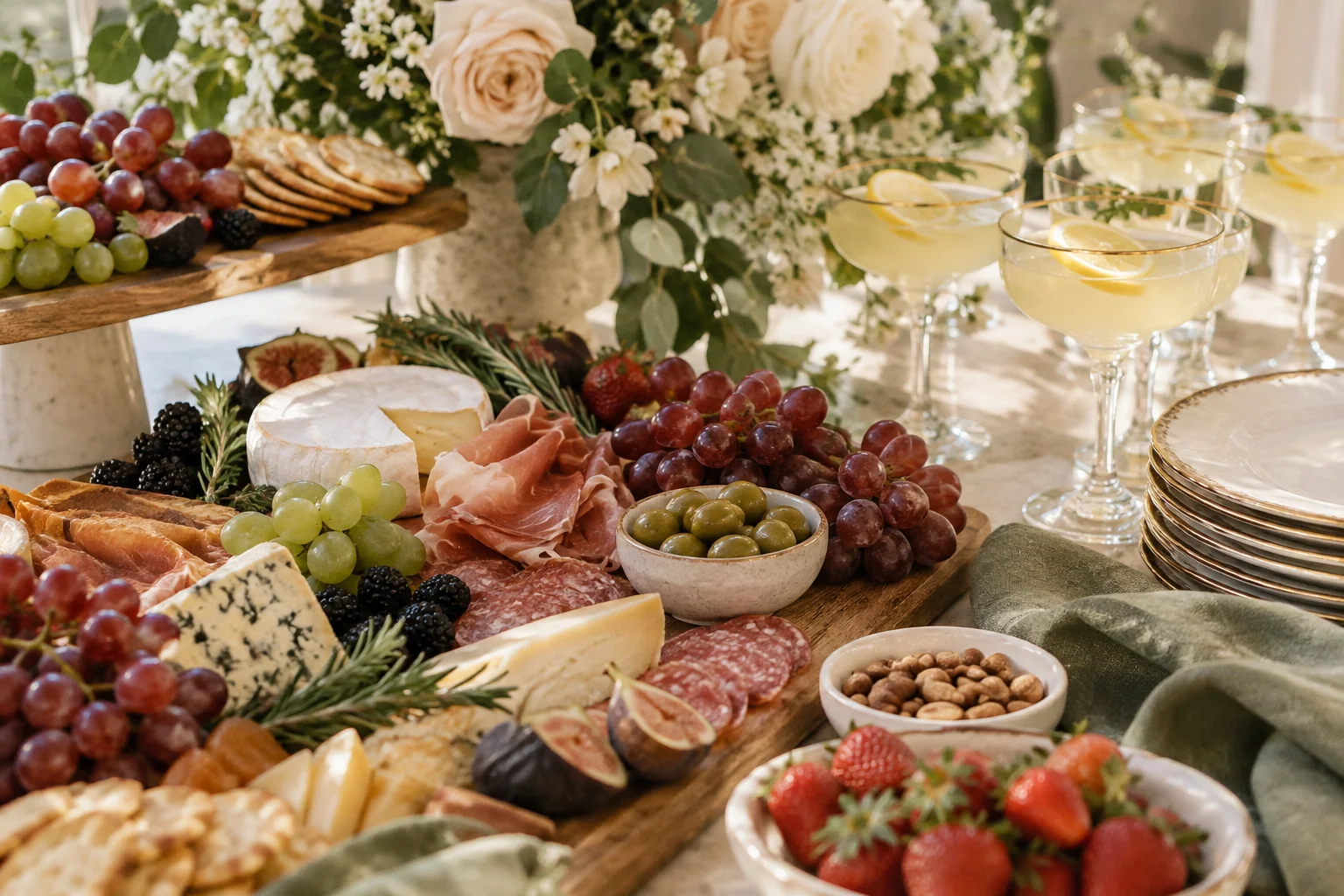
Pick the food format. Three formats cover most party food: the seated dinner (plated courses served to seated guests, 14 to 40 guest comfort window), the cocktail or grazing format (standing or scattered seating, charcuterie boards, passed appetizers, station-based food, 20 to 60 guest comfort window), and the buffet (self-service across a buffet table, 30 to 100 guest comfort window). Pick the format to fit the venue, headcount, and budget.
Plan the per-guest quantity. Cocktail-format hosting needs 8 to 10 appetizer pieces per guest across a 3-hour window; seated dinners need 1 appetizer course (3 to 4 pieces), 1 main course (1 protein with 2 sides), and 1 dessert; buffets need 1.5 portions per guest across each food category to handle second servings. Plan about 2 drinks per guest in the first hour and 1 per guest each hour after, alcoholic and non-alcoholic counted together. Favor-quantity math follows the same per-guest logic; the Party Favor Quantity Guide guide runs those numbers.
Plan for dietary needs. Pass the dietary summary from the RSVP tracker to the caterer or grocery list 1 to 2 weeks ahead. Plan one explicit vegetarian or vegan main option, label every dish with a one-line ingredient flag (gluten-free, contains nuts, vegan, dairy-free), and keep separate serving utensils for allergen-flagged items. Always check for food allergies before serving and label each dish with its ingredient list.
Build the drink program. Three drink setups cover most adult event formats: the full bar (beer, wine, spirits, soft drinks, mixers, 30 to 60 guests), the signature cocktail plus wine and beer (2-cocktail menu, simpler service, 14 to 40 guests), and the no-alcohol or low-alcohol option (coffee, mocktails, sparkling water, juice, family-friendly events, kid parties, daytime gatherings). Source 1.5 glasses per guest per drink type for cocktail format (guests cycle through more than one drink). The Holiday Party Ideas guide covers the holiday-specific drink-menu brief.
Time the food service across the event. A 3-hour adult cocktail event runs 3 food waves, appetizers at arrival (first 30 minutes), main passed food at the 60-to-90 minute mark, and dessert plus coffee from minute 120 onward. A seated dinner runs one course every 30 to 40 minutes (appetizer, main, dessert in a 90-minute eating window). Schedule the cake-cut moment 45 to 60 minutes before the planned end of the event so guests are still in attendance.
Confirm the caterer or grocery plan 5 to 7 days out. Place the caterer order 2 to 3 weeks ahead and confirm the final headcount and dietary summary 5 to 7 days out. For self-catered events, build the grocery list against the per-guest quantity math and shop 3 to 5 days ahead for non-perishables and 1 to 2 days ahead for perishables. The Baby Shower Ideas guide walks through brunch-and-shower food; the Baby Shower Favors guide covers favors and take-homes.
Build the Day-Of Hour-by-Hour Run Sheet
The day-of run sheet turns a planned event into a calm, well-paced experience. The run sheet covers 4 blocks, the setup window (vendors and host arrival, decor install, food prep), the guest arrival window (welcome moment, first drink, mingling), the milestone moments (cake cut, speeches, photo set, gift exchange), and the send-off window (final dessert, favor distribution, vendor breakdown).
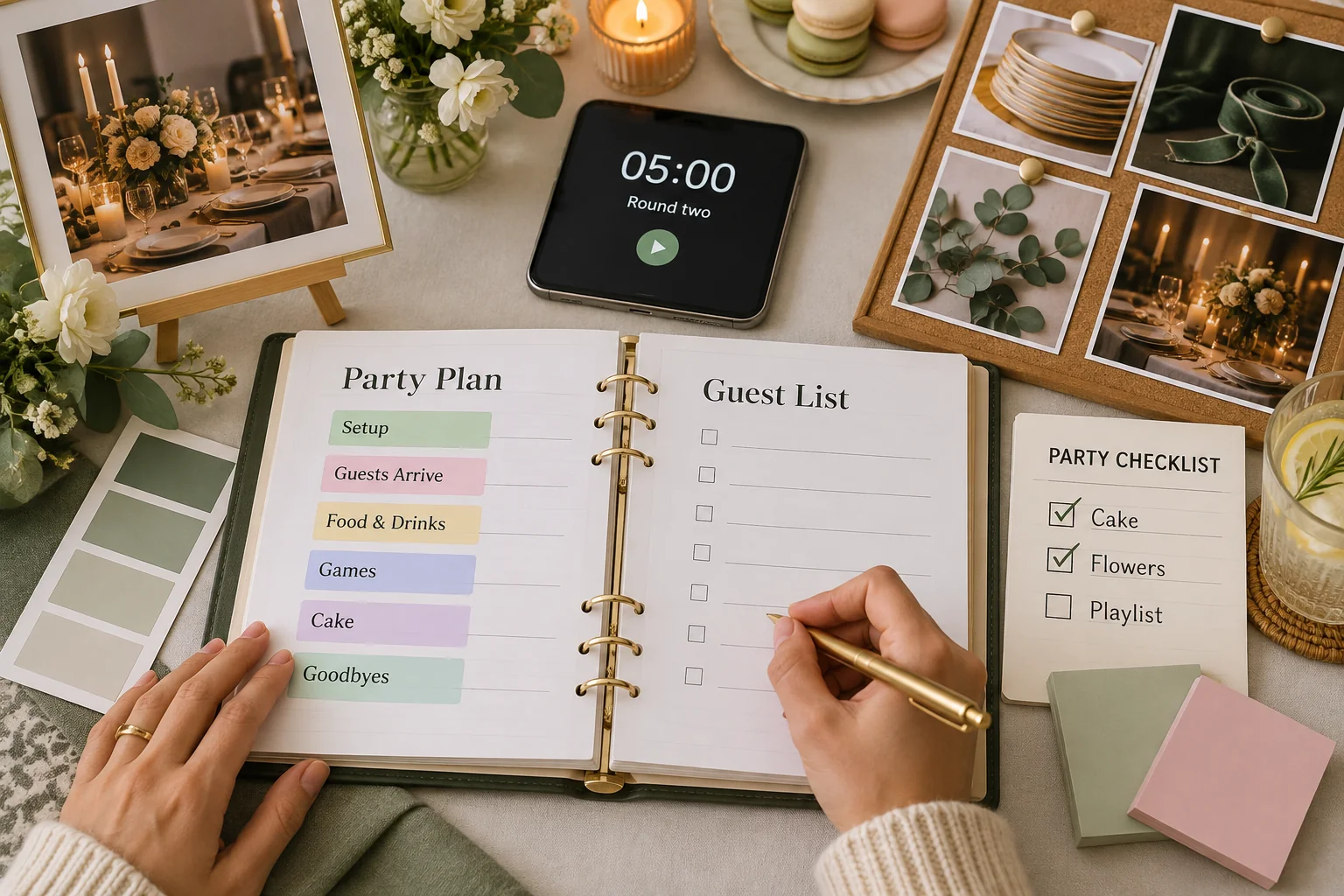
Build the setup block, 2 to 4 hours before guest arrival. Vendors and rental delivery arrive first (linens, china, florals, photo booth). Decor install runs next (balloon garland, centerpieces, signage, lighting). Food prep follows (charcuterie boards, drink station, ice). Host walks the room 30 minutes before guest arrival for a final check (signage clear, candles lit, music started, bar stocked). The free Day-of Hour-by-Hour Timeline counts a setup block back from your start time, with an arrival slot for each vendor you pick.
Plan the guest arrival window, first 30 to 45 minutes. Welcome guests at the door with a hosted moment (greeter, name tags for milestone parties over 30 guests, drink hand-off). Direct guests to the bar and appetizer station so the mingling rhythm starts. Music sits at a conversational level (60 to 70 decibels) during the arrival window so guests can talk without raising their voices.
Schedule the milestone moments. Three milestone moments anchor most party formats, the cake cut (45 to 60 minutes before the planned end of the event), the speech or toast moment (mid-event, 60 to 90 minutes in), and the photo set (group photo at the 90-to-120-minute mark, before guests start leaving). Build a 15-minute buffer around each milestone for natural conversation overflow.
Manage the food and drink service rhythm. Food waves come every 30 to 45 minutes for cocktail formats; seated dinners run courses every 30 to 40 minutes. Refill the bar and water stations every 30 to 45 minutes (assigned to one specific person, not a rotating volunteer). Restock napkins and clear used plates throughout the event so the room never tips into clutter.
Plan the send-off and breakdown window. A 30-minute send-off window covers final dessert, favor distribution, and guest departures. Music shifts to a lower-energy playlist 30 minutes before the end. Confirm vendor breakdown timing (rentals picked up same-night for restaurants, next-morning for home or hall venues). Take-home and favor-distribution details split across the Party Favors for Adults and Birthday Party Favor Ideas by Age guides.
Assign one day-of coordinator. Pick one person (the host, a family member, a hired event coordinator) to hold the run sheet on the day. The coordinator runs the time-check at every 30-minute mark, redirects rhythm if a milestone slips, and stays calm so the host can enjoy the event. For events over 30 guests, hire a coordinator at $250 to $600 for 4 to 6 hours. The cost fits inside the contingency budget and frees the host to be with guests.
Coordinate Vendors, Rentals, and Suppliers
Vendor coordination is what holds everything together once the planning decisions are locked. Five vendor categories run across most party formats: the caterer or food vendor, the photographer or videographer, the florist, the rental house (linens, china, chairs, marquee letters, photo booth), and the entertainment (DJ, band, character performer, activity host).
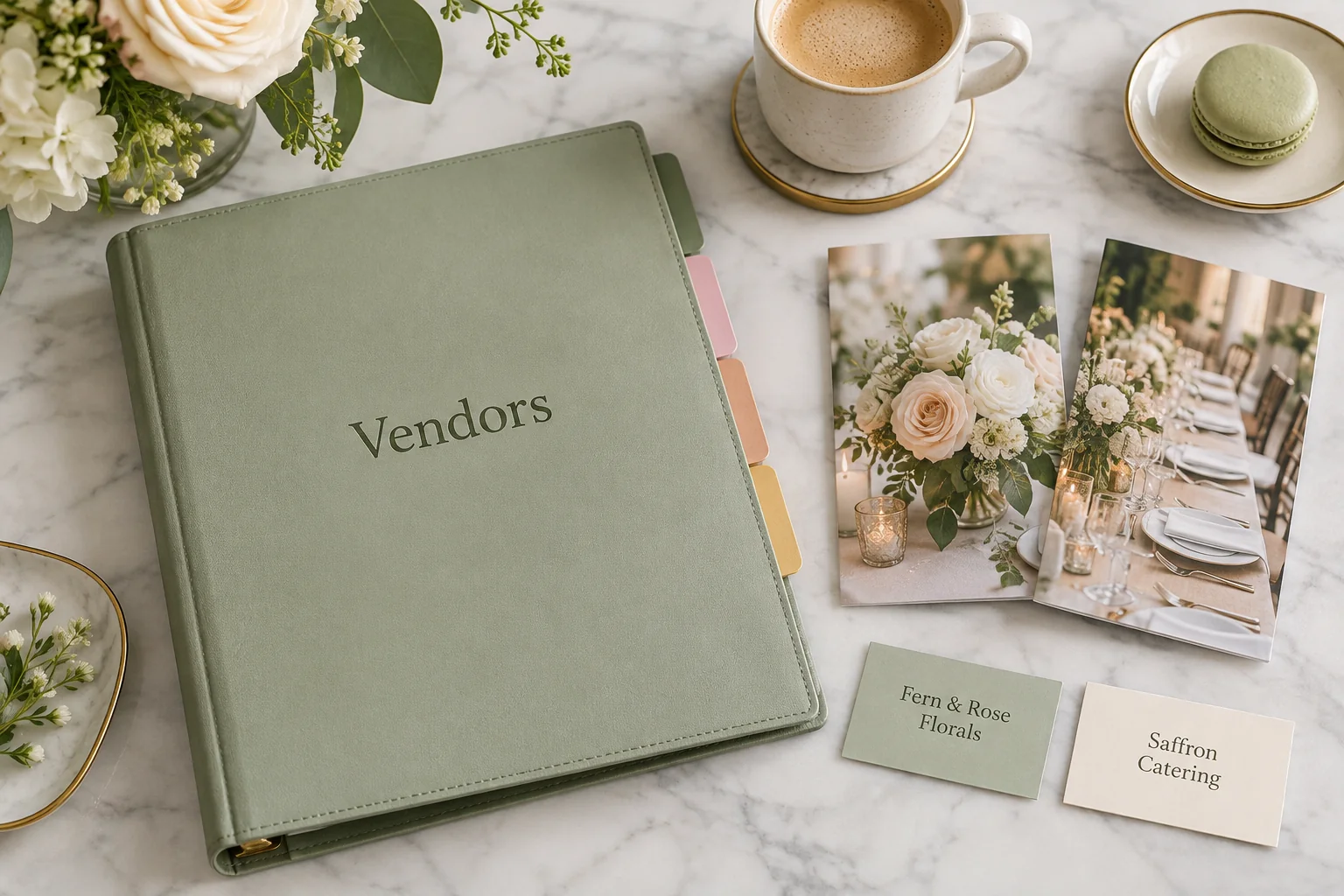
Build the vendor list against the format. Confirm which vendor categories the event needs (a 14-guest at-home cocktail event may need zero vendors; a 50-guest backyard graduation may need 4 to 5). The Party Planning Checklist Guide guide places the cake order and the rentals in their planning phase. The Goodie Bag Ideas and Gift Bag Ideas by Size, Material and Color guides cover the favor bags themselves.
Request 2 to 3 quotes per category. Source vendor quotes 4 to 6 weeks ahead (8 to 10 weeks for weddings and large milestone events). Log each quote with the line items, total cost, deposit amount, cancellation policy, response time, and inclusions. Skip vendors that take more than 5 business days to respond; the day-of communication will be worse.
Confirm the vendor contracts in writing. Every vendor booking needs a signed contract or written email confirmation with the date, time, scope of work, total cost, deposit paid, cancellation policy, and a clause covering weather, illness, or a venue cancellation. Pay deposits via traceable methods (credit card, bank transfer, signed check), and skip cash deposits for vendors over $200.
Coordinate vendor arrival and load-in. Build a vendor arrival schedule that staggers load-in by 15-to-30 minute windows so the venue doesn't bottleneck. Rental delivery and the florist arrive first, as the setup block opens 2 to 4 hours before guest arrival; the caterer follows once the decor install is done, and the photographer or DJ lands 30 minutes before the welcome window. The Goody Bag Ideas and Gift Bag Ideas by Size, Material and Color guides cover the take-home logistics.
Plan the vendor day-of communication. Share the vendor contact list with the day-of coordinator and confirm vendor cell numbers, arrival ETAs, and breakdown timing 24 hours ahead. Schedule a 15-minute check-in with vendors 30 to 60 minutes before guest arrival so everyone knows how the day flows. For disposable plates, the Birthday Plate Ideas guide shortlists themed sets.
Build the post-event vendor follow-up. Confirm vendor breakdown timing and pickup logistics with each vendor 24 hours after the event. Settle remaining balances within 7 days. Send thank-you notes or reviews to vendors who delivered well (referrals carry the booking economy for vendors). The Party Planning Checklist Guide guide puts the returns and thank-yous on the checklist's wrap row.
Party Planning by Event Type and Budget Tier
Each event type has its own feel, adapting the same 7 decisions to the audience, the occasion, and the budget. Six event guides cover most party hosting across the calendar.
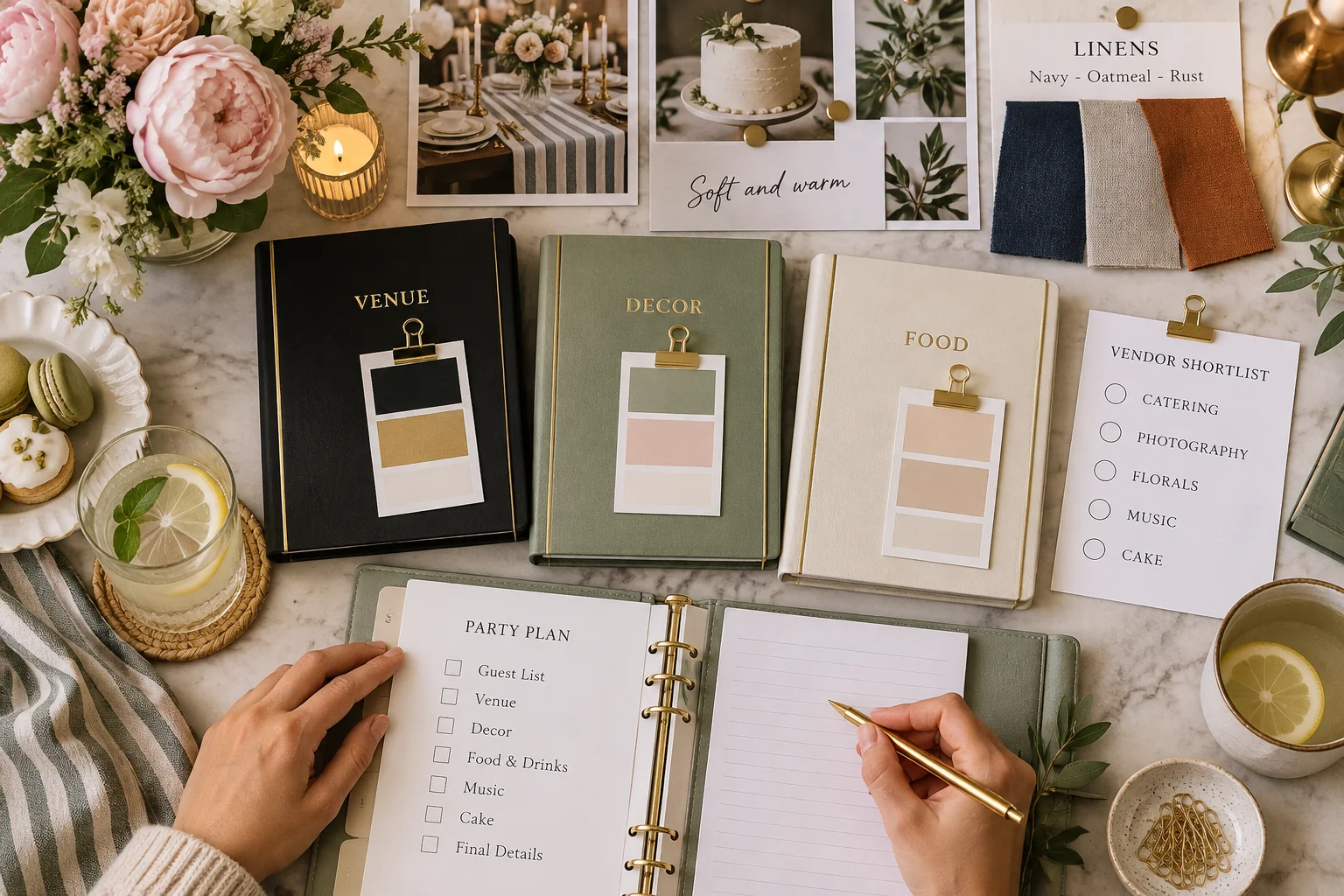
Birthday parties. Birthdays split across age brackets and milestone moments. For under-10 kids, the plan tilts to an event window that grows with age (60 to 75 minutes for 2- and 3-year-olds, up to 2.5 hours at age 9), an activity-led format (games, characters, crafts), and a per-guest budget of $20 to $60. For teens and young adults, the plan covers a photo-led format with a backdrop and signature drinks. For 30th and 40th milestones, the plan sits in a 3-to-4 hour cocktail format with a styled bar moment and milestone-number signage. For 50th-and-up milestones, the plan moves to seated-dinner formats at venues. The Birthday Party Ideas guide covers birthdays more broadly; the Kids Party Ideas guide covers planning for kids.
Baby showers and gender reveals. Baby showers have the softest feel of any event: a 2-to-3 hour brunch or afternoon-tea format, 15 to 30 guests, a pastel palette, games and activities (diaper raffle, advice cards, well-wishes), and a registry-led gift moment. Gender reveal events add a single reveal moment (color powder, balloon-pop, cake-cut) with the room styled neutral until the reveal. The full event playbook sits in the Baby Shower Ideas guide.
Weddings and bridal showers. Wedding planning is the longest-runway event type at 4 to 12 months. The plan splits across the engagement window (vendor sourcing, venue lock), the styling window (decor, menu, music, attire), and the execution window (final headcount, seating chart, day-of run sheet). Bridal showers carry a softer 6-to-8 week version of the wedding planning runway. The Wedding Reception Ideas guide walks through reception planning; the Bridal Shower Ideas guide covers the shower format.
Bachelorette parties. Bachelorette planning covers a 1-to-3 day event window with a destination or weekend format. The plan splits across destination booking (flight, hotel, restaurant reservations), activity blocks (spa day, dinner, club night, daytime brunch), and the per-guest-cost coordination (shared expenses, individual extras). The Bachelorette Party Ideas guide covers the full destination-and-weekend plan.
Graduation and milestones. Graduation parties carry a backyard-cookout or banquet-hall format with a memory-lane photo display and a future-plans signage moment. The plan covers a 4-to-6 week runway, a per-guest budget of $25 to $60, and a 3-to-5 hour event window. For planning by school level, the Graduation Party Ideas guide goes deeper.
Seasonal and holiday parties. Holiday planning adapts the same 7 decisions to the calendar event. Christmas and Thanksgiving events tilt to seated-dinner formats with multi-generational guest lists; Halloween and 4th of July tilt to outdoor or themed-format hosting. The Holiday Party Ideas guide covers per-holiday planning; the Party Decoration Ideas guide covers seasonal decor.
How the Party Budget Calculator and Companion Tools Carry the Plan
The Party Budget Calculator is a free tool that returns a per-category budget envelope from headcount and budget tier in under 2 minutes. The tool prices 8 categories from per-guest rates (food, drinks, decorations, entertainment, photography, favors, cake, and venue), lifts whichever categories you mark as priorities, adjusts the whole envelope for venue type, run time, and the supplies you already own, then adds a contingency row at 5 percent. The point of running it before you call the first vendor is that the category caps are already in place to keep spending from creeping up.
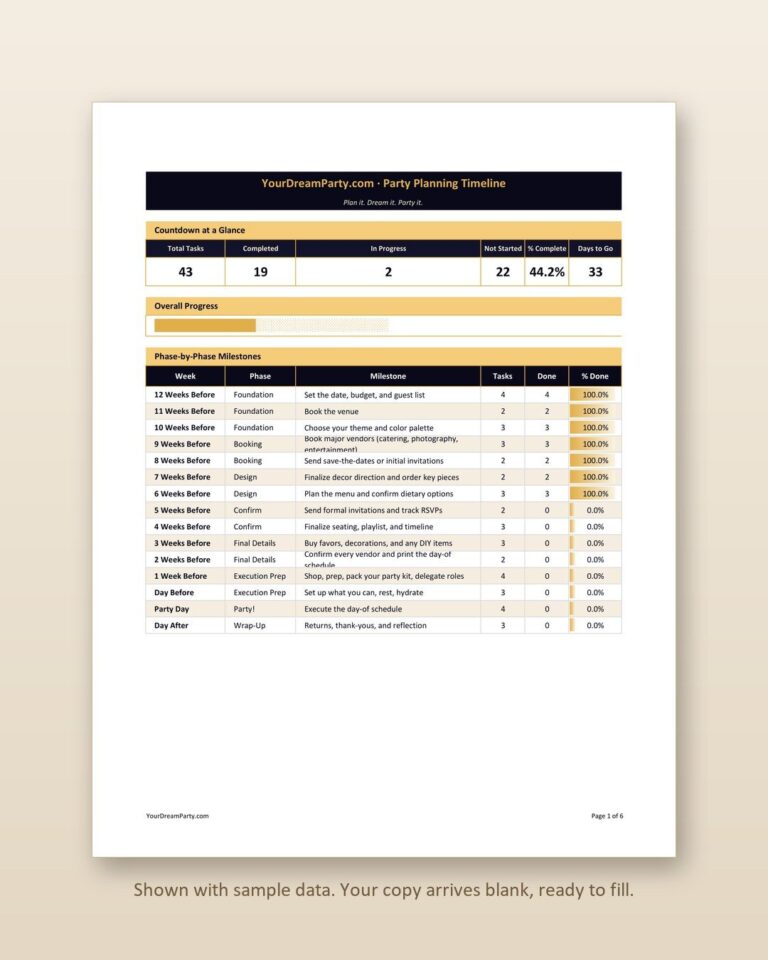
The Party Planning Timeline drafts a per-week checklist tied to the event date and format in under 90 seconds. On a Standard or Elaborate plan the tool covers the 8-week, 6-week, 4-week, 2-week, 1-week, 3-day, day-before, and day-of milestones with task-level detail (book venue, send invitations, confirm headcount, book the caterer, pick up florals). Drop in the event type, date, headcount, and complexity (simple, standard, or elaborate), and the timeline returns a printable checklist plus calendar-ready reminders. The free Day-of Hour-by-Hour Timeline is the separate companion for the event day itself, a run sheet timed from your start time.
The Guest List & RSVP Tracker holds the headcount accuracy through the planning runway. The tracker captures guest names, RSVP status, 8 dietary flags, whether a plus-one is allowed, and a free-text note per guest for accessibility or travel, in one dashboard with confirmed-vs-declined-vs-pending summaries. Hosts who run the tracker from week 6 onward avoid the late-RSVP scramble and pass a clean dietary summary to the caterer 1 to 2 weeks ahead.
The Invitation & Sign Wording Generator drafts invitation copy, RSVP wording, welcome-sign text, and save-the-date wording in under 2 minutes. The tool returns 4 copy variants per surface so the wording matches the event's tone. Feed it the surface, the event type, the tone (formal, warm, playful, elegant, bold, heartfelt), the key details such as host, date, time, and venue, any optional lines, and a card style for the preview. Switching surfaces on the results screen keeps your details, which gives you a coordinated set of copy across invitations, signage, and printed materials.
Run the 4 tools in sequence: the budget calculator sets the category budgets, the planning timeline schedules the weeks, the guest list and RSVP tracker holds the headcount, and the wording generator handles the copy across invitations and signage. Hosts who run all 4 in one evening walk away with a full party plan. For hosts who want the whole thing in one guided pass, the free Complete Party Planning Mega-Wizard walks all 8 planning phases, from event basics to day-of logistics, and builds the master plan in a single flow. The Party Games & Activities hub covers the games and activities that pair with your plan; the Party Decoration Ideas guide covers the decor that builds on the planning foundation.
Frequently Asked Questions
How far in advance should I start party planning?
Start party planning 6 to 8 weeks ahead for a mid-size adult event (20 to 40 guests), 3 to 4 weeks ahead for a casual at-home gathering under 20 guests, 12 to 16 weeks ahead for large graduation parties over 50 guests, and 4 to 12 months ahead for weddings. Anything under 4 weeks means express shipping on rentals and a thinner vendor pool; for a mid-size event, anything past 12 weeks lets the plan drift while extras pile on. The free Party Planning Timeline builds a custom checklist around your date and format from 4 short questions.
What is the right party budget per guest?
Budget $40 to $80 per guest for an adult cocktail evening at home, or $90 to $180 at a venue. A seated dinner needs $70 to $150 per guest at home and $150 to $300 at a venue, while kid birthday parties sit between $20 and $60 per guest depending on age and format. Take the per-guest figure times your headcount, then add 5 to 10 percent for contingency. Collecting a second and third vendor quote is the simplest guard against an inflated envelope.
How do I split the party budget across categories?
Food and drink takes the biggest slice at 40 percent, followed by venue or rental at 20, decor at 15, entertainment at 10, favors and stationery at 8, and contingency at 7. For kid parties, move entertainment up to 20 percent and trim food to 30. Wedding receptions push venue toward 30 percent and decor toward 20. The free Party Budget Calculator turns a headcount and a budget tier into a category-by-category envelope of its own in a couple of minutes.
How many guests should I invite to fit a venue capacity?
Work from comfort-capacity, roughly 60 to 70 percent of the venue's stated maximum, rather than the maximum itself. Translated to a 50-capacity room: 30 to 35 guests for a seated dinner, 40 to 45 for a cocktail format. A room at its limit makes the night seem rushed; one with headroom keeps it calm. As a floor-space check, give each guest 12 to 15 square feet at a cocktail event and 18 to 22 at a seated dinner.
When should I send party invitations and set the RSVP deadline?
Send printed paper invitations 4 to 6 weeks ahead for milestone events and 8 weeks ahead for weddings (12 to 14 weeks for destination weddings). Send digital invitations 3 to 4 weeks ahead for casual and modern milestone formats. Put the RSVP deadline 2 to 3 weeks out (4 for weddings), and nudge anyone who has not replied about a week before it passes. The free Guest List & RSVP Tracker keeps confirmed, declined, and pending guests visible on one dashboard.
How much food and drink do I need per guest?
For a 3-hour cocktail format, count 8 to 10 appetizer pieces per guest. A seated dinner works out to 1 appetizer course (3 to 4 pieces), 1 main (a protein with 2 sides), and 1 dessert. Buffets want 1.5 portions per guest in each food category to absorb second helpings. On drinks, figure about 2 per guest in the first hour and 1 an hour after that, soft drinks included, and stock 1.5 glasses per guest per drink type to cover rotation.
How do I handle dietary needs and food allergies at a party?
Give the RSVP form 3 optional fields: dietary needs (vegetarian, vegan, gluten-free, nut-free, halal, kosher, dairy-free), accessibility needs (mobility, hearing, vision, seating), and plus-one details. Hand the dietary summary to the caterer 1 to 2 weeks ahead, build at least one vegetarian or vegan main into the menu, flag every dish with a one-line ingredient note, and give allergen-flagged items their own serving utensils. Always check for food allergies before serving.
What does a day-of party run sheet look like?
Four blocks. A setup window opens 2 to 4 hours before guests arrive for vendor load-in and decor install; the arrival window covers the first 30 to 45 minutes with the welcome moment and first drink; the milestone moments follow (cake cut, speeches, photo set, with the group photo around the 90-to-120-minute mark); and a 30-minute send-off closes out dessert, favors, and departures. One person should own the sheet from setup through breakdown. The free Day-of Hour-by-Hour Timeline drafts a run sheet from your event type, start time, run length, key moments, and vendors.
How many vendors do I need for a party?
It depends on the format. An at-home cocktail evening for 14 can run vendor-free, a 30-guest milestone birthday at a venue usually wants 2 to 3 (caterer, photographer, sometimes a florist), a 50-guest backyard graduation climbs to 4 or 5 once rentals and entertainment join, and a wedding reception runs 6 to 10. Whatever the count, collect 2 to 3 quotes per category starting 4 to 6 weeks out (8 to 10 for weddings).
Should I hire a day-of coordinator?
For events over 30 guests, yes. At $250 to $600 for 4 to 6 hours, a hired coordinator takes vendor load-in, the milestone schedule, and the time-checks off the host's plate, which frees the host to actually be with guests. Fund the fee from contingency. Under 30 guests, the host or a designated family member can carry the role.
How do I plan a party on a tight budget?
Settle the format first. An entry-tier budget ($490 to $640) can look genuinely polished when the headcount stays tight (under 20 guests), the venue is your own home (zero rental cost), and the food is grazing or casual, charcuterie boards plus a signature drink instead of a full bar. Pass on the imported decor haul in favor of DIY pieces (balloon garland, fresh greenery), a chalkboard welcome sign, and digital invitations. The next tiers up run $1,165 to $1,490 for a mid-tier party of 30 guests at home and $3,980 to $5,085 for a premium party of 50 guests in a rented hall. Run the free Party Budget Calculator to size the per-category split for your guest count and budget tier.
What is the difference between a planning timeline and a day-of run sheet?
A planning timeline covers the 8-to-1 week runway with phase-level tasks (book venue, send invitations, confirm headcount, order food). A day-of run sheet covers the 4-to-6 hour event window with hour-by-hour detail (setup arrival, guest arrival, food service, milestone moments, send-off). The two work in tandem: one paces the weeks, the other paces the hours. The free Party Planning Timeline takes the runway side; the free Day-of Hour-by-Hour Timeline takes the event day.
Ready to Plan Your Party?
Three decisions drive every party: headcount, budget, timeline.
The fastest path from a blank page to a confident party is to settle those 3 in one sitting, then work through the rest, vendors included, around that core. The free Party Budget Calculator and Party Planning Timeline handle the heaviest decisions in under 4 minutes, and the Ultimate Party Planner Bundle below carries the full printable set from budget tracker to seating chart and menu planner.
This page contains affiliate links to Amazon and other retailers. As an Amazon Associate, we earn from qualifying purchases at no extra cost to you. This helps us keep all our tools free.
Results generated by this tool are for planning and inspiration purposes only. Estimates are based on general guidelines and may vary depending on your specific circumstances. Always check for food allergies before serving. Always verify with your suppliers before making purchasing decisions.