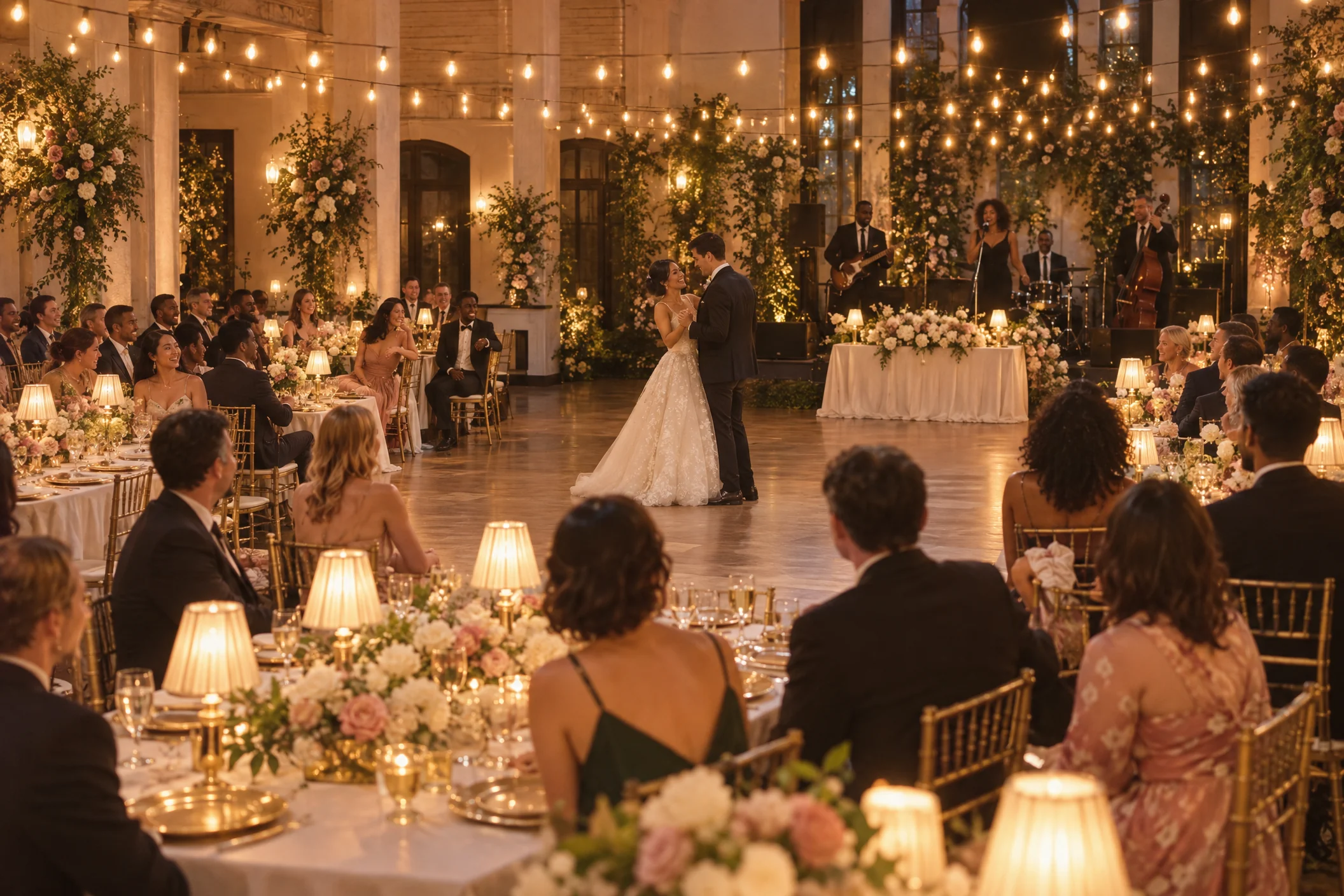
Quick answer
Wedding reception ideas come together when you settle the format, venue, headcount, and budget per head up front, before any decor or vendor decisions. From there, plan cocktail hour, dinner, dancing, and send-off across about 5.5 to 6 hours, and give each part one standout moment to build around.
At a wedding reception, every later choice flows from 3 early ones. Strong wedding reception ideas settle those 3 before the venue deposit goes down: the format the couple actually wants, the headcount the budget supports, and the one moment that ties the room together.
Do it the other way around, booking florals, signage, and tablescape rentals before format and headcount are settled, and the reception splinters into 4 loosely connected pieces instead of one smooth flow from cocktail hour through send-off.
Every format builds on the same 3 decisions. A 130-guest ballroom dinner with a live band, a 100-guest garden reception under a clear-top tent, an 80-guest barn celebration with family-style platters, or a 200-guest hotel reception with a set dance-floor program all trace back to them. From there, the rest of the day falls into place one piece at a time: the format, the venue, the hour-by-hour timeline, the tablescape and centerpieces, the lighting, the seating and floor plan, the music, the bar and signature drinks, the dress code, and the photos. The free Wedding Reception Planner at the close takes the reception style you pick along with your guest count, season, venue type, and budget; the Choosing Wedding Reception Venues guide sorts venues by type, capacity, and indoor or outdoor setting.
- 30 to 220Guests Across 4 Formats
- $90 to $500Per-Head Cost by Format
- 5.5 to 6Hour Standard Reception Window
🛒 As an Amazon Associate, we earn from qualifying purchases, at no extra cost to you.
Wedding Decor
Check Price on AmazonWedding Signage
Check Price on AmazonWedding Favors
Check Price on AmazonWedding Centerpiece
Check Price on AmazonWedding Cake Stand
Check Price on AmazonWedding Party Supplies
Check Price on AmazonWhere Should Reception Planning Start?
Start with the format, because every other choice depends on it. Lock the format first, and the guest-count limit, the venue options you are weighing, the per-head budget, the dress code, the catering style, and the music all fall into one plan instead of 4 competing ones. Four reception styles cover most US celebrations across budgets and guest counts.
The formal ballroom dinner. A 100-to-220 guest reception in a hotel ballroom or country-house hall with plated dinner service, a set program (entrance, toasts, first dance, cake, open dancing), and a live band or premium DJ. Expect $200 to $400 per head once you add venue, catering, bar, florals, and entertainment. The Choosing Wedding Reception Venues guide sets the hotel ballroom beside the other venue types; the Wedding Venue Decoration guide covers the styling these rooms need.
The garden or tent romance. An 80-to-160 guest outdoor or clear-top tent reception with long banquet tables, family-style or buffet catering, a string quartet at the cocktail hour, and a move to a DJ-led dance floor for the evening. Runs $150 to $280 per head depending on tent rentals and seasonal florals. For the outdoor plan and the weather backup, start with the Garden Wedding Ideas guide.
The rustic barn or farm celebration. A 70-to-130 guest reception in a working barn, vineyard pavilion, or restored farm space with mixed seating (long banquet plus 60-inch rounds), family-style plates, a live folk or country band, and string lights overhead. Runs $130 to $230 per head, and the photos come back warm and casual. The DIY Wedding Decorations guide covers the personal touches this style usually leans on.
The intimate restaurant or destination reception. A 30-to-60 guest reception at a buyout restaurant, vineyard private dining room, or destination venue with a single tasting menu, a curated playlist over a sound system, and a tight program (no entrance, short toasts, no first-dance staging). Expect $250 to $500 per head when the food is the main event. An engagement dinner in a private dining room often comes first, and the Engagement Party Ideas guide covers that format; for a teen's promposal rather than a wedding, the Prom Proposal Ideas guide covers the ask.
Settle 4 things first. Pick one format, one standout moment (the first dance, the cake cut, the parent dance, or the send-off), one color family, and one per-head budget. Couples who skip this and book signage, florals, and rentals before the format is set end up with a room that looks like a sample wall instead of one pulled-together look. The shower held 4 to 8 weeks before the wedding is covered separately in the Wedding Shower Ideas guide.
Which Venue Fits the Headcount and the Format?
Venue and headcount go hand in hand, because a room sized wrong sinks the reception before the first plate lands. A 200-guest reception in a 150-capacity room photographs cramped and backs up at the bar. Put 60 guests in a 200-capacity ballroom and the space feels half-empty, with the toasts landing in a quiet room. Whatever your budget or headcount, you will keep circling back to the same 7 venue types.
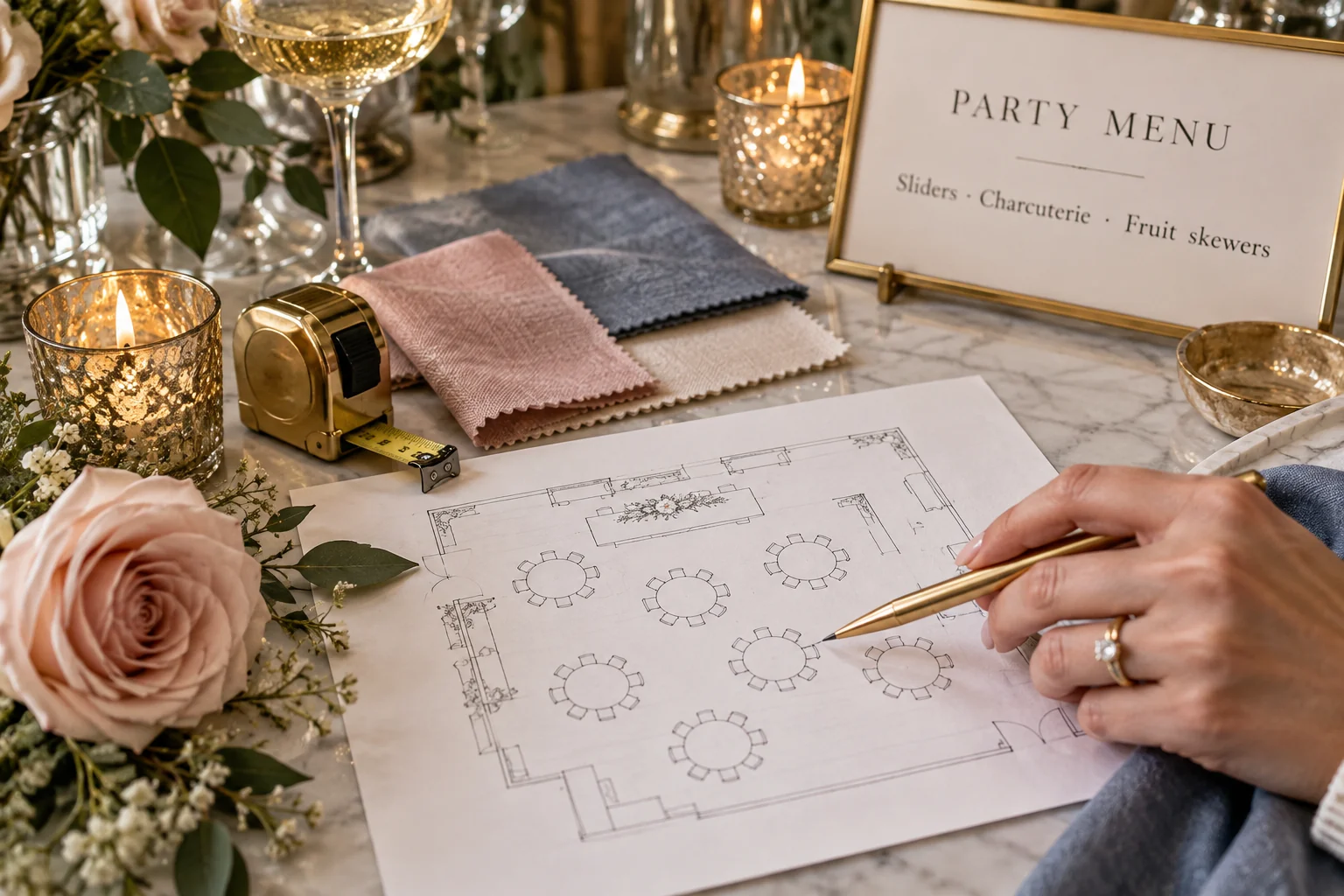
Hotel ballroom and country-house manor. A 120-to-300 capacity room with in-house catering, a dance floor, and uplighting already installed. Your main costs are the venue fee, food and beverage minimums, and corkage on outside wine. The photos come back warm and formal. Two guides, What a Wedding Reception Venue Costs and Wedding Reception Site Ideas, sort hotel and estate venues by budget tier.
Barn and farm space. An 80-to-180 capacity rustic venue with exposed beams, often with a separate ceremony space on-site. Your main costs are the venue fee, a full outside catering setup, dance-floor rental, and overhead string lights. Expect warm, rustic photos. The Choosing Wedding Reception Venues guide flags the generators and portable facilities many barns run on.
Garden, beach, and outdoor venue. A 60-to-180 capacity outdoor site with a tent, a mobile bar, generator-powered catering, and a weather backup plan. Add tent rental, a dance-floor build, and AV rental to the cost. The Garden Wedding Ideas guide walks the outdoor reception plan from start to finish.
Restaurant buyout or private dining room. A 30-to-90 capacity space with an in-house menu, built-in sound, and little styling to add. The cost is a food-and-beverage minimum plus a venue-buyout fee on weekends. Intimate and formal in feel, this style skips the dance-floor staging for couples who care more about dinner than dancing.
Tent on private property. A 50-to-220 capacity build on a family home, country estate, or rented field. The costs add up across tent rental, a dance-floor build, a full catering kitchen rental, generator power, a restroom trailer, and parking. For the photo booth this style often adds, see the Wedding Photo Booth Ideas guide.
Religious and reception combo. A reception held in a synagogue, church, mosque, or temple hall right after the ceremony, often with limited alcohol service or a set catering vendor list. Lower per-head cost ($90 to $160), but less freedom on decor and music.
Destination venue (US or international). A 30-to-90 guest reception at a resort, villa, or cruise venue with on-site coordination, package pricing, and limited vendor freedom. The whole event unfolds over 3 days, from a welcome dinner to the reception to a farewell brunch. Destination receptions usually call for resort-formal dress, and the Reception Dress Ideas guide suggests light, wind-friendly dresses for the bride at a beach or destination reception.
Leave room to spare. Book a venue with about 15 percent more capacity than your final headcount estimate. A 130-guest reception books a 150-capacity room, not a 130-capacity one. That extra room absorbs late additions, larger table layouts, and the bar-and-dance-floor space that tight venues squeeze out.
How Long Should a Reception Actually Run?
Receptions run about 5.5 hours from cocktail hour to send-off, or about 6 at 200 guests or more, and the program either holds together or falls apart around the 90-minute mark when energy dips. Build your timeline around 5 moments: the cocktail hour open, the wedding party entrance, the first dance, the cake cut, and the last-dance call. Hold those, and the day stays on track. The How Long Is a Wedding Reception guide digs into the duration question by format.
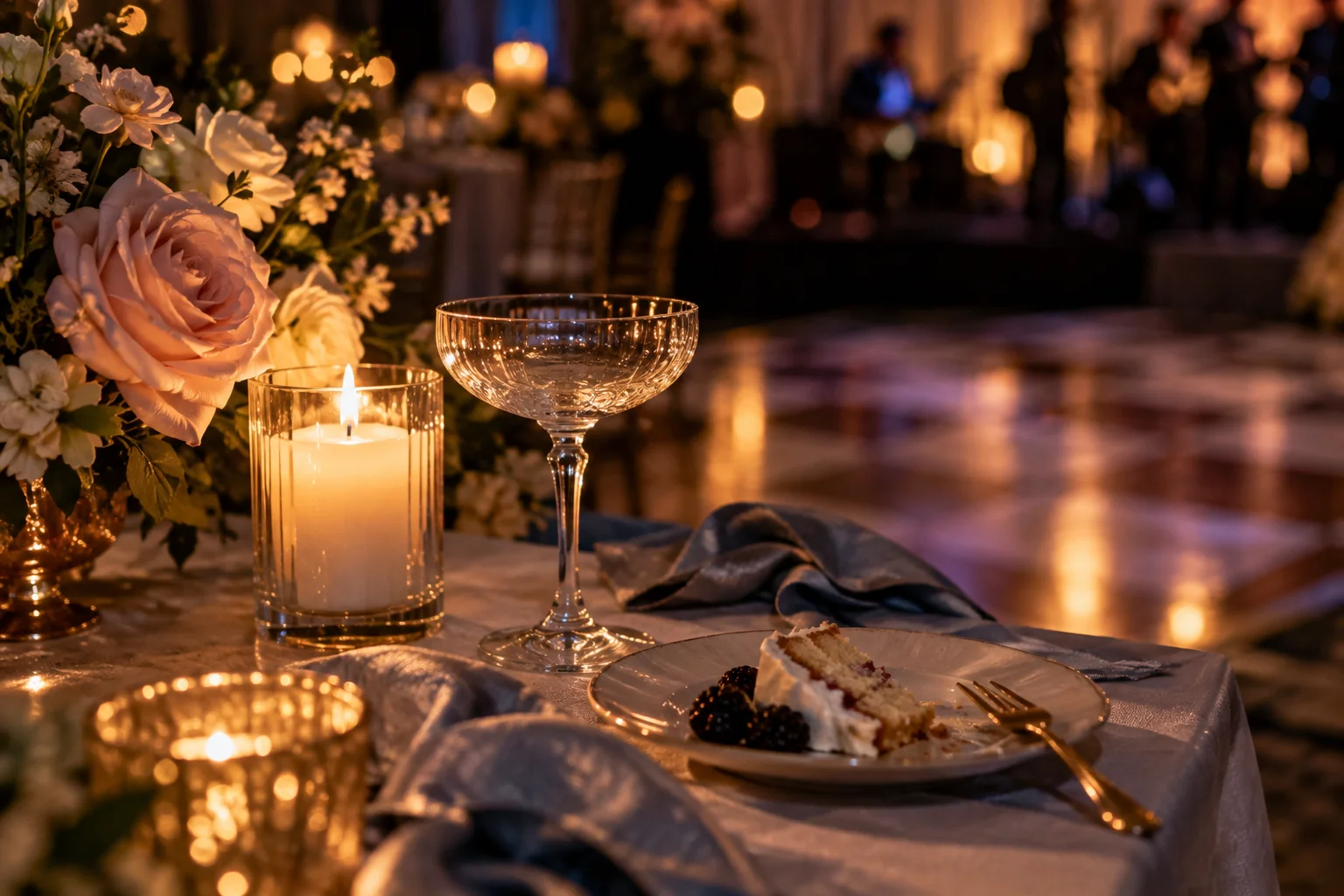
Cocktail hour, 60 minutes. Guests arrive, drink, and mingle while the couple and wedding party finish portraits. Serve 2 passed appetizers, set up a self-serve charcuterie or hors-d'oeuvres station, and run one pour-only bar to keep the flow smooth. The Wedding Reception Timeline guide sets a length for each block of the night; for the order of events step by step, the Wedding Reception Order of Events guide goes deeper.
Grand entrance and first course, 25 minutes. The MC announces the wedding party (or the couple alone, for tight programs), and guests settle in for the first course as plates arrive. Plate the salad or first course before the entrance ends so the dinner keeps its momentum. Wedding Party Entrance Songs sorts entrance music by style, and Entry Songs for a Wedding Reception builds the energy from the guests' arrival to the couple's.
Toasts and dinner service, 60 to 75 minutes. The father of the bride or one parent-host opens with a welcome (under 4 minutes), the maid of honor follows after the entrée plates (under 5 minutes), and the best man closes before dessert (under 5 minutes). Programs with 2 or 3 toasts both work. Cap each toast at the agreed length to keep dinner at 75 minutes.
First dance, parent dances, and cake cut, 15 to 20 minutes. Move the room from dinner to dance floor with 4 cues in a row: the couple's first dance, the parent dance (one or two), the cake cut, and the final dessert pour. The cake cut is the photo moment for dessert and signals open dancing to the room.
Open dancing, 2.5 hours (3 at 200 guests or more). The longest stretch, run by the DJ or band leader with a rising-and-falling energy (a slow ramp over the first 10 minutes, a peak near the middle of the block, a mid-tempo stretch after it, and the last-dance call in the closing minutes). Dance-floor music gets its own pages: Wedding Reception Music for the set blocks by venue size and Wedding Reception Song Ideas for the genres the guest list calls for.
Send-off, 15 minutes. A planned exit (a sparkler walk, a classic-car drive-off, a bubble or rose-petal toss, or a last-dance circle) plus a 10-minute window for guests to head out. For the song that brings the couple in at the start of the night, the Wedding Reception Entrance Song Ideas guide sorts picks by genre.
Build in some slack. Book the venue for about 12 percent longer than the 6 blocks run. On a 5.5-hour program that adds about 40 minutes, so the booking runs about 6 to 6.5 hours (6.5 to 7 at 200 guests or more). Spread the slack across the move from cocktails to the entrance, the pause between dinner and toasts, the cake-to-dance transition, and the close from dancing to send-off. That cushion absorbs late vendor cues and family-photo overruns without breaking the program.
Style the Tablescape and the Centerpiece Run
The tablescape sets the look at every guest seat, and the centerpieces are the single biggest thing you can change in the room. Five ideas cover the styling, drawn from the Wedding Table Centerpiece Ideas guide and the Wedding Reception Table Decorations and Room Decor guide.
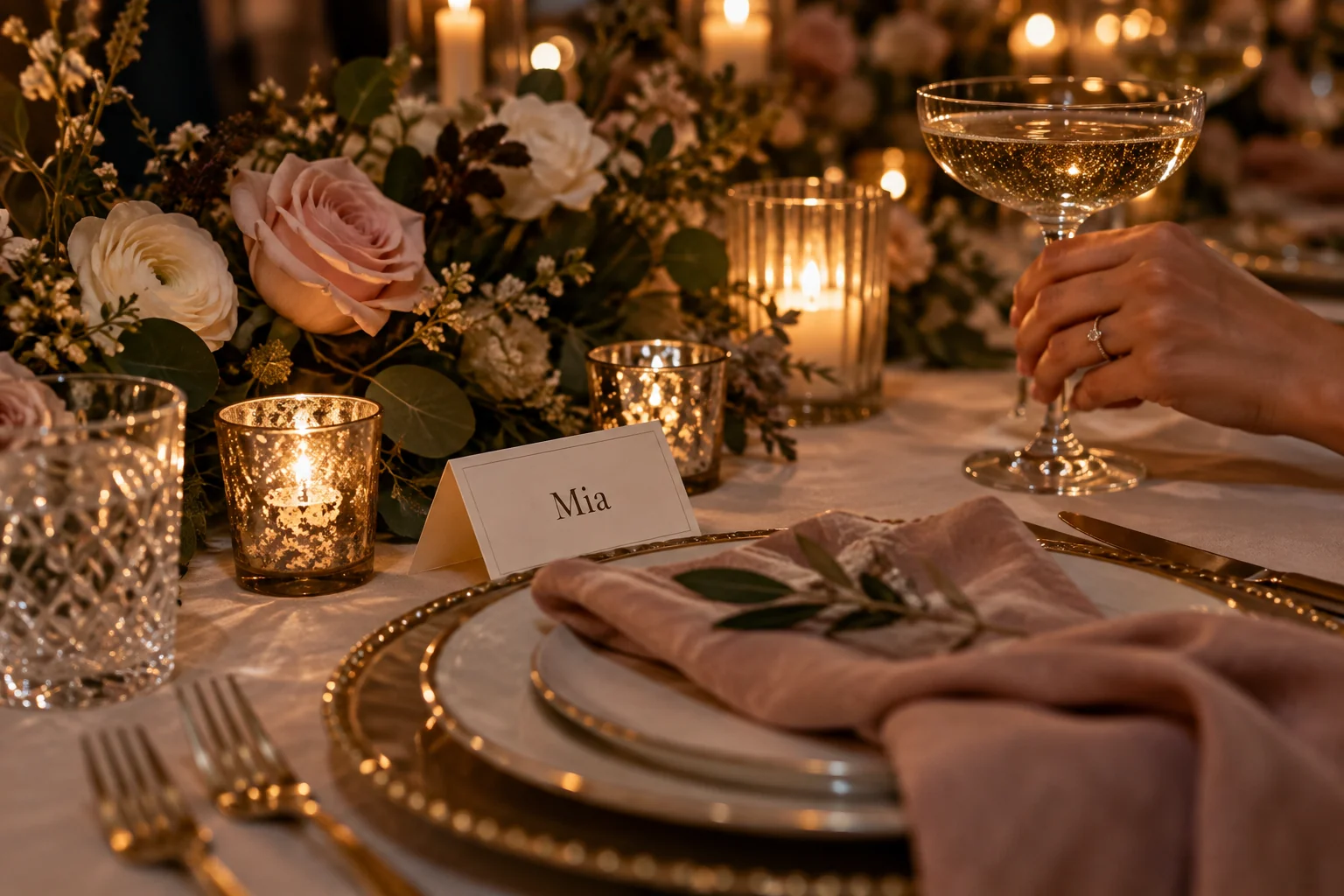
Stick to 3 colors. Pick 3 colors from the same temperature family (all warm or all cool), one base linen tone, and one accent metal (gold, rose-gold, brushed silver, or matte black). Mix 4 different palettes across linens, florals, and signage and it looks like a supply-store haul.
Centerpiece styles that work. Four centerpiece looks suit almost any reception: a low garland runner (eucalyptus, dusty miller, blush roses) for long banquet tables, a tall pedestal floral for round tables in high-ceilinged ballrooms, a mixed-height candle-and-floral cluster for medium-height rooms, and a single statement bloom in a tall vase for minimalist palettes. Vary the heights across the room, but keep each table consistent within itself rather than mixing styles on one table.
Linens and napkins. Three textures lift the table for next to nothing: a textured linen (slubbed, washed, or velvet for winter), a contrast napkin (folded under the plate or tied with a sprig of greenery), and a charger plate one tone deeper than the dinnerware.
The personal touches at every setting. A printed menu card per setting (or one per 2 settings for shared menus), a place card in calligraphed or printed serif, and an optional favor (a wrapped chocolate, a small candle, a seedling). Three thoughtful items beat 7 scattered ones; the camera does not pick up a busy place setting from the angle wedding photographers shoot from.
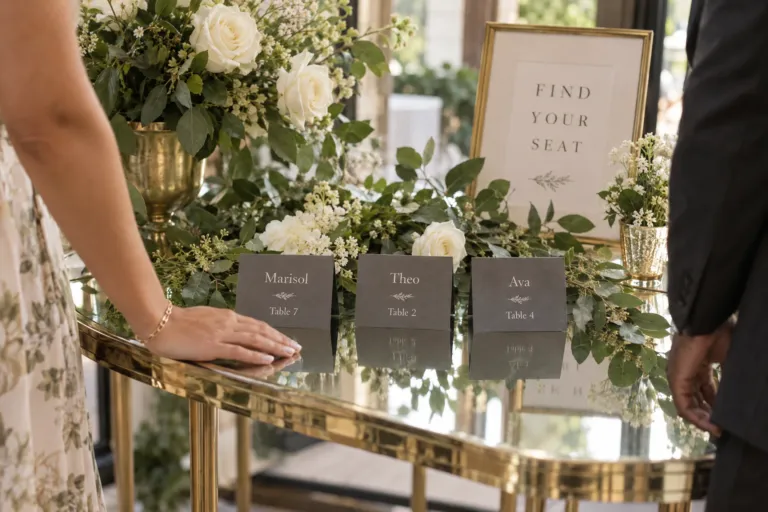
The welcome table and the head table. Two tables deserve extra styling: the welcome table at the entry (seating chart, place cards, an optional guest book) and the head table where the couple and wedding party sit. Style the head table at about 1.5 times the centerpiece density of the guest tables, then keep the rest of the room consistent. The Wedding Venue Decoration guide covers venue-wide styling; the DIY Wedding Decorations guide covers the personal touches for handmade receptions.
A note across party types. For broader styling ideas across all kinds of events, see the Party Decoration Ideas hub. These wedding tablescape ideas carry over neatly to bridal-shower brunches and milestone-anniversary dinners.
Light the Room Like an Editorial Photograph
After catering, lighting does the most for how the room feels and photographs. It works in 3 parts: a soft glow overhead, warm accents at table level, and spotlights on the features you want guests to notice. Skip the harsh overhead fluorescents most ballrooms come with; the hard top-down light goes cold on camera and flattens skin tones. The Wedding Reception Lighting guide walks lighting by venue type.
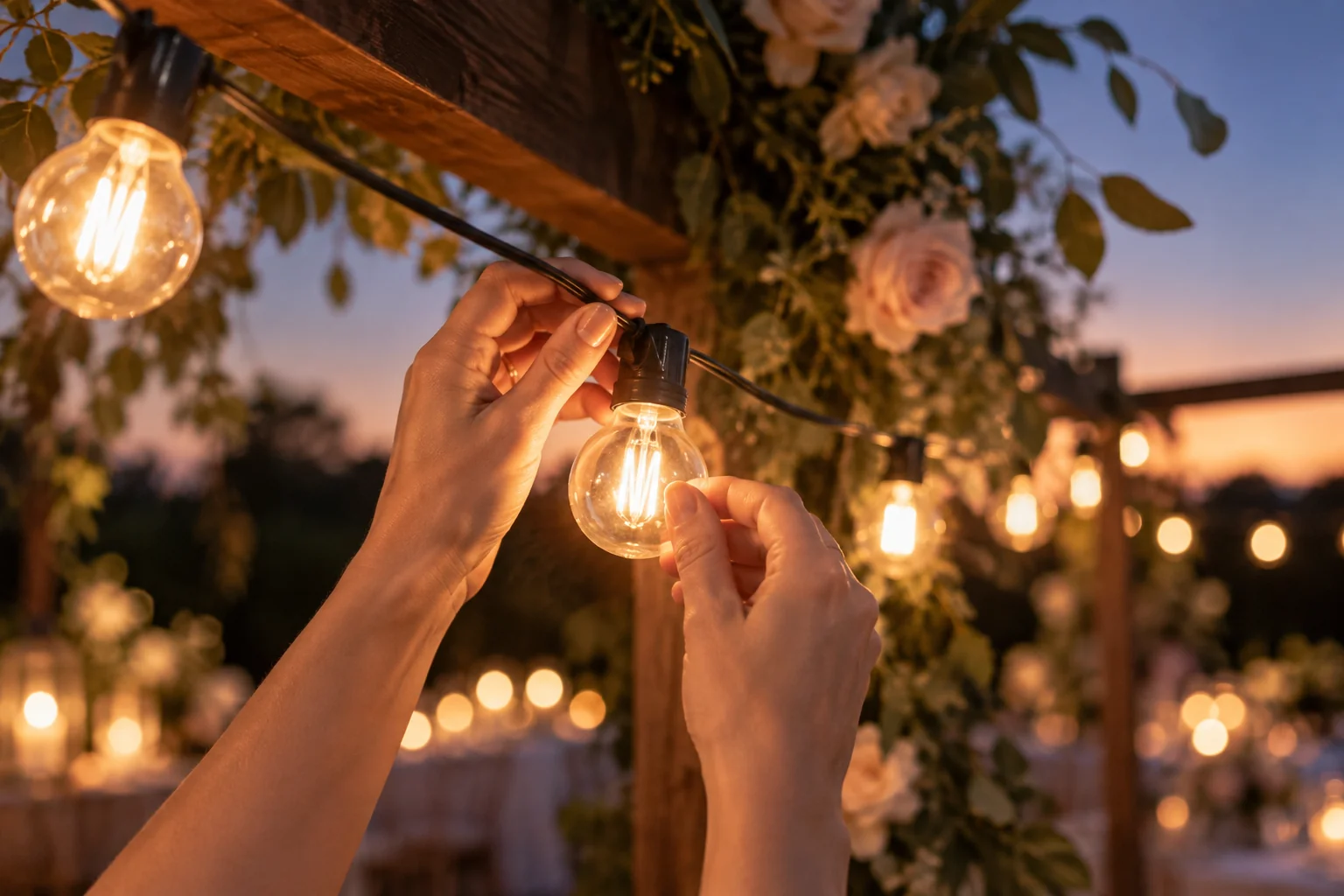
Overhead lighting. Replace harsh overhead lighting with one of 3 options: market lights strung in parallel rows above the dance floor (rustic and garden formats), pin-spotted chandeliers dimmed to 40 percent (ballroom format), or a fabric-draped ceiling with an up-cast LED wash (tent format). Keep it brightest during dinner, then drop it 30 percent for the first dance.
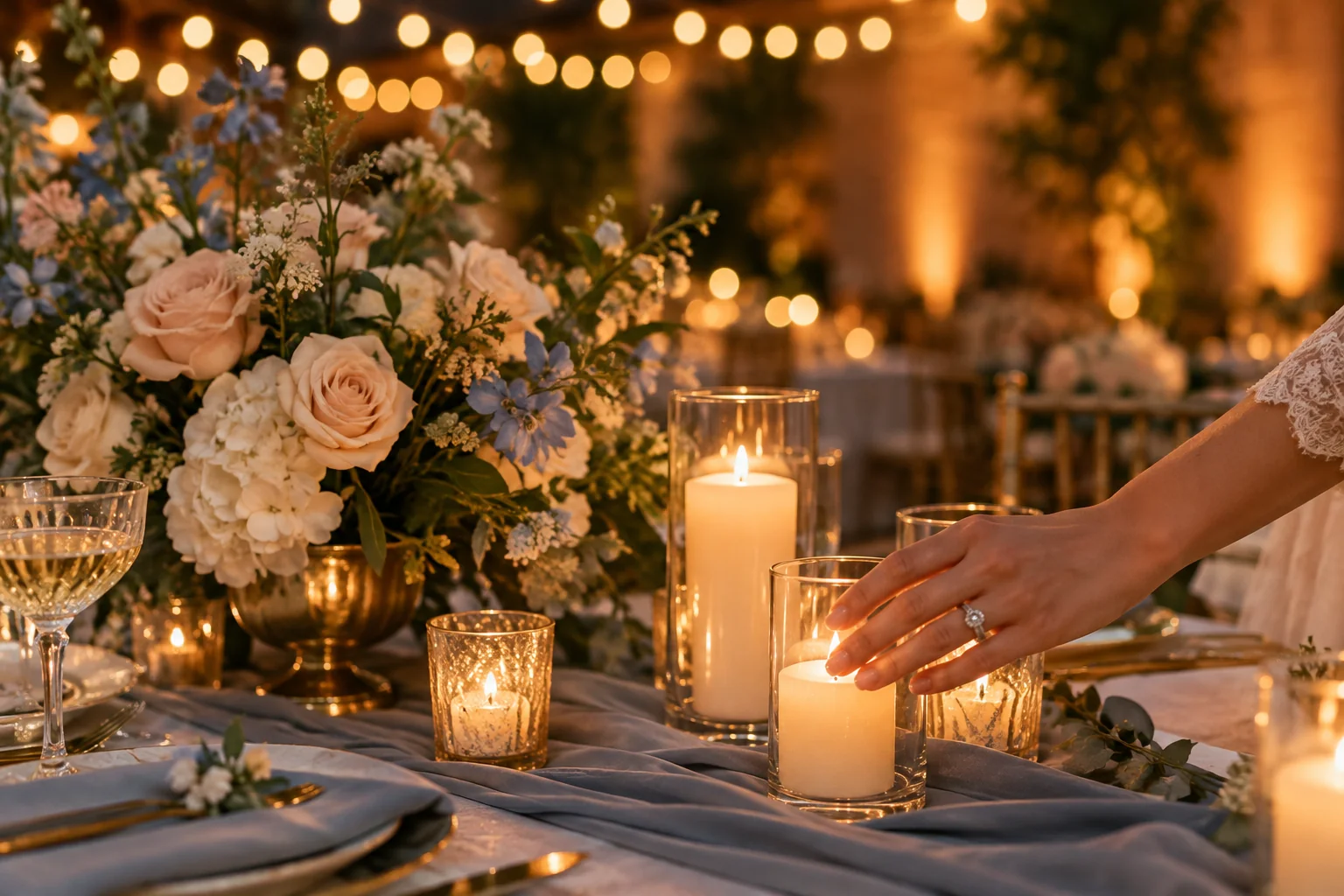
Table-level accents. Candle clusters at the center of each table (3 to 5 votives plus one or two taller pillars in glass hurricanes), a pin-spot from above on the centerpiece if the venue allows it, and one small lantern or candle at every fourth setting to carry the warmth down the table. Battery LED votives look close enough to real wax to do the job, with no open flame.
Focal-point spot lighting. One pin-spot or up-light on the cake table, one on the head table, one on the band or DJ booth, and one on the dance-floor entry arch (if the room has one). These 4 spots stay put across the photographer's room shots and draw the eye to the staged moments.
Uplighting around the perimeter. Set 8 to 12 LED uplights along the room's perimeter walls, and the photos warm up noticeably. Stick to warm amber (2200K to 2700K) for romantic palettes or pale blush for pastel ones. Cool-tone uplighting (cold white or blue) clashes with warm candlelight, and the room starts to look like a corporate retreat instead of a wedding.
The dance-floor light sequence. Dim the room 30 percent for the first dance, another 20 percent for parent dances, then bring up the dance-floor LED rig at the open-dance cue. Many premium DJ packages include the dance-floor rig, so ask for the rig list at booking.
Lighting and weather backup for outdoor formats. Outdoor receptions need a backup plan for evening wind or rain: lowered market lights, tent perimeter lights, and battery uplighting that does not need ground power. Lock the backup rig in writing 21 days before the wedding.
Lock the Seating Chart and the Floor Plan Early
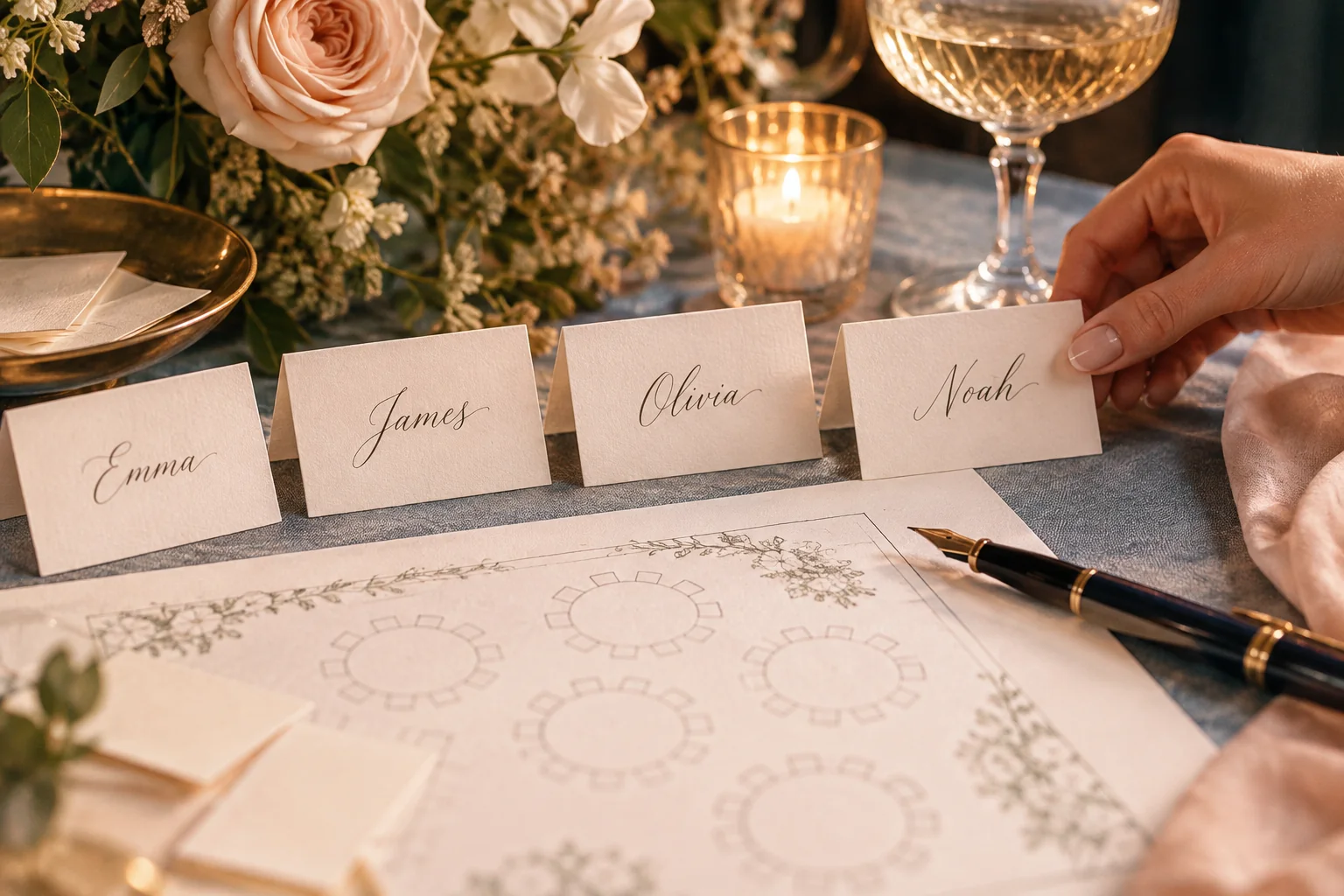
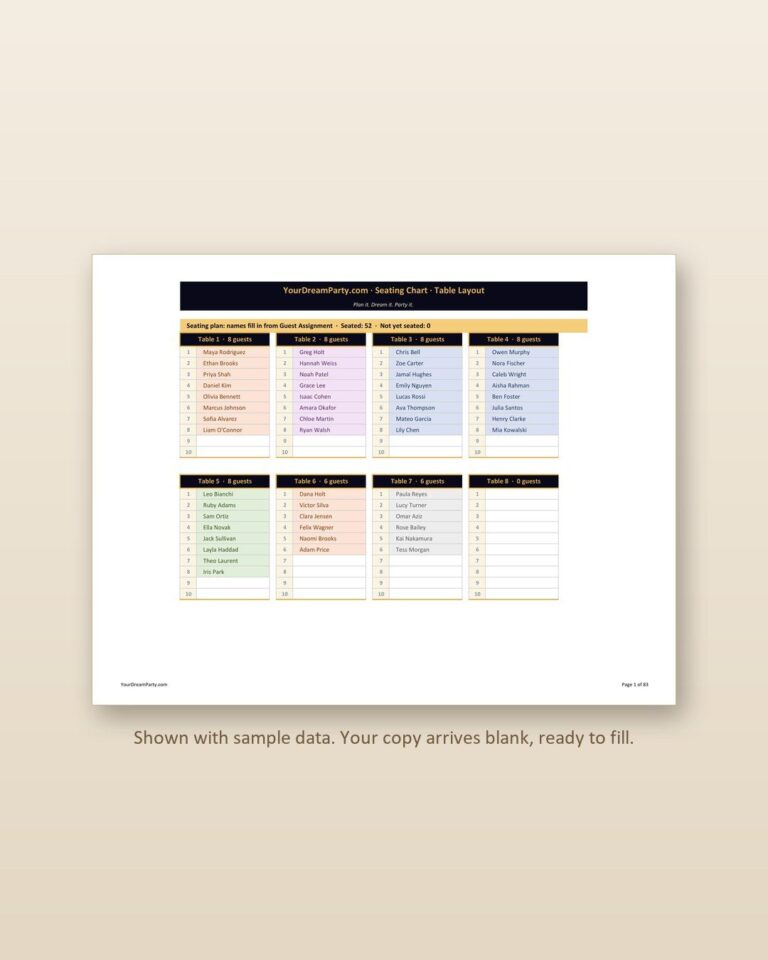
Nothing eats up planning hours like a shifting seating chart. Lock the chart at the 4-week mark and only rework the last 5 to 10 percent of seats in the final 2 weeks as RSVPs settle. The Wedding Seating Arrangements guide covers table layouts and how to group guests; the free Seating Chart Planner handles the drag-and-drop when manual reshuffles get heavy.
How many tables you will need. You will be choosing among 3 table types for almost any room: 60-inch rounds (8 to 10 guests), 72-inch rounds (10 to 12 guests), and 8-foot banquet tables (10 across, or 12 with end seats). A 130-guest reception fits cleanly into 15 ten-top rounds plus a head table for 12, or 13 banquet tables of 10 plus a sweetheart table for the couple. Add one spare table for staff and entertainment if the venue does not provide back-of-house seating.
Choosing your head-table setup. Three setups cover most weddings: the sweetheart table (couple only), the full wedding party at one long table (with partners), or the family table (couple plus immediate parents and siblings). The sweetheart-and-wedding-party combo (couple at a sweetheart table, wedding party at an adjacent banquet) includes partners without crowding the head table.
Dance-floor placement. Put the dance floor at the center of the room, with the band or DJ booth on one side, the head table opposite, and the cake table on a third side within sight. A 16-by-16 foot dance floor handles up to 120 guests at peak. Larger receptions add a 20-by-20 foot floor without crowding the room.
How to group guests. Group tables by shared context rather than by demographic mix: the couple's college friends together, work colleagues together, neighborhood family together. Avoid a singles table, which comes across as a forced setup. Mix the parent generation with extended family for warm cross-table conversation, and keep the under-30 crowd together for the dance-floor energy.
Keep a few flex seats. Mark 4 to 6 seats across the chart as flex seats you can swap at the last minute without breaking the layout. Late RSVPs, dietary swaps, and family adjustments slot into those seats without rebuilding the whole chart. When the venue layout shapes your seating, the floor-plan notes in the Choosing Wedding Reception Venues guide are worth a read.
Tricky family situations. Divorced parents, estranged family members, plus-one mismatches, and dietary groupings all need to be flagged and sorted before the chart goes to print. Keep the chart in a shared spreadsheet with a notes column so the venue coordinator, planner, and host hand off cleanly on the day.
Which Music Cues Take You From Entrance to Last Dance?
Reception music runs across 5 key cues, the last of them a dance-floor stretch of 2.5 hours (3 at 200 guests or more), and most receptions nail one or two cues while letting the rest run on autopilot. Build your list around the 5 key moments and the playlist follows. For the music cue by cue, Wedding Reception Music sets the blocks and the tempo curve, Wedding Reception Song Ideas goes moment by moment, and Wedding Reception Entertainment weighs a band against a DJ and MC.
Cocktail-hour playlist (60 minutes). A 14-to-18 song playlist of mid-tempo acoustic, jazz standards, or instrumental covers that let conversation flow without pulling focus. Avoid lyrically intense tracks that pull attention away from the conversation. A live string quartet, a solo guitar, or a curated playlist over the venue's house sound all work well.
Wedding party entrance songs. The MC announces the wedding party as they enter, either in pairs or as one group. One upbeat instrumental track (60 to 90 seconds) covers a group entrance, or each pair walks in to their own short clip. The couple closes the entrance with a separate song. Wedding Party Intro Songs covers the intro script and the clips; the ceremony aisle walk earlier in the day has its own page, Wedding Party Processional Songs.
The first-dance song. The single most-photographed moment of the night. Three things guide the pick: a song that means something to the couple (not a generic chart-topper), a length between 2:30 and 3:30 (longer drags, shorter feels clipped), and a rehearsed 3-step entry (couple to center, a brief pause, then the dance). The DJ or band leader fades the song at the agreed mark if the couple stops earlier.
Parent dance and cake-cut cues. The father-daughter dance, the mother-son dance, and the cake-cut song. Keep parent dances to one or two unless the family calls for more. Cake-cut songs run 60 seconds while the couple cuts and feeds, and the dance floor opens right after the cut.
Open dancing. The DJ or band leader runs a rising-and-falling playlist (slow ramp, peak, mid-tempo dip, peak again, wind-down, last-dance call). Hand the DJ a 12-to-15 song must-play list and a 5-to-8 song do-not-play list, then trust them to read the room. Give them no direction at all and the dance floor can stall early and never recover.
DJ versus live band. A DJ runs $1,200 to $3,500 in most US markets and handles all 5 music cues plus the pacing. A live band runs $4,500 to $12,000 and brings a stage energy no DJ can match, but with less precise cue control. Most couples hire a DJ; a band makes more sense in a big ballroom that already has a stage set up for it.
Wedding-party games and activities. A 20-minute games block (the shoe game, how-well-do-you-know-the-couple, a photo scavenger hunt) fits between dinner and open dancing, when the energy needs a little structure. The Wedding Reception Games guide walks the reception-games options. For games more broadly, see the Party Games and Activities hub.
Plan the Bar and the Signature Cocktail
Bar planning comes down to 2 questions: what the bar serves (open, limited, beer-and-wine, or signature-only) and how it keeps up with the crowd through cocktail hour and the dancing. Set aside 12 to 20 percent of the total budget for the bar, which draws nearly as many guest photos as the cake table. Catering coordination, from service style to staffing, has its own walkthrough in the Wedding Reception Food guide.
Open bar versus limited bar. Open bar runs $35 to $90 per guest across the reception, depending on the drink quality (well, call, premium, top-shelf). Limited bar (beer, wine, and 2 signature cocktails) comes to $20 to $45 per guest and keeps things inside a mid-range budget. A cash bar feels off at most US receptions and suits niche destination settings only.
Signature cocktails. Two signature drinks per reception (one named for each partner) cover most of the orders through the night. Pick one whiskey-or-bourbon base for the cooler-toned drink and one citrus-or-spirit-forward base for the brighter one. Pre-batch both 30 minutes before cocktail hour so the bar pours each in under 90 seconds at peak.
How many bar staff to hire. One bartender per 50 guests at peak (cocktail hour and after dinner), one bar back per 100 guests for ice, glassware, and cleanup. Larger receptions add a second bar station to keep waits under 4 minutes. Let the bar shape the floor plan: set it opposite the dance floor so the 2 busiest spots do not overlap.
Wine and champagne. Stock dinner with one red, one white, and one champagne option (sparkling rosé for warm-weather palettes). Plan 0.5 bottles of wine per guest across dinner and 0.25 bottles of champagne per guest for the toast. Most caterers carry house wine; couples with a specific taste bring outside wine with a corkage agreement.
Non-alcoholic and zero-proof options. Two zero-proof cocktails on the signature menu plus sparkling water with a citrus garnish at the bar take care of pregnant guests, designated drivers, and anyone skipping alcohol, without singling anyone out. Style the mocktail list as its own proper menu line, not an afterthought.
Bar close and last call. Call last orders 30 minutes before the planned send-off, with a 15-minute final-pour window. After that, the bar shifts to coffee, espresso, a water-and-citrus station, and one closing dessert pour (an Irish-cream coffee for receptions that include it). In the photos, that closing pour comes across as a warm wind-down.
Pick the Dress Code That Reads on Camera
A dress code keeps 150 guest outfits looking consistent on camera and guides the wedding party's styling. Almost every US reception lands on one of 5 dress codes, and the right one falls out of your format, venue type, and season. Dressing the bride for the reception itself? The Reception Dress Ideas guide sorts silhouettes by venue.
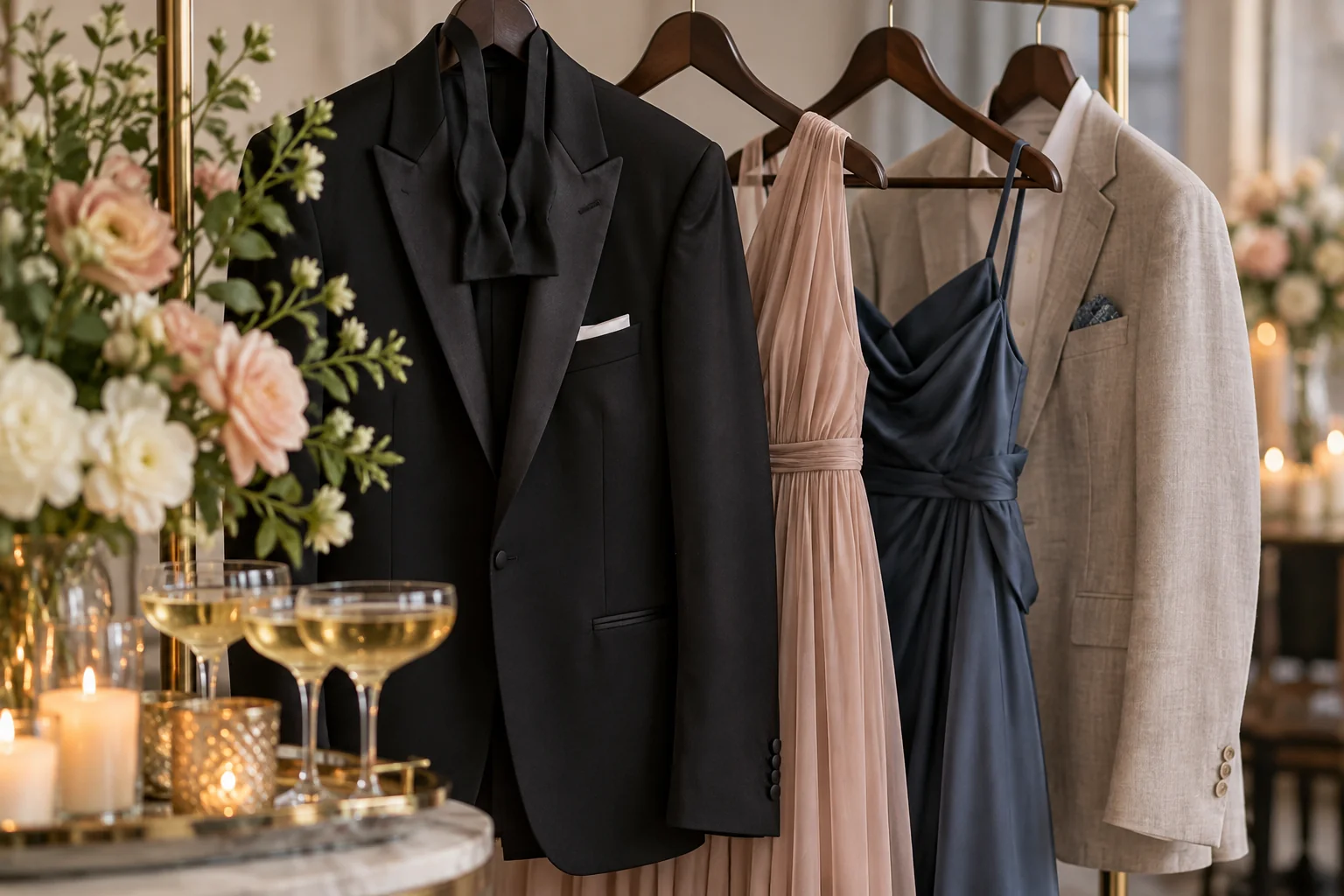
Black-tie and black-tie optional. Tuxedos for men, full-length gowns for women, and formal cocktail-length dresses for black-tie optional. Suits formal ballroom receptions, hotel dinners, and destination receptions at luxury resorts. At this level, the wedding party's dress code belongs to the What to Wear to a Wedding Reception guide.
Formal and semi-formal. Suits for men in dark or mid-tone fabrics, mid-length to full-length dresses for women, and cocktail dresses too. Suits country-house manor receptions, restaurant buyouts, and most evening ballroom receptions below the black-tie level. For the rehearsal dinner the night before, the Rehearsal Dinner Dress Ideas guide covers the bride's dress, and the Rehearsal Dinner Outfit Ideas guide dresses the wedding party and guests.
Cocktail attire. Suits or sport coats for men, cocktail-length dresses or dressy separates for women. Suits afternoon receptions, garden venues that move into the evening, and rustic-barn formats with a polished touch. Warm and friendly in feel, without the formal weight of black-tie.
Smart casual and garden party. Linen suits and chinos with blazers for men, sundresses or pant-and-blouse separates for women, in light fabrics and warm-weather colors. Suits outdoor garden receptions, beach destinations, and daytime brunch celebrations. The bride's own dress for a garden or beach reception gets a deeper look in the Reception Dress Ideas guide.
Theme or palette-specific. A palette code ("dusty rose, sage green, navy blue") that asks guests to pick within a set range, or a theme code (vintage glam, Mediterranean coastal, rustic-modern) that gives them a style direction. Skip overly specific theme codes that put the styling work on guests; a palette range beats a strict theme code at nearly any reception.
The wedding-party look. Coordinate the wedding party in one of 3 ways: matching (same dress, same color), coordinated palette (different cuts, same color family), or coordinated cuts (same cut, different complementary colors). Let the dress code guide it: black-tie suits matching dresses, and cocktail formats suit coordinated palettes.
The after-party outfit. The couple often changes into a second look for the dancing or the send-off. A shorter dress or a separates set replaces the ceremony gown, and the photos gain a second styled scene. The Wedding After Party Dress guide covers the second look in detail.
A note on related events. Pre-wedding events that lead into the reception, the bridal shower and bachelorette, follow their own dress codes. They run as separate plans under their own hubs, Bachelorette Party Ideas and Bridal Shower Ideas.
Capture the Day With a Photo Booth and a Shot List
The photos are the keepsake the couple keeps the longest. Two things handle most of the capture: the hired photographer with a shot list, and the guest-driven photo booth or hashtag stream. Run both together and the photos come together in one place, without the couple chasing camera rolls across 40 phones the following week. The Wedding Reception Photo Booth Ideas guide covers booth styling.
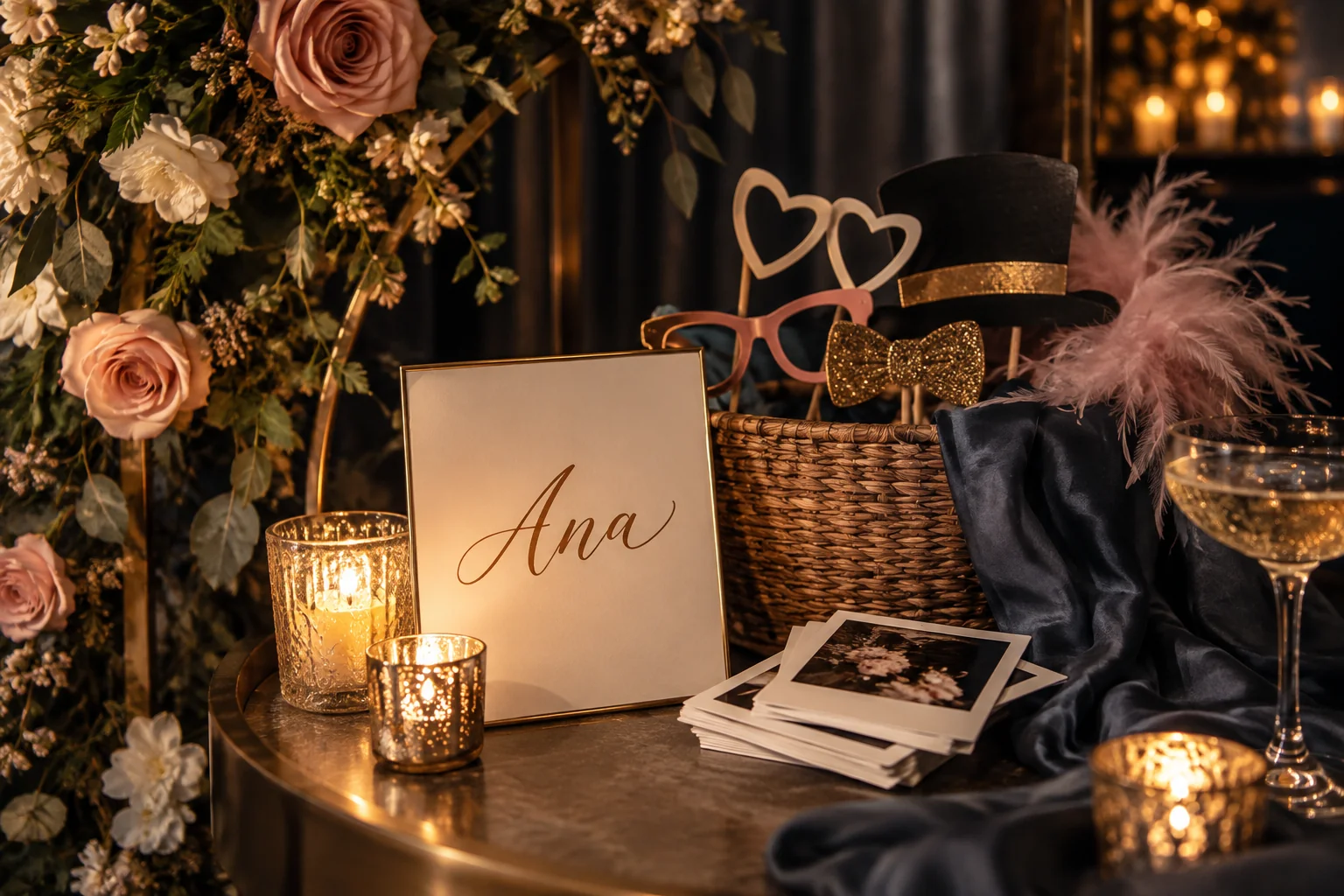
The photographer shot list. A list of 30 to 50 must-capture moments, handed to the photographer at the engagement session and tightened up at the 4-week mark. The key moments are the entrance, the toasts (face shots of speakers and reaction shots of the couple), the first dance, parent dances, the cake cut, the open-dance peak, and the send-off. Add family portraits to the list as named groups with a note on positioning.
Photo booth format pick. Three booth types cover most receptions: a styled backdrop with an instant camera (warm and casual, low-cost), an open-air photo booth with props and instant prints (mid-range, fully managed), or a 360-video booth that captures short rotating clips (premium, high engagement). How the booth setup changes by venue type is covered in the Wedding Photo Booth Ideas guide.
Hashtag and digital stream. A single wedding-day hashtag printed on the welcome sign, the cocktail menu, and the cake-table tent card pulls guest uploads into one searchable thread. When the obvious option is already in use across other weddings, the free Party Name and Hashtag Generator drafts a list of hashtag ideas from the couple's first names in under a minute. Search each one before it goes on the sign, because the tool cannot see which tags other couples use.
Guest-camera management. Ask one wedding-party member to be the photo cue, signaling the couple before staged moments so the camera catches their faces from the front. Most candid moments work without any prompting, but the cake-cut, first-dance, and toast-reaction shots all benefit from a planned cue.
Print versus digital delivery. The photographer delivers a digital gallery within 6 to 10 weeks after the wedding, with print rights included in most US packages. Couples who want printed albums add a print package at booking (a 60-to-80-page hardbound album runs $400 to $1,200). The instant-print booth photos become a second keepsake, attached to a photo board guests sign through the night.
The highlight reel. A 90-to-180 second video edit covering the ceremony through the send-off, delivered separately from the photo gallery. Most US photographers partner with a videographer (contracted separately) or sub-contract through a videography vendor. Couples who skip video at booking tend to wish they had it once the day fades from memory.
One closing check. Print one shot-list checklist for the venue coordinator and one for the photographer; the coordinator confirms each key moment is captured before the room clears. Without that double check, missed family portraits turn up in the proofs 3 weeks later, when they cannot be recreated.
Shop the Wedding Collection
Mrs. and Mr. mugs, Just Married and Honeymooning tumbler pairs, a Bridesmaid tee, a Wedding Crew tank and a Wedding Host hoodie.




How the Wedding Reception Planner and Companion Tools Sharpen the Day
The Wedding Reception Planner is a free tool that drafts a full reception plan in under 3 minutes from your reception style, guest count, venue type, season, budget range, and top 3 priorities. Couples get stuck most often on priorities, when the budget forces a choice between food, florals, music, and photography. The planner hands back a vendor priority list with book-by lead times, season-specific things to watch, and a reception timeline that passes cleanly to your day-of coordinator. Pair it with the Wedding Planning Checklist PDF for the full 12-month plan.
The Seating Chart Planner handles the drag-and-drop of matching your guest list to tables. Paste your confirmed guest list one name per line; the planner lays out the number and shape of tables you set at the start, and you drag each guest onto a table, or use the per-guest assign dropdown on a phone. Pair the chart export with a printed seating diagram for the venue coordinator on the day. For tricky family situations and dietary needs, add a guest one at a time to give them a dietary flag and an "avoid pairing with" note. If that guest lands at a table with someone whose full name is in the note, the summary lists the pair as a conflict, so a late swap that seats the two together shows up there before the chart goes to print.
The Charcuterie and Tablescape Designer styles one surface per run, and the size you pick sets the zones it lays out: a long table gets a centerpiece plus appetizer and dip stations, a grazing table gets cheese, charcuterie, dips-and-fruit and dessert stations. Serving ware comes back matched to the palette, and decorative accents to the aesthetic. Couples styling the tablescape themselves (instead of fully outsourcing it) fold weeks of decisions into a couple of evenings.
The Party Lighting and Atmosphere Designer maps out the lighting by venue type and the atmosphere you want. A zone-by-zone plan (ambient, accent, feature, task), the uplighting spacing, a per-zone product list with a note for your budget tier, and a downloadable plan diagram all come out as a single planning sheet for the lighting vendor. Lighting quotes often come back vague; a sharper planning sheet gets you tighter, more comparable quotes across vendors.
Use the 4 tools in order: the planner settles reception style and priorities, the seating chart handles the guest layout, the tablescape designer drafts the styling, and the lighting designer sets the room's feel. Couples who run all 4 in one evening hand their venue and vendors a full reception plan in under 90 minutes of focused work. Anniversary planning that follows the wedding uses the same seating, tablescape, and lighting tools, and the 50th Anniversary Party Ideas guide shows how a milestone anniversary brings back the wedding portrait and the first-dance song.
Frequently Asked Questions
What is the standard timeline for a wedding reception?
Most US wedding receptions run about 5.5 to 6 hours from cocktail hour to send-off. The usual sequence is a 60-minute cocktail hour, a 25-minute grand entrance and first course, a 60-to-75-minute dinner and toasts, a 15-to-20-minute first-dance and cake-cut block, a 2.5-hour open dancing block (3 hours at 200 guests or more), and a 15-minute send-off. Leave about 12 percent of the program as slack to absorb late vendor cues and family-photo overruns without breaking the timing.
How much should I budget per guest for the reception?
Per-head reception costs in the US run $90 to $160 for religious-hall formats, $130 to $230 for barn and rustic formats, $150 to $280 for garden and tent formats, $200 to $400 for ballroom and country-house formats, and $250 to $500 for destination and restaurant-buyout formats. Set aside 12 to 20 percent of the total budget for the bar. The full reception budget for a 130-guest US wedding lands between $25,000 and $55,000 at the mid-range.
Do we need a cocktail hour before dinner?
A 60-minute cocktail hour keeps guests happy between the ceremony and dinner, and covers the photography window while the couple finishes portraits. Skip it only when the ceremony and reception run back-to-back at the same venue with no photo window. Most receptions put cocktail hour first, with 2 passed appetizers and one pour-only bar to keep the flow smooth.
How many tables do we need for 100 guests?
A 100-guest reception fits cleanly into 12 ten-top rounds (using 60-inch round tables), plus a head table for 8 to 12 guests. Other options include 10 banquet tables of 10 plus a sweetheart table for the couple, or a mix of long banquet and round tables for variety. Add one spare table for staff and entertainment if the venue does not provide back-of-house seating, and confirm the venue's chair count matches the table layout before signing the floor plan.
Open bar or limited bar for the reception?
Open bar runs $35 to $90 per guest across the reception and is the hospitality choice guests notice first. Limited bar (beer, wine, and 2 signature cocktails) comes to $20 to $45 per guest and keeps things inside a mid-range budget with no visible drop in the guest experience. A cash bar sits awkwardly at most US receptions and belongs in niche destination settings only. Pre-batch the signature cocktails 30 minutes before cocktail hour for under-90-second pours at peak.
Should we hire a DJ or a live band?
A DJ runs $1,200 to $3,500 in most US markets and handles all 5 reception music cues (cocktail-hour playlist, wedding-party entrance, first dance, parent dances, open dancing) plus precise cue control. A live band runs $4,500 to $12,000 and brings a stage energy no DJ can match, but with less cue precision. Most receptions hire a DJ for that control; bands suit larger ballroom receptions that already have stage infrastructure and a budget for the premium end.
How early should we send the wedding invitations and RSVPs?
Send save-the-dates 8 to 10 months ahead for in-town receptions, 10 to 12 months ahead for destination weddings. Formal invitations follow at the 8-week mark for in-town receptions and the 12-to-14-week mark for destination weddings. Set the RSVP deadline 4 weeks before the wedding to give the venue and caterer the final headcount with enough lead time. Rehearsal-dinner planning pairs with this invitation timeline; the Wedding Rehearsal Dinner Ideas guide picks up that thread.
What goes in a wedding welcome bag for out-of-town guests?
A canvas tote or kraft-paper bag at each guest's hotel room with bottled water, 2 snack items (a salty bite and a sweet treat, often locally sourced), a hangover kit (electrolytes, pain reliever, eye mask), a printed itinerary for the wedding weekend, a hotel-and-venue map, and an optional small gift (a custom candle, a local artisan item, a wedding-favor candy). Total cost comes to $15 to $30 per bag. Pre-pack the bags before guests arrive and leave them with the hotel concierge for check-in handoff.
How do we handle plus-ones for the reception?
The standard pattern extends plus-ones to married, engaged, and cohabiting partners (named on the invitation), and to wedding party members whatever their relationship status. Casual-dating plus-ones are at the couple's discretion based on headcount and budget. Spell out your plus-one policy on the invitation (a named plus-one or "and guest") to avoid confusion, and add a meal-choice line on the RSVP card so the caterer has the headcount and dietary breakdown 4 weeks out.
What is the best send-off moment for the reception?
Four send-offs cover most receptions: the sparkler walk (guests lining up with sparklers as the couple walks through), the classic-car or vintage-vehicle drive-off (the couple leaving in a styled car), the bubble or rose-petal toss (guests tossing as the couple walks past), and the last-dance circle (guests forming a ring around the couple for the final song). Pick one and stage it as the closing photo moment, with a 10-minute window after it for guests to head out. The send-off photo often becomes the couple's signature wedding shot.
Ready to Plan the Reception?
The quickest path from a blank page to a booked reception is to settle the format, venue, headcount, and per-head budget first, then build the timeline, tablescape, lighting, seating, music, bar, dress code, and photos around them. The free Wedding Reception Planner handles the reception style and priorities in under 3 minutes, and the Wedding Planning Checklist below carries the 12-month plan from engagement to send-off, so the couple never has to assemble vendor templates from scratch.
This page contains affiliate links to Amazon and other retailers. As an Amazon Associate, we earn from qualifying purchases at no extra cost to you. This helps us keep all our tools free.
Results generated by this tool are for planning and inspiration purposes only. Estimates are based on general guidelines and may vary depending on your specific circumstances. Always check for food allergies before serving. Always verify with your suppliers before making purchasing decisions.