
Quick answer
Graduation party ideas come down to 3 decisions the family makes early: the graduating tier the honoree is finishing (kindergarten through doctoral), the celebration format the family wants (backyard cookout, open house, restaurant dinner, or banquet hall), and the headline display the day builds toward (photo wall, achievement table, or money-tree station). Anchor the palette on school colors, choose one display, and size the food format to the room, then lean on the planner and budget templates below.
The strongest graduation party ideas take shape around the honoree, and 3 questions settle that shape before any cap-and-gown decor ships. Start with the graduating tier the honoree is finishing: kindergarten, elementary, middle school, high school, college, graduate program, or trade. From there, name the celebration format the family wants: a backyard cookout, an all-afternoon open house, a sit-down restaurant dinner, or a rented banquet hall. Then fix the headline display the day builds toward: a through-the-years photo wall, an achievement showcase, or a money-tree and card station.
Trouble starts when parents buy tassel garlands and graduation-themed napkins before the format and palette are settled. The day that should flow as one cohesive arc, from the arrival hour through to the send-off, ends up feeling like 3 projects bolted together.
Change the format, and the plan underneath holds steady. A kindergarten promotion in a backyard with 12 family members, a high school open house with 60 guests dropping by through the afternoon, a college send-off dinner in a restaurant's private room, a doctoral hooding-day reception in a banquet hall: every one runs on the same core plan. This guide walks you through the format choice, the theme, invitation timing, decor and the photo display, food and drinks, games and prompts, favors and gift etiquette, the card box and money tree, tier notes from kindergarten through doctoral, and the tools that draft your planner and wording in minutes. The free Graduation Party Planner handles the timing for your format in under 2 minutes, and the printable Invitation Templates below give you matching invitations, RSVP cards, and thank-you cards.
- 30 to 75Guests for Most Graduation Parties
- 3 to 5Hours Average Open-House Window
- 8Weeks Standard Lead Time After Commencement Date Locks
🛒 As an Amazon Associate, we earn from qualifying purchases, at no extra cost to you.
Graduation Party Decorations
Shop on AmazonGraduation Party Banner
Shop on AmazonGraduation Party Cake Topper
Shop on AmazonGraduation Party Photo Props
Shop on AmazonGraduation Party Favors
Shop on AmazonGraduation Party Supplies
Shop on AmazonSettle the Graduation Party Format Before the Decor Lands
Nail down the format first, because everything else follows from it. Once the format is set, the venue, menu, guest count, invitation tone, and timing all fall into line instead of pulling in 3 directions. Families who skip ahead buy cap-shaped napkins before they have chosen open house or sit-down, and the finished day looks disjointed.
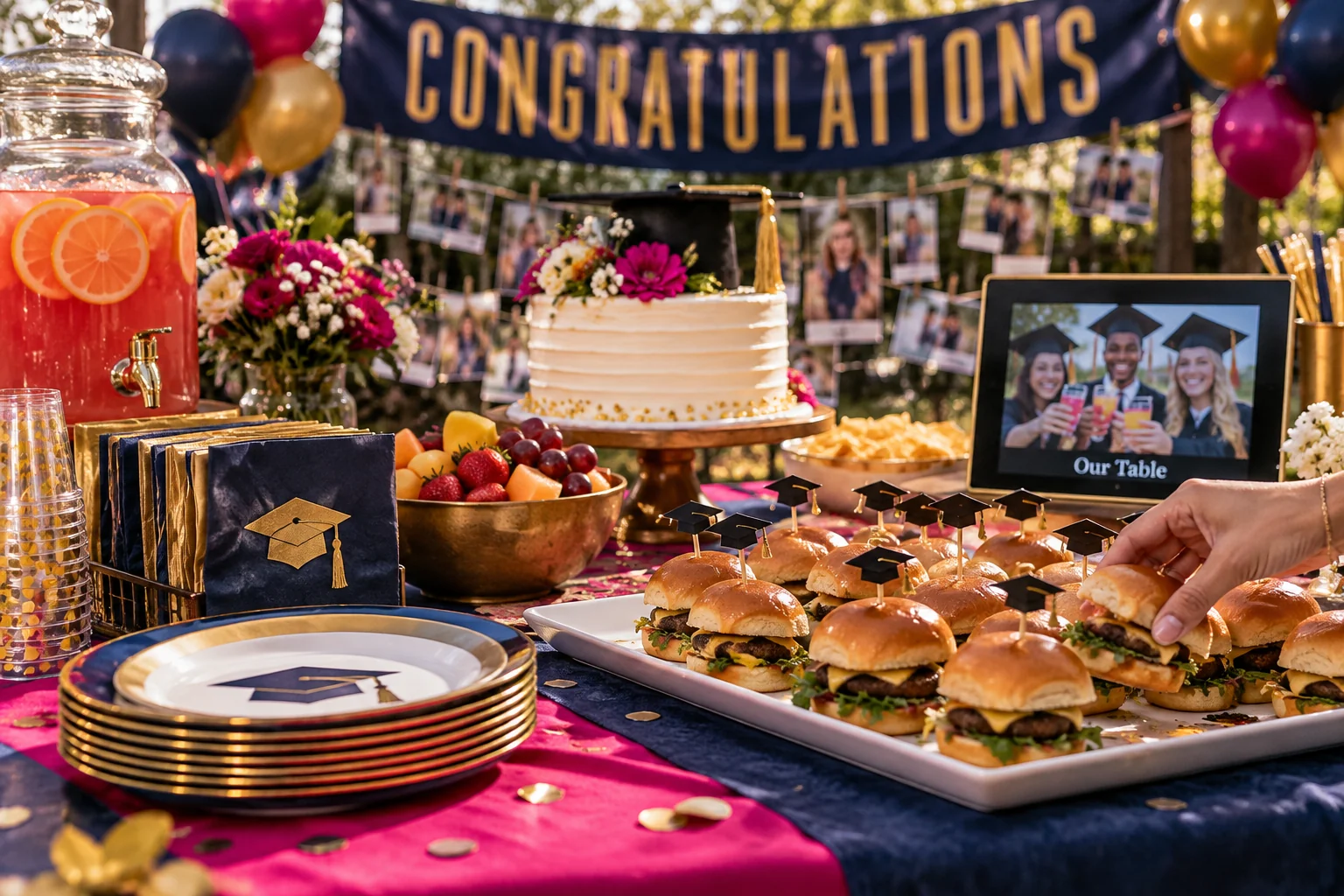
The backyard cookout format. A 2 p.m. to 6 p.m. window with 30 to 60 guests hosted at the family home, anchored on a grill spread (burgers, hot dogs, grilled chicken, corn on the cob), self-serve drink coolers, picnic-table seating, and outdoor lawn-game space. For high school and college tiers, this is the natural first stop among graduation party formats. Outdoor styling lives in the Grad Party Decoration Ideas guide, with the supply list for each budget band in the Graduation Party Decorations guide.
The open-house format. A 1 p.m. to 5 p.m. drop-in window with 40 to 80 guests rotating through the home or venue, anchored on a grazing-style buffet that holds steady across 4 hours, a self-serve drink station, and a continuous music background. Suits families with extended-network guest lists (neighbors, coworkers, distant relatives, school staff) who cannot all attend a single seated meal. The Ideas for Graduation Supplies guide covers the supply shortlist by category; the Graduation Party Checklist guide makes the case for an open-house window when the class calendar is crowded.
The restaurant private-room format. An 11:30 a.m. to 2 p.m. lunch or a 6 p.m. to 9 p.m. dinner window with 20 to 35 guests hosted at a restaurant private room, with a plated meal or family-style courses, a single shared toast moment, and a controlled photo window. Suits doctoral, graduate, and professional-program graduates whose family wants something more polished than a backyard cookout. For an evening crowd pitched older, see the College Graduation Party Themes guide.
The banquet hall format. A 4 p.m. to 9 p.m. window with 60 to 150 guests at a rented venue, with a catered buffet or plated meal, a DJ or playlist-only sound system, a formal program (parent speech, graduate speech, toast), and a styled photo backdrop. Suits joint graduations (multiple graduates sharing one event), large extended families, or cultural traditions where the celebration scale matches the milestone. The High School Graduation Party guide weighs the rented hall against 3 other venue formats.
The joint celebration format. A merged event for 2 to 4 graduates from the same family or close-friend group, hosted at one venue with a split decor plan: 2 photo displays, 2 cake-cutting moments, and paired send-off favors. A natural fit when siblings, cousins, or close friends graduate from the same tier in the same season. Skip this format when the graduating levels differ too much. A kindergarten promotion and a high school senior in one event pull the styling too far apart. Zone-by-zone styling, from the entry to the favors station, gets its own walkthrough in the Graduation Decor Ideas guide.
Lock 4 things first. Pick one format, one palette (school colors or the graduate's picks), one main display (photo wall, achievement table, or money-tree station), and one guest-count range. Build everything else around those 4. Families who skip this step buy supplies before the format is set, and the open house looks like a supply-store haul instead of a curated send-off.
Choose a Theme That Fits the Graduate and the Tier
The theme you choose shapes the invitation, the photo wall, the cake, and the favor tags all at once. Four things guide it: the graduate's level, their color preference (often the school colors), the format you picked above, and any hobby or future-plans angle they want to show off. Ten directions cover nearly every graduation party theme angle, at every level, and that choice matters more than chasing every look on a mood board.
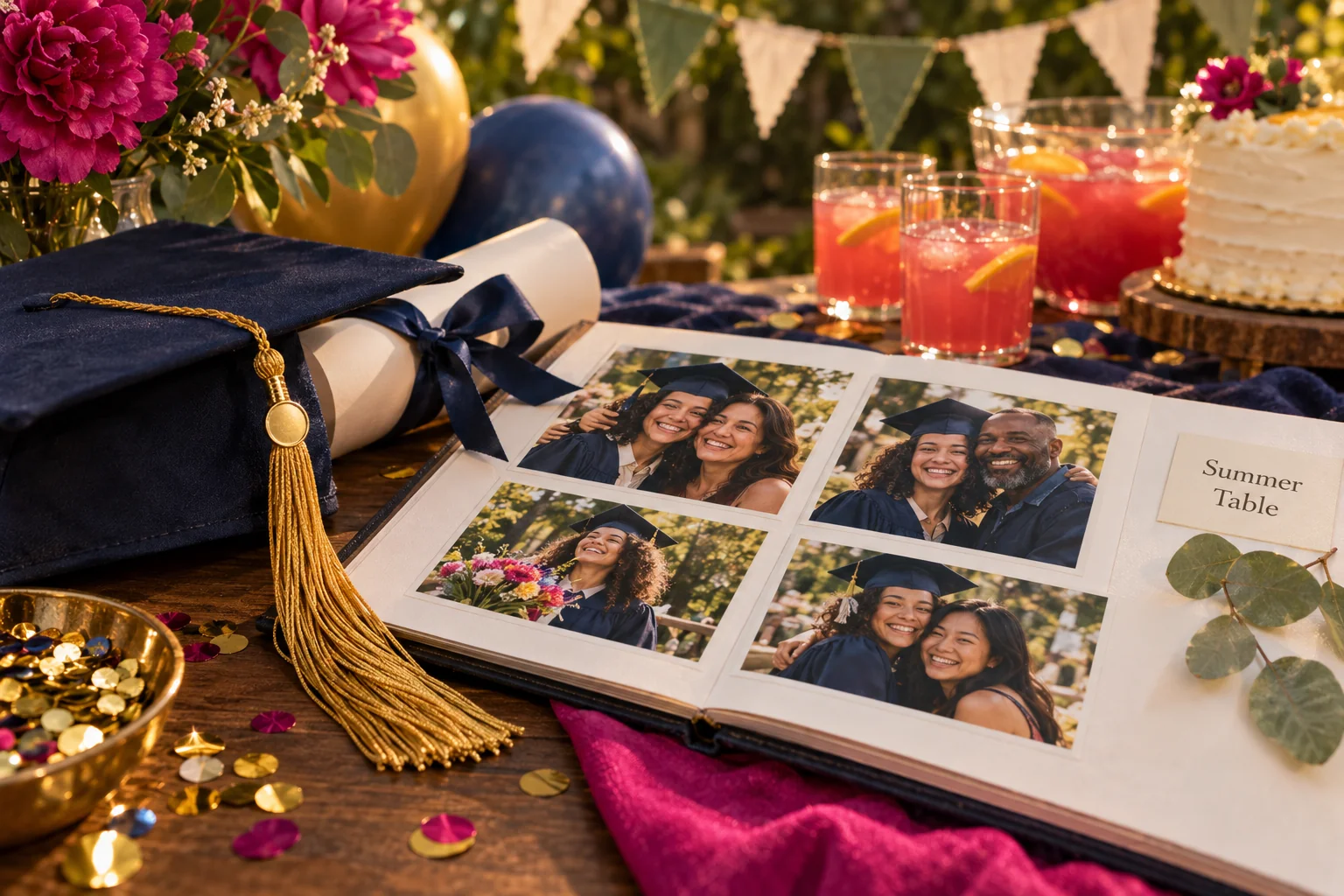
Classic cap and gown. Black, gold, and white anchored on cap-and-tassel iconography, a "Congratulations Graduate" banner, a small diploma replica as a tablescape centerpiece, and gold-trimmed dinnerware. The effect is warm-traditional at every tier from elementary through doctoral. The classic-styling variants by budget band break down in the Graduation Party Decorations guide.
School colors. Two-color palette pulled directly from the graduate's school (the school website often lists the official hex codes), built into balloon arches, table runners, and napkin selections. Works particularly well for school-spirited graduates and high school tiers where the school identity is central. The Graduation Table Ideas guide covers school-color tablescapes.
Future plans. A theme angle that surfaces what comes next, the graduate's accepted college (pennants, college mascot, freshman-year welcome packet display), the graduate's career path (subject-specific decor for a teaching-program graduate, scrubs-and-stethoscope for nursing-school), or the graduate's gap-year travel plans (map decor, passport-stamp guestbook). Warm and personal, and it hands extended-family guests something to ask the graduate about.
Memory lane. A theme angle anchored on a through-the-years photo wall (baby photo, first day of kindergarten, milestone school photos, prom or senior portraits, graduation photo) with a curated playlist of the graduate's school-era favorites in the background. Works particularly well for parents who want the celebration to honor the journey, not only the destination. The Graduation Party Decorations guide covers the photo-wall supplies.
Adventure ahead. Travel-coded decor (vintage suitcases, world maps, passport guestbook, instant-photo station, travel-quote signage) for graduates heading to gap-year travel, study-abroad programs, or moves across the country. Pairs particularly well with college-tier graduations where the next chapter involves a literal geographic shift.
Class of [the graduating class]. A traditional theme built around the graduating class itself, with class-themed decor: a yearbook display, a signed class-mascot sign, a prom-photo backdrop, and a classmate-greeting station. It shines when many graduates' families coordinate joint events. Put the year on signs and printables as an editable field, not baked-in text, so the same templates work for future classes.
Hobby or passion themed. A theme angle anchored on what the graduate loves outside academics, the basketball player's court-themed cake, the future engineer's robot-and-gear decor, the future chef's culinary-tools tablescape, the future artist's paint-palette guestbook. Suits graduates with a strong identity outside school who want something beyond the cap-and-gown default.
Minimalist black and white. A modern, restraint-forward palette in monochrome with bold sans-serif typography, simple white florals, and one statement piece (a black-and-gold balloon column or a typographic backdrop). A strong choice for graduate-program and professional-program send-offs, where the mood tilts more sophisticated than the high school party.
Garden-and-floral graduation. A spring or early-summer outdoor format anchored on fresh-cut florals, a botanical-print invitation, and a daylight-photography window. Pairs particularly well with graduate program ceremonies that fall in the spring window, beside the summer high school cycle. Alongside it, the Party Decoration Ideas hub holds the broader styling ideas.
Tropical send-off. A summer-coded palette with monstera leaves, citrus garnishes, woven coasters, and a punch-bowl moment. Suits graduates heading to coastal colleges, summer-travel adventures, or families who lean into the warm-weather setting. The mood is warm-fun, not warm-formal; the Grad Decor Ideas guide lays out the decor zone by zone.
Stick to 3 colors. Pick 3 colors in the same temperature family (all warm or all cool), 1 fabric texture, and 1 statement piece (balloon arch, photo wall, or a standout cake station). Mix 4 palettes across decor, invitations, and favors and you get a supply-store haul, not a curated look.
Match the theme to the level. Kindergarten and elementary graduations land best on bright, playful palettes with kid-friendly typography; middle school tilts toward graduate-chosen colors and personality cues; high school anchors on school colors and milestone-coded decor; college skews toward future-plans or adventure-ahead angles; graduate programs and professional schools land on minimalist or refined palettes that match the achievement weight.

Shop the Graduation Collection
A Graduate hoodie, a Next Chapter tumbler and a Degree Earned mug, with no year or school name printed.



Send Invitations That Read the Room
Before a guest commits, the invitation has to answer 6 things: who the graduate is, what level and school, what the format is, when and where, what to wear, and whether to bring a gift or skip it. Six lines cover the minimum on the printed card: the graduate's name, level and school, format and date, venue, dress note, and gift-or-no-gift note. The tone follows the graduate's level and the guest mix, not the season.

The traditional printed invitation for high school and college. A printed invitation in serif or modern script typography ("Please join us in celebrating [Graduate's Name], [School Name] graduating class"), a separate RSVP card with a stamped return envelope, and a 4-week reply window. Multi-generational rooms with grandparents and extended family respond more reliably to printed-and-mailed invitations than digital. What each card must say, and 6 ways to send it, break down in the Graduation Party Invitations guide.
The casual-modern invitation for cookout and open-house formats. A digital invitation with the palette built into the design, an RSVP link, a "drop in any time" note, and a 3-week reply window. Skips the formal-script typography in favor of a clean sans-serif look and the graduate's casual photo. Works for friend-heavy guest lists and younger guest mixes.
The playful invitation for kindergarten and elementary. A first-person-from-the-graduate voice ("I'm graduating from kindergarten! Come help me celebrate"), a digital RSVP, a kid-friendly design with the graduate's drawing or class photo, and a 2-week reply window. Young-family guest lists respond warmly to it, and it sidesteps the formal tone that feels overdone for a kindergarten promotion.
The graduate-program invitation for master's, doctoral, and professional schools. A refined printed invitation with the graduate's earned title ("Please celebrate Dr. [Graduate's Name], [Program Name]"), a more formal RSVP card, and a 5-to-6-week reply window. Matches the achievement weight of the milestone and signals the formality of the event to out-of-town academic guests.
The save-the-date for destination or large-format graduations. A separate save-the-date card sent 8 to 10 weeks before the event, with the format and date locked but venue and dress-code details on the follow-up invitation. Saves out-of-town guests from booking-window stress, particularly when commencement weekend involves multiple ceremonies and side events.
The dress-code line. Five words at most, "casual cookout," "summer-afternoon dressy," "garden-party florals," "cocktail attire," or "school colors welcome." Avoid open-ended dress codes, because they leave the styling to each guest and produce inconsistent photos. The free Invitation & Sign Wording Generator can add a dress-code line, phrased in your chosen tone, to its invitation variants and drafts the matching welcome-sign wording in under 2 minutes.
The gift-or-no-gift line. Three formats handle most graduation gifts: a "your presence is the present" line that explicitly skips gifts, a "cards and contributions to college fund welcome" line that signals a preferred giving format, or a discreet silence on gifts (which signals the standard graduation-gift expectation). One of the first 2 usually serves better, because guests appreciate a clear signal, not the awkward guess at the family's preference. The Party Planning hub covers invitation coordination more broadly.
Plan the thank-you cards early. Plan the thank-you cards alongside the invitations instead of leaving them as a post-event scramble. Order the matching card stock at the same time as the invitations so the look stays consistent from save-the-date through the last thank-you, and have the graduate write the cards within 2 weeks of the party.
Decorate the Anchor Display and the Tablescape
With a graduation party, the camera roll comes first and the physical room second. Build one anchor display (the photo wall, the achievement showcase, or the balloon-and-cap statement piece) that photographs cleanly, then layer the surrounding surfaces to support it. The 7 choices below cover most graduation party decorations at every level.
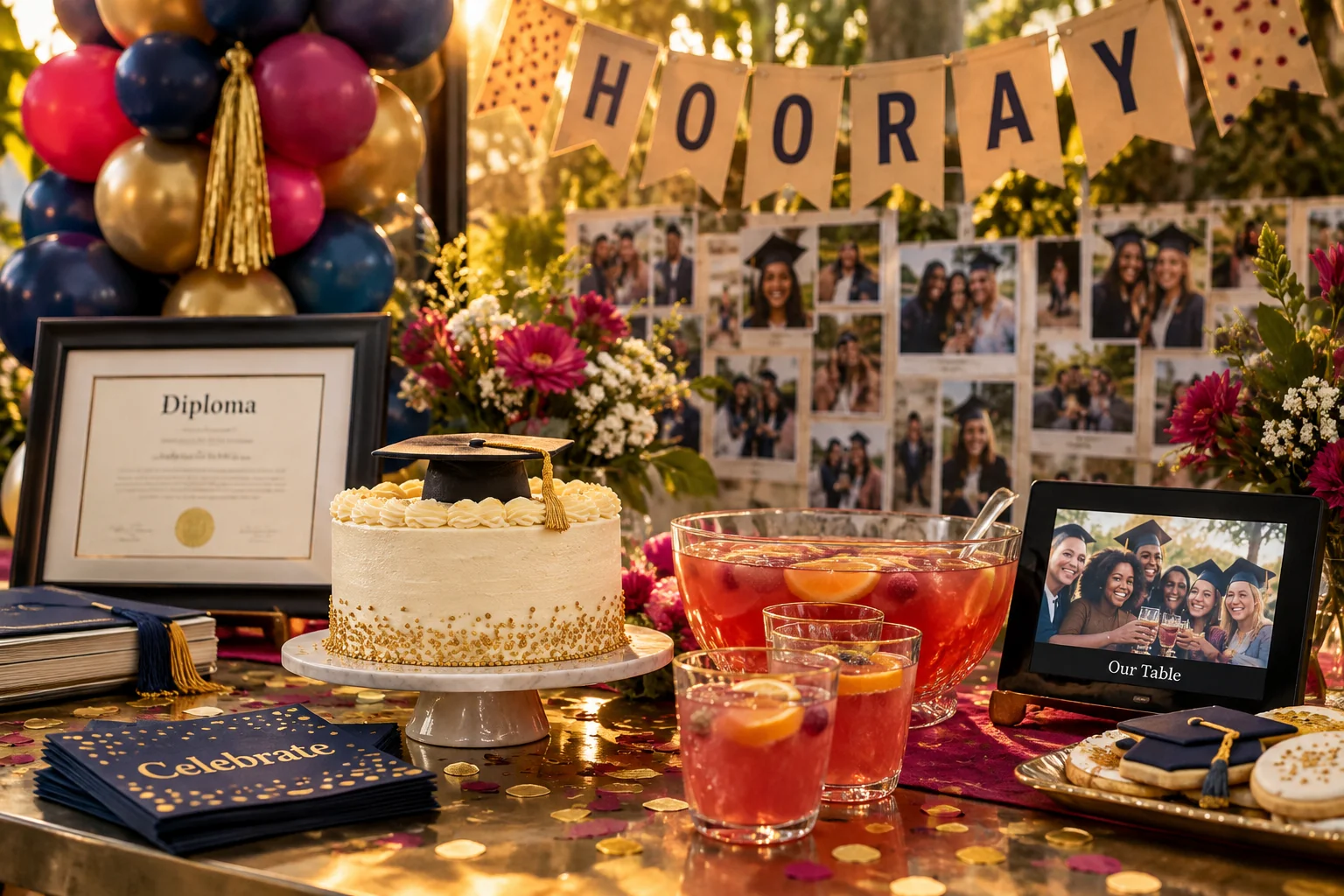
The through-the-years photo wall. A 6-to-10-foot stretch of wall or fence styled with a chronological photo display from baby through graduation, anchored with matching frames (often black, gold, or natural-wood) and small captions noting the year and the milestone (kindergarten promotion, first day of high school, prom, graduation). Across graduation party themes at every level, this is the decor guests gather around longest. The Graduation Party Themes guide sets the photo wall among its 3 photo setups; the Graduation Party Decorations guide walks the supply list.
The achievement showcase. A side table styled with the graduate's diploma or graduation certificate (often in a frame stand), the cap and tassel laid alongside, any awards or honors from the school years, the graduate's senior portrait, and a small floral arrangement that matches the palette. Pairs particularly well with the through-the-years photo wall on the opposite side of the room. The Graduation Decor Ideas guide walks the photo-wall and memory-display styling that faces it.
The balloon-and-tassel arch. Three balloon sizes do the work: 5-inch fillers, 11-inch standards, and 16-to-18-inch statement pieces in school colors plus metallic gold or silver accents. A 6-foot organic graduation balloon arch needs 70 to 90 balloons, with about 60 percent fillers, 30 percent standards, and 10 percent statement pieces, plus a tassel garland across the front and a "Class of [graduating class]" banner on top. Mounted at 7 to 8 feet, the arch floats above guest heads and does the work of a headline backdrop. For the arch-construction shortlist, turn to the Graduation Party Decorations guide.
The graduation cake and dessert station. A small side table with the graduation cake (often single-tier sheet for cookout or open-house formats, 2-tier for sit-down dinners or banquet halls), cap-shaped sugar cookies, diploma-rolled candy (chocolate-and-fondant scrolls), tassel-decorated cupcakes, and a curated drink station. Position the dessert station near the cake-cutting moment so the photograph stays clean. The dessert-station shortlist gets its own treatment in the Graduation Party Food guide.
Lighting before the dress-up. Two warm-white floor lamps angled at the anchor display from a 45-degree angle, set 6 feet apart, render skin tones cleanly on phone cameras, and the difference shows in every indoor shot. Overhead fluorescent lighting alone casts hard shadows that no filter rescues. Daylight outdoor formats handle this naturally; indoor venues need the supplemental lamp setup.
Signage that ties the day together. A welcome sign at the entry with the graduate's name and level, a directional card at the bar or buffet, a hashtag tent card at the photo wall, a "Cards and Gifts" sign at the gift station, and a "Take a Favor" tent card at the send-off table carry the look from arrival to last guest out. Keep the signage typography consistent so it all feels of a piece. The Party Decoration Ideas hub covers the broader styling in parallel.
The styling-supply shortlist. A graduation party aesthetic carries reliably on 6 core supply categories: the balloon arch hardware (PVC frame, $50 to $100), balloon assortment in school colors plus metallic accents (70 to 90 balloons for the 6-foot arch, plus a few spares for pops, $30 to $80), tassel garland and banner ($20 to $50), photo display frames (12 to 18 frames, $40 to $120), the achievement-showcase frame and stand ($30 to $60), and warm-white lighting ($25 to $80 for 2 floor lamps). The Ideas for Graduation Supplies guide sorts the shopping list into tableware, banners, balloons, and the rest.
Plan Graduation Party Food and Refreshments That Travel the Day
Graduation party food carries the day when it flows as one arc from the arrival snack to the closing dessert, not 5 disconnected courses fighting for room on the plate. Three menu formats cover most graduation party food plans, and the right one falls out once the format is settled.
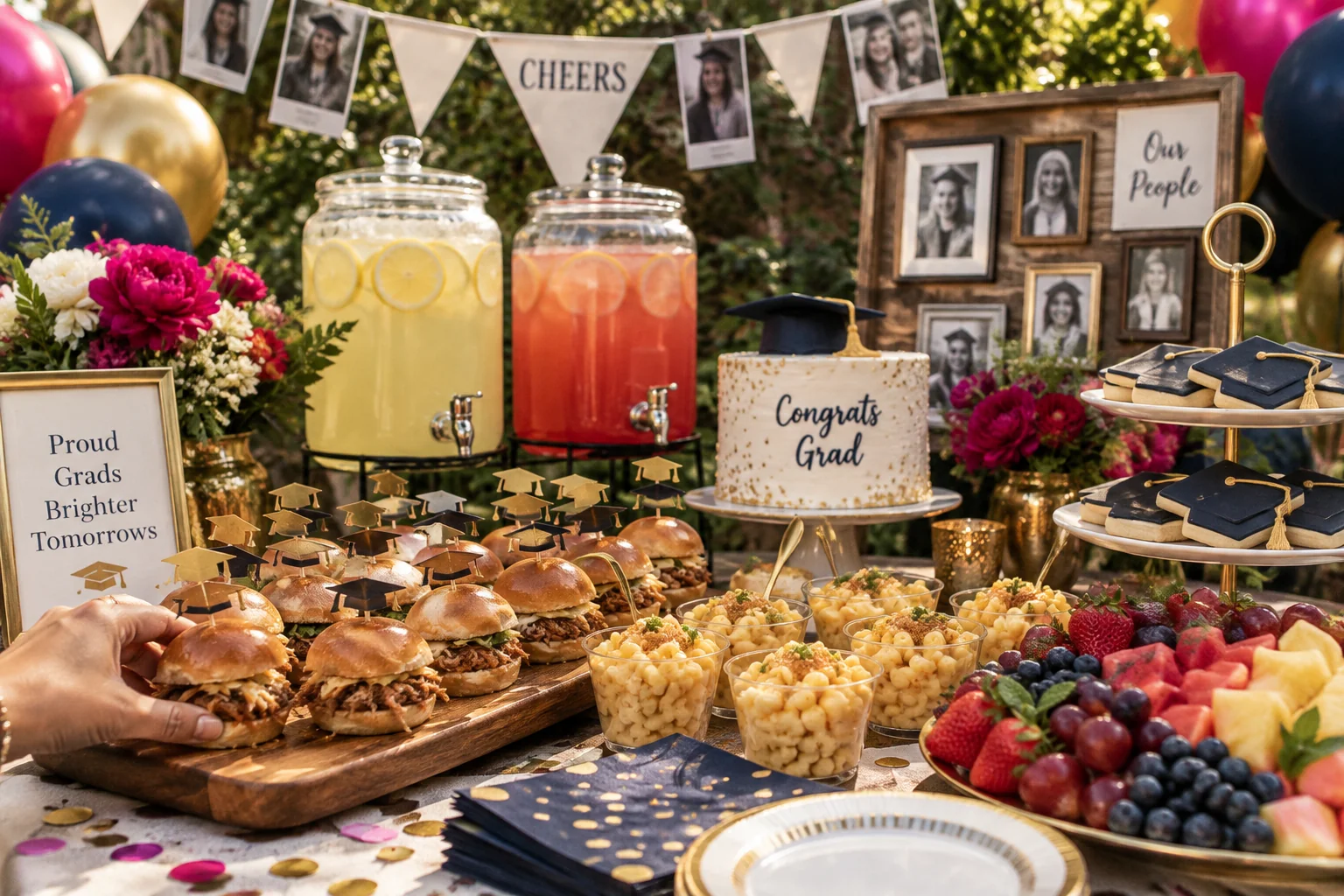
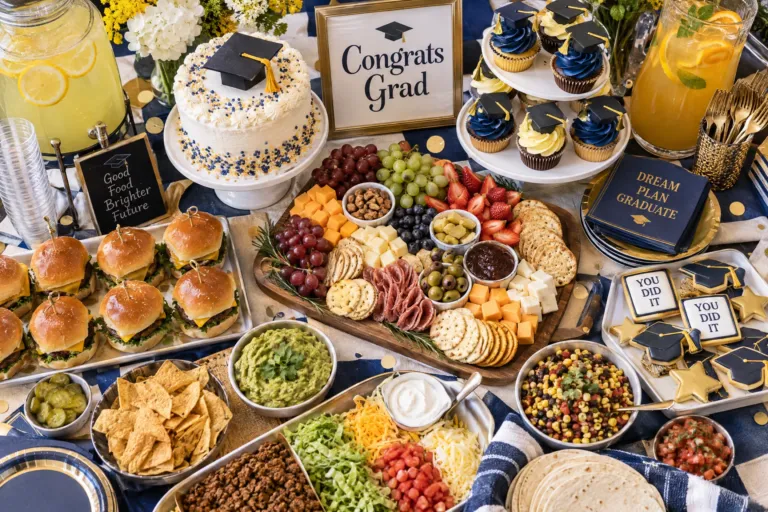
The cookout-and-grill menu. A backyard cookout format runs on 3 menu layers: the grill round (burgers, hot dogs, grilled chicken thighs, grilled vegetable skewers), the side dishes (potato salad, pasta salad, corn on the cob, baked beans, watermelon slices), and the dessert station (cap-shaped sugar cookies, diploma-scroll brownies, graduation cake). Serves 30 to 60 guests reliably for $6 to $12 per head when the family cooks in-house, $14 to $22 per head with a catered grill service. The cookout-menu walkthrough by guest count lives in the Graduation Party Food guide.
The open-house grazing-style buffet. An open-house format runs best on a steady-state buffet that holds across 4 hours: the savory layer (cold-cut sandwich platter, mini sliders, baked chicken tenders, cheese-and-cracker boards), the sides layer (fresh fruit platter, vegetable crudité with dip, chips-and-salsa bowls, pretzel-and-mustard station), and the sweet layer (cap-shaped cookies, mini cupcakes, brownies, graduation cake, fresh fruit kebabs). Holds steady from 1 p.m. through 5 p.m. without losing visual integrity. Plan for 1.5 servings per guest because the rotating-guest pattern means most guests eat across 2 visits. The Party Planning hub covers the broader buffet-style menu logic.
The sit-down restaurant or banquet hall menu. A restaurant private-room or banquet-hall format runs on 3 courses: the appetizer round (salad, soup, or shared appetizer plates), the entree round (plated or family-style with 2 protein options and 2 side options), and the dessert moment (graduation cake plus coffee-and-tea service). Confirm dietary restrictions during the RSVP window and lock the menu with the venue at least 2 weeks ahead. Pairs particularly well with the graduate-program level, where the feel is more formal than the cookout.
Match the drinks to the crowd. The drinks follow the format and the guest ages. The cookout runs on a self-serve cooler with sodas, sparkling waters, lemonade, and iced tea, plus a separate beer-and-wine cooler for adults only. The open house runs on a lemonade-and-iced-tea dispenser plus coffee for older guests. The restaurant or banquet format runs on a curated cocktail menu, a wine flight, and a non-alcohol option per course. Always check local rules on alcohol service before serving, and verify with your venue and caterer before purchasing. The Graduation Party Themes guide sets the palette pairings the drinks table can borrow.
The dietary-restriction handling. Confirm dietary restrictions during the RSVP window (the digital RSVP form should include a "dietary notes" field, or the host calls each guest's contact ahead). Build the menu so every restriction has a safe option across the appetizer, side, and dessert courses. Always check for food allergies before serving, label dishes with allergen-warning cards at the buffet, and consult with your caterer or venue about cross-contamination protocols. Never assume; always verify with each guest's input before the menu locks.
The bulk-ordering shortlist. Quantities run reliably on per-guest math: plan for 1.5 servings of the protein round, 2 servings of the side dishes (cookouts tend to over-consume sides), 2 to 3 dessert pieces per guest, and 2 to 3 drinks per guest across a 4-hour window. The Graduation Party Checklist guide puts the final quantity count in the last 2 weeks; the Ideas for Graduation Supplies guide covers the disposable-supply quantities (plates, napkins, cups, utensils) per guest.
Which Graduation Party Games Land Across Every Guest?
Game programming on a graduation party lives in the bridge between the meal moment and the cake-cutting, when the room needs a structured activity that holds for 30 to 45 minutes without dominating the day. The game-and-activity formats below cover most graduation party games, and the guest mix decides more than the graduate's level.
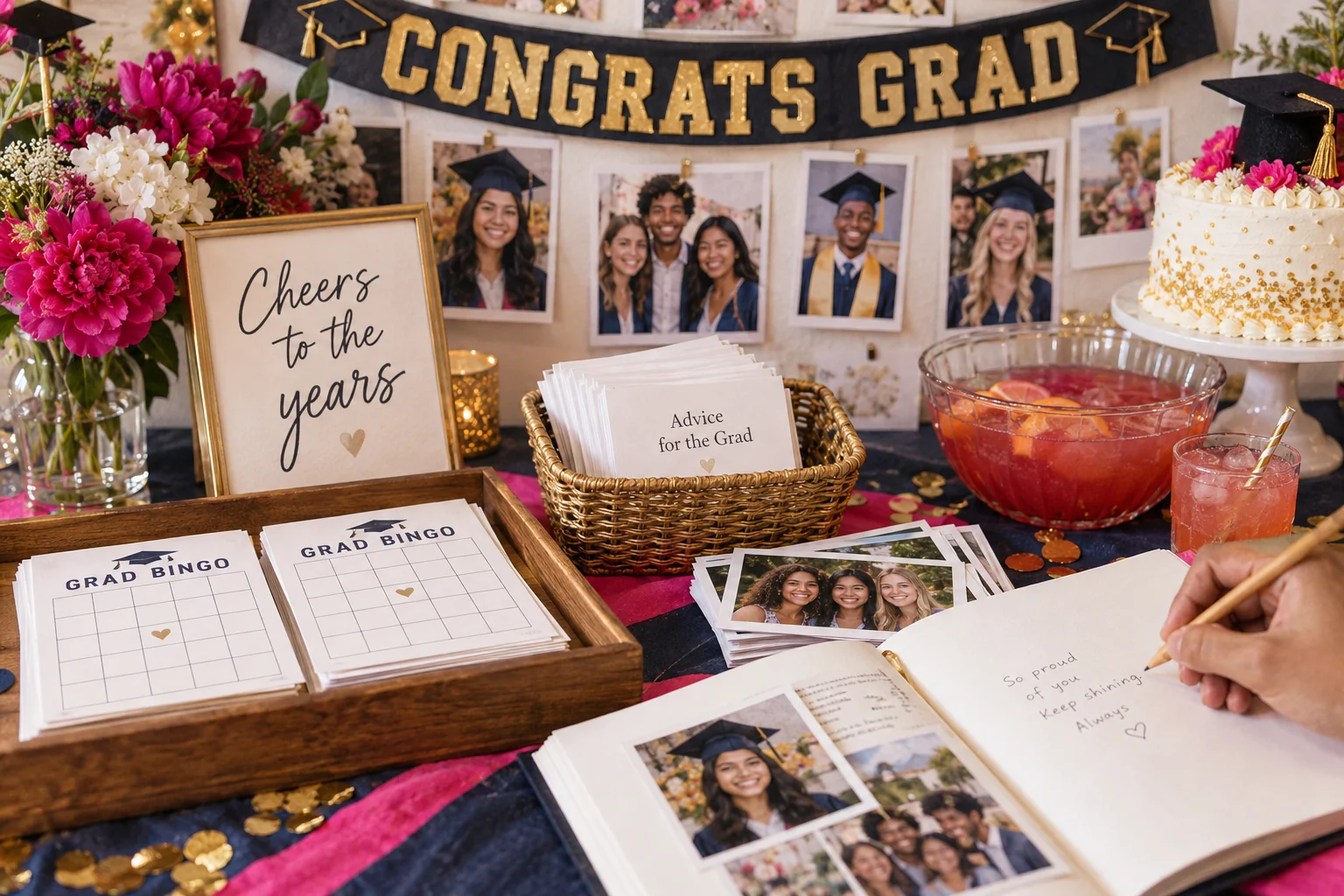
The advice-and-wishes station. A guestbook-replacement format where guests fill out prompt cards ("Best advice for the next chapter," "A favorite memory of [Graduate]," "A wish for the next 5 years," "A book or song recommendation") and drop them into a styled box for the graduate to read later. Every tier and every guest mix takes to this one. Skip the digital-signature variants for older guest layers; the printed-and-handwritten version travels better across generations. The Party Games & Activities hub covers how to build prompt stations; the Graduation Party Games guide carries the activity shortlist.
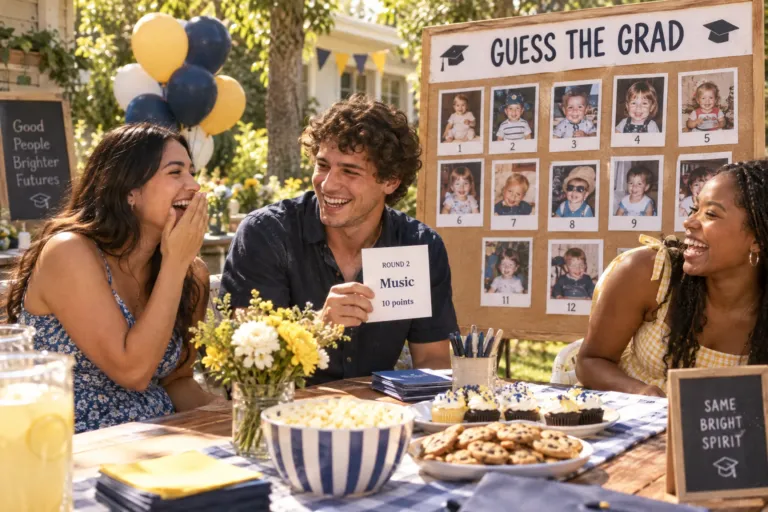
The guess-the-baby-photo display. A wall or table display with 8 to 12 baby photos of the graduate and any close family members or friends, with a guessing sheet for each guest. Few settings suit it better than a graduation party, where the through-the-years framing pairs with the milestone moment. Award a small token or favor for the guest with the most correct guesses. The photo-display construction breaks down in the Graduation Party Games guide.
The "How well do you know the graduate" trivia. A 12-to-15-question quiz about the graduate's school years, favorite teachers, embarrassing moments, accomplishments, and future plans. Hosts run it as a printed quiz or a verbal-Q-and-A format depending on the room energy. Works across high school, college, and graduate-program parties; less suited to kindergarten or elementary tiers where the trivia base is thinner.
The yearbook-style signing display. A large foam-core board, a styled photo of the graduate as the centerpiece, and a stack of permanent markers in school colors for guests to leave a signed message. The board becomes a keepsake the graduate brings to college, graduate school, or the first apartment. Pairs particularly well with the through-the-years photo wall as a dual-keepsake station.
The instant-photo-and-frame station. An instant camera (or smartphone with portable printer) loaded with film, a styled photo backdrop, a stack of small frames or magnets, and a "Take a photo for the fridge" sign. Guests photograph themselves with the graduate, frame the print, and take it home as their favor. Doubles as a photo-favor station and a guest activity, and is at its best at open-house formats where guest engagement spans 4 hours.
The lawn-game block for cookout formats. Cornhole, giant tumbling tower, ladder toss, washer toss, and bocce ball as a side-yard activity for the outdoor-cookout format. Provides a structured activity for younger guests while older guests settle into seated conversation at the picnic tables. Pairs particularly well with the Graduation Party Games outdoor activity shortlist.
The toast-and-speech moment. A structured 15-to-20-minute window where parents, the graduate, a sibling or mentor, and (for graduate-program tiers) an academic advisor each share a brief reflection. It works best at the cake-cutting moment, so the speech, toast, and cake flow into one continuous, well-photographed moment. Skip impromptu speeches; a curated lineup is the warmer route and spares you the "anyone want to say something?" silence.
Make it work for every age. Kindergarten and elementary tier parties should anchor on simple activities (a coloring station, a sticker-and-craft table, an outdoor lawn game), not the trivia-and-speech format that suits older tiers. Multi-tier joint parties (one sibling graduating kindergarten, another graduating high school) pull too far apart to share one event, so give each graduate a party of their own. The Preschool Graduation Ideas and Kindergarten Graduation Party guides cover the kid-friendly variants.
Choose the Favors for the Graduate
Graduation favors close the party arc with a small takeaway that thanks the guest for the celebration. Six favor formats cover most graduation party favors, and the graduate's personality and the format matter more than the headline theme.
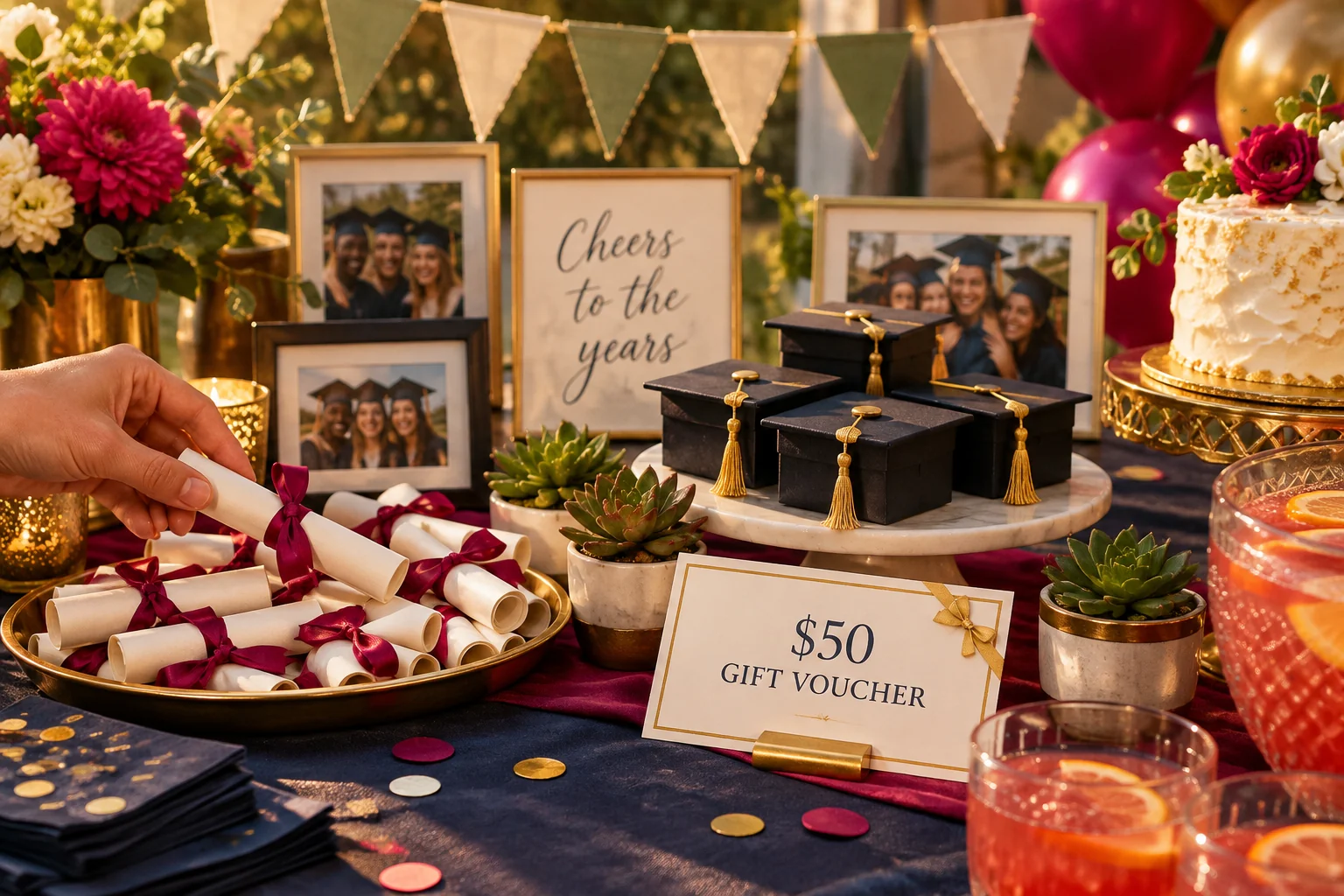
The mini diploma scroll. A small parchment paper rolled and tied with a school-color ribbon, often with the graduate's thank-you note printed on the inside. Because the diploma symbol echoes the celebration's headline moment, this is the favor guests reach for first. Reliably runs $1.50 to $3 per favor when the host assembles in-house. The name and year tags that finish each favor live in the Grad Favor Ideas guide.
The "Class of [the graduating class]" candy bag. A small kraft paper bag with a printed label and a curated candy mix (school-color candy-coated chocolates, mini chocolate caps, school-mascot lollipops). Suits high school and college, where the class identity is central. Part party favor, part take-home for guests with kids, and welcome either way. For edible favors priced per piece, see the Graduation Party Favors guide.
The cap-and-tassel chocolate box. A small black or school-color gift box with mini chocolate caps (chocolate-and-fondant cap shapes with a tassel), often tied with a school-color ribbon. This one belongs at graduate-program level, where the favor feels more refined than the kraft-bag candy version.
The succulent-or-seedling favor. A small succulent in a clay pot or a paper seedling pack with a "Grow Where You're Planted" or "Grow into the Next Chapter" tag. Suits adventure-ahead and future-plans theme angles where the metaphor lands cleanly. Reliably runs $3 to $5 per favor and travels well as a keepsake guests keep on the windowsill. Match the tag to the party palette, which the Grad Decor Ideas guide carries through every zone.
The instant-photo-as-favor. Guests photograph themselves with the graduate at a styled backdrop, the print develops on-site, and the guest takes it home as their favor with a small frame or magnet. Doubles as a guest activity and a takeaway. Runs $1 to $2.50 per print in film cost (the camera itself amortizes across multiple events).
The donation-as-favor. A small card at each place setting stating that the family has donated to a cause meaningful to the graduate (the graduate's high school scholarship fund, a literacy charity, a local food bank) in lieu of physical favors. Suits older-tier graduations where guests prefer a low-clutter takeaway and the family wants to surface the graduate's values.
Set up the favor table right. Position the favor table near the exit so guests grab a favor as they leave, label it with a "Take One Per Guest" tent card, and refill it halfway through so latecomers still find it stocked. The Party Planning hub times the favor hand-off inside the send-off window.
The budget shortlist. Favor budgets reliably run $1 to $5 per favor at most graduation parties. Above $5 per favor, the favor starts competing with the actual gift the guest brought. The Ideas for Graduation Supplies guide lists the favor boxes, bags, and tags to buy.
How Do You Handle Gift Etiquette and the Card Box?
Gift handling at a graduation party runs in 2 directions: the favor the host gives the guest as a thank-you takeaway (covered above), and the gift the guest brings the graduate (cash, gift card, or physical item). Modern graduation etiquette has softened around mandatory gift-giving, but most guests still arrive with a gift or card, so the host plans the receiving station ahead of time.
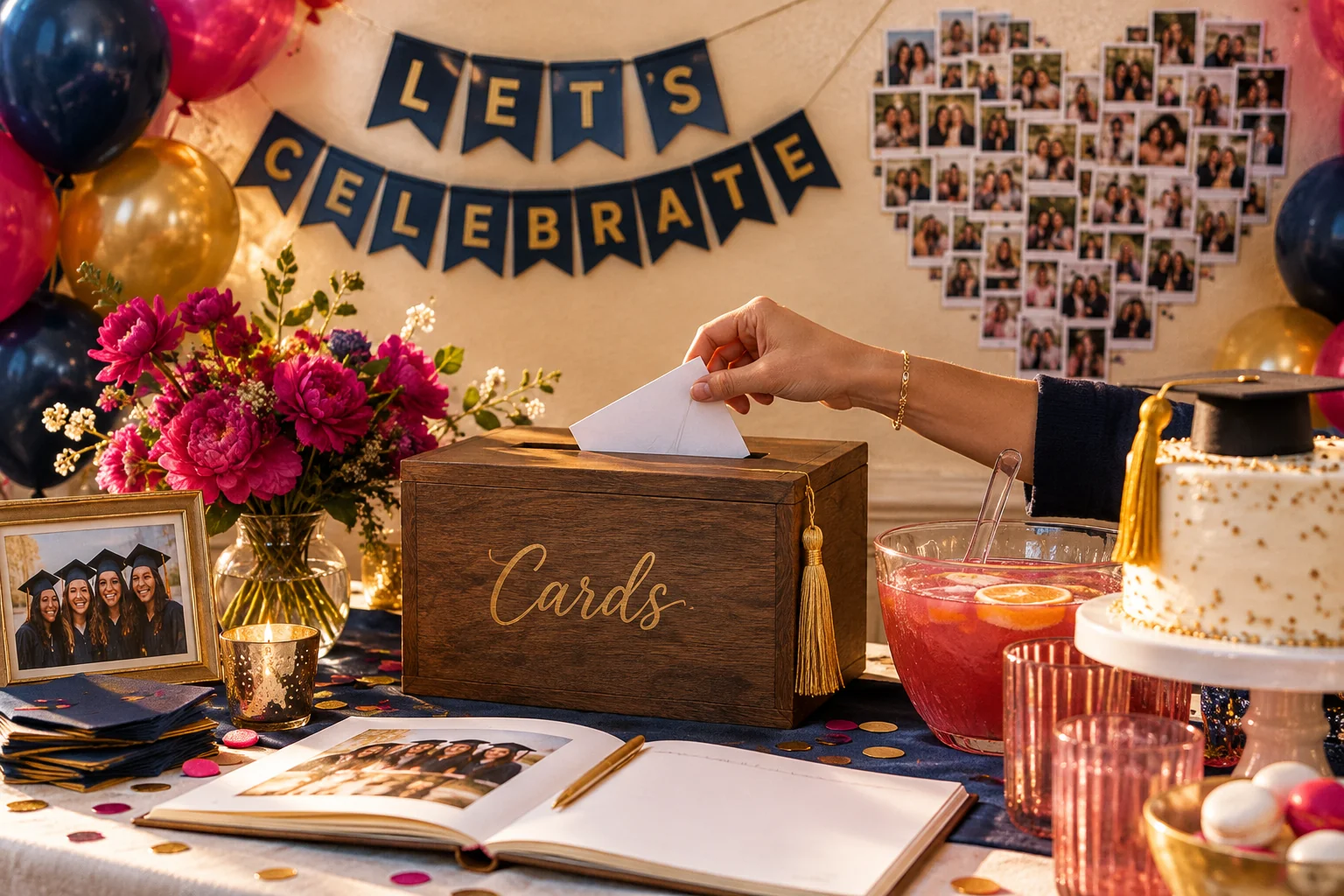
The card box station. A styled wooden or decorated card box with a slot lid, positioned at the entry or near the gift table, with a "Cards and Gifts" sign in matching typography. The graduate or a designated family member empties the box at the end of the night and tracks each card-and-gift pairing for thank-you-note purposes. What guests tuck inside is the subject of the Graduation Gift Ideas guide, with amounts set by relationship, and the Graduation Party Themes guide holds the palette pairings the sign can match.
The money tree. A small decorative tree (often a manzanita branch or a styled potted plant) with cash or gift cards clipped to the branches as guests arrive. In cultural traditions where cash-gifting is the norm, it gives the family a visible way to surface the generosity. The host clips a "Money Tree" tent card at the base and replenishes the visible-cash count discreetly (often by clipping additional small bills) so the early-arrival guests do not see a bare tree. The Party Planning hub maps the entry-and-welcome zone, a natural spot for the tree.
The wish-jar or shared-fund jar. A clear glass jar with a "[Graduate's Name] Fund" label and a slot for cash contributions, often used when the family wants to surface a specific savings goal (study-abroad fund, first-apartment deposit, textbook budget). Pairs particularly well with the donation-as-favor format where the family also surfaces the graduate's giving direction.
The gift-tracking sheet. A printed sheet (or a digital note on a phone) at the gift table where a designated family member logs each gift, the giver, and a brief note (cash amount, gift card retailer and amount, physical gift description). Drives the thank-you-card writing in the 2 weeks after the party. The Graduation Party Checklist guide books the card box and the thank-you card stock weeks ahead.
The guest gift-expectation framing. Most guests arrive at a graduation party with a gift, but the host can soften that expectation with the invitation wording ("your presence is the present," "cards welcome, gifts optional"). For close-friend and family-coded guest lists, gifts are nearly universal; for extended-network open-house formats with neighbors and coworkers, a "presence-only" framing strikes a warm note and reduces guest-side stress.
What guests typically give. Cash and gift cards are a common graduation gift at every level from high school through doctoral, with typical amounts running $20 to $50 per guest from extended family and $50 to $200 from close family. Physical gifts (luggage for the college-bound graduate, a stethoscope for the medical-school graduate, a watch for the professional-program graduate) often come from immediate family and mentors. Always check cultural norms and family expectations before adjusting the gift framing, and consider the family's regional context when sizing typical gift bands.
The post-party gift-handling protocol. Within 48 hours of the party, the graduate (with parents' help if younger) opens every card and gift, the family member running the tracking sheet logs the amount and item against each guest's name, and the graduate begins writing thank-you cards within 2 weeks. Out-of-state guests' cards go in the mail; in-state guests may receive a hand-delivered thank-you note at the next family gathering. The Party Planning hub covers the vendor side of the post-party follow-up.
The donation-redirect option. For graduates with strong charitable values or family resources, an invitation line stating "in lieu of gifts, please consider a donation to [cause]" sets a generous tone and shifts the gift expectation entirely. The host can position a styled donation jar with the cause's name and brief description at the entry so guests can contribute on-site if they prefer. Suits older graduates (graduate, doctoral, professional) more than the high school cycle, where the gift-receiving norm is more entrenched.
Tier Notes for Each Graduating Level
Graduation parties span an unusually wide tier range, from kindergarten promotions for 5-year-olds through doctoral hooding ceremonies for 35-year-olds. The core decisions (format, palette, photo display, food, favor) hold at every level, but the styling and the activities need tuning to the graduate's age and the weight of the milestone.
Kindergarten and preschool graduations. A backyard or living-room celebration with 10 to 25 guests (immediate family, the graduate's closest friends and their parents), anchored on a kid-friendly cake, a sticker-and-craft table for the kid guests, a small "I graduated kindergarten" sash for the graduate, and a single photo display showing the graduate's pre-K through kindergarten journey. Skip the speech-and-toast block; a kindergarten promotion sits better as a casual milestone moment than as a formal event. The Preschool Graduation Ideas and Kindergarten Graduation Party guides walk the kid-friendly format variants.
Elementary school graduations. A backyard cookout or living-room party with 15 to 35 guests, anchored on the graduate's chosen palette (often more graduate-driven than parent-driven at this age), a class-photo display, a lawn-game block for the kid guests, and a small cake with the school name. Let the graduate pick the theme angle (favorite hobby, favorite color, future-school excitement) instead of defaulting to the cap-and-gown traditional, and the warmth follows.
Middle school graduations. Less commonly hosted as standalone events, often folded into a family dinner or a small backyard gathering with the graduate's closest school friends. When hosted standalone, keep it casual and modern, with the graduate's middle-school identity front and center (sports team, club, a favorite teacher). Avoid the formal cap-and-gown decor at this tier; the milestone carries plenty of warmth without the full traditional treatment.
High school graduations. Often the largest party of all the tiers, with 40 to 100 guests across cookout, open-house, or banquet-hall formats. Anchor on school colors, the through-the-years photo wall, a curated playlist of the graduate's high school favorites, and a balloon arch with the school mascot or "Class of [the graduating class]" banner. The send-off layer (college destination, gap-year plans, military commitment, trade school) gets surfaced in the styling and the toast. The high-school-specific shortlist lives in the High School Graduation Party guide.
College and university graduations. A 25-to-60-guest event hosted at the family home, a restaurant private room, or a banquet hall (often coordinated with commencement weekend out-of-town family travel), anchored on the college's school colors, a senior-year photo display, the graduate's diploma in the achievement showcase, and a forward-looking theme angle (career, graduate school, gap-year travel). The College Graduation Party Themes guide walks the college-tier details; the Birthday Party Ideas hub covers milestone celebrations for the graduate's same-window birthday.
Graduate-program graduations (master's, MBA, doctoral, professional). A more formal event with 20 to 50 guests, often at a restaurant private room or a banquet hall, with a plated meal or family-style courses, a curated toast block including academic advisors and program mentors, and a refined photo display. The graduate's earned title gets surfaced in the invitation, the cake topper, and the signage. Match the styling to the weight of the achievement. Restraint flatters a doctoral hooding-day reception more than overdone cap-and-gown kitsch.
Trade school and professional certification graduations. A backyard cookout or restaurant dinner with 20 to 50 guests, anchored on the trade or profession the graduate is entering (toolbelt-and-blueprints styling for construction trades, scrubs-and-stethoscope styling for nursing programs, chef-jacket-and-knives styling for culinary school). There is real warmth in styling that honors the actual career path the graduate has trained for, rather than defaulting to generic cap-and-gown decor.
Retirement-tier and milestone-career celebrations. Adjacent to graduation events, retirement parties for long-serving employees, teachers, or community members run on a similar through-the-years-and-future-chapter framing. The Retirement Party Ideas guide carries the retirement-format brief; the Retirement Party Themes guide covers the styling shortlist.
Style for the graduate, not the gender. Many graduation parties default to gendered styling (florals for daughters, sports for sons), but the styling should follow the graduate's actual identity, not an assumed default. The Graduation Party Ideas for Guys guide covers one common slice of that; the styling should adapt to the individual graduate. Avoid assuming the graduate's preferences from the tier alone; ask the graduate to pick the color, the theme angle, and the activity block.
How the Graduation Planner and Budget Tools Sharpen Your Event
The free Graduation Party Planner drafts the event plan in under 2 minutes. Drop the graduating tier (kindergarten through doctoral), the school colors, the celebration format (backyard cookout, catered at home, restaurant dinner, banquet hall, open house, or joint with classmates), the guest count, the theme angle (future plans, memory lane, adventure ahead, class-of traditional, hobby-themed), and, for a joint celebration, how many graduates share the day, and the planner returns a structured plan with a decor-and-photo-display section, a timeline-and-speech-order section, and a gift-display-and-favors section. Parents stall most often on timing: the format is settled, but the hour-by-hour order still has to be worked out across arrival, food, speeches, cake-cutting, photo windows, and send-off. The planner outputs a printable timeline and speech order that hands off cleanly to the host family.
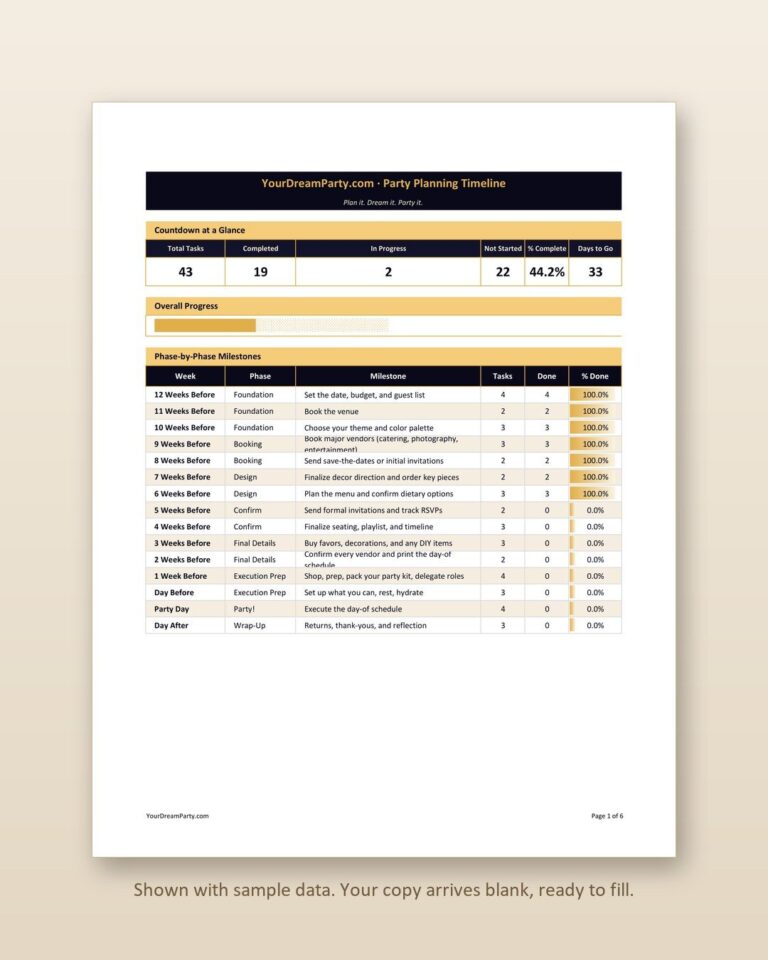
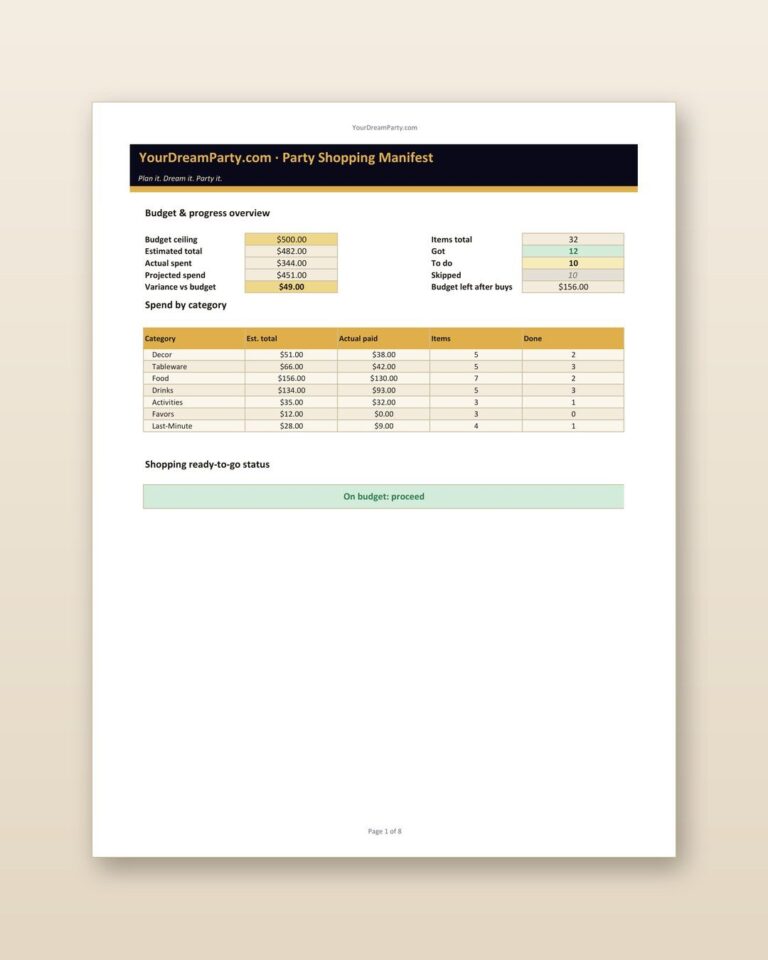
The free Party Budget Calculator handles the money side of the graduation party. Choose Graduation, then drop the guest count, the budget tier, your top priority categories, the venue type, how long the party runs, and what supplies you already own, and the tool returns a category-by-category allocation across food, drinks, decor, entertainment, photography, favors, cake, venue, and contingency. A budget left unsettled drags on every decision behind it, and the tool gives you realistic allocations in under 2 minutes. Pair the budget calculator with the Party Planning Timeline printable for a complete plan from start to finish.
The free Invitation & Sign Wording Generator drafts the graduation party invitation copy, save-the-date wording, welcome-sign text, and RSVP card wording from one set of answers, with tabs on the results screen to flip between them. Wording is an easy place to lose an evening, and the tool drafts matching copy for each of those pieces in under 2 minutes. Pair the wording generator with the printable Invitation Templates for a complete invitation-to-thank-you-card runway.
The free Party Planning Timeline handles the lead-time call across up to 8 weeks before the party date. Set the event to Graduation, then drop the party date (often the commencement weekend itself), the guest count, and how elaborate the party is, and on the Standard or Elaborate setting the tool returns a structured timeline covering the date, venue, and budget decisions (8 weeks ahead), catering bookings (6 weeks ahead), invitations (4 to 6 weeks ahead), supply ordering (4 weeks ahead), photo-display setup (1 week before), decorations (the day before), and day-of execution. Particularly useful when commencement weekend involves multiple family events stacked across 2 days.
Run the 4 tools in sequence: the graduation party planner builds the plan around your format and theme, the budget calculator handles the cost allocation, the wording generator drafts the invitation, save-the-date, welcome-sign, and RSVP copy, and the planning timeline locks the lead time. For more, the Party Planning hub covers event planning, the Party Decoration Ideas hub covers the styling, and the Party Games & Activities hub covers the activities. Graduation parties gain a lot from stacking these tools, because there is so much to plan: invitations, signage, photo display, run sheet, and budget.
Frequently Asked Questions
What are the best graduation party ideas for a small budget?
A backyard cookout with a grill-anchored menu (burgers, hot dogs, sides), a self-printed photo wall, a balloon arch in school colors, and printable advice-prompt cards runs $300 to $600 for 40 to 60 guests. The budget-saver is hosting at home, building 1 anchor display (the photo wall) instead of 3, and cooking the menu in-house instead of catering. That band works out to about $5 to $15 per head when the family handles the food and assembles the decor themselves, and the Invitation Templates printable supplies the matching invitation, RSVP, and thank-you cards for $7.00. The Graduation Party Checklist guide books the venue, rentals, and cake at week 8, while those calls are still cheap.
How far ahead should I send graduation party invitations?
Send save-the-date cards 8 to 10 weeks before the event for destination or large-format graduations; send formal invitations 4 to 6 weeks ahead with a 3-week reply window. For multi-generational guest lists, prefer printed-and-mailed invitations because older guests respond more reliably to physical mail than digital invites. The party itself often lands on the commencement weekend, so out-of-town family can stack the celebration with the ceremony attendance. The Graduation Party Invitations guide covers what every graduation invitation has to say.
What guest count works for a graduation party?
A typical graduation party runs 30 to 75 guests. Kindergarten and elementary tiers tend toward 10 to 35 guests (immediate family and the graduate's closest school friends and their parents); high school tiers tend toward 40 to 100 guests and college tiers toward 25 to 60 (extended family, the graduate's friend group, neighbors, school staff); graduate and professional tiers tend toward 20 to 50 guests (closer family, academic mentors, professional contacts). Above 100 guests, the open-house format handles the rotating attendance better than a sit-down dinner.
Who hosts the graduation party and who pays for it?
The graduate's parents traditionally host and pay for the celebration. Modern practice has softened this rule, and graduation parties hosted by the graduate themselves (for college, graduate, and professional-tier graduates with their own income), by grandparents, or by joint family-and-graduate funding are common. For joint celebrations involving multiple graduates from different families, the hosting families split the financial weight by guest count or by event-share basis. The Party Planning hub covers the broader budget-coordination logic.
Should we have a separate party for the commencement ceremony and the celebration?
Many families fold both moments into one celebration weekend instead of hosting 2 separate events. The pattern that works best is the commencement ceremony attendance on day 1 (with immediate family only) followed by the graduation party on day 2 or that evening (with the full extended-network guest list). Skips the double-event-fatigue that 2 separate parties produce. For graduate and professional tiers where the hooding ceremony involves academic regalia and a more formal moment, a small immediate-family reception immediately after the ceremony, plus a larger party that evening or weekend, handles both registers cleanly.
What is the difference between an open house and a sit-down graduation party?
An open house runs as a drop-in window (typically 1 p.m. to 5 p.m. or 2 p.m. to 6 p.m.) with guests rotating through across 4 hours, no assigned seating, a steady-state buffet, and a self-serve drink station. A sit-down party runs with a fixed start and end time, assigned or family-style seating, plated or family-style food courses, and a structured program with speeches and toasts. Open houses suit extended-network guest lists with neighbors and distant relatives; sit-down parties suit closer guest lists where every guest stays for the full event. Format choice depends on guest list size, venue, and whether the family wants something structured or relaxed.
Should I host a joint graduation party with another graduate?
Joint graduations work well when 2 to 4 graduates from the same family or close-friend group are graduating from the same tier (2 high school seniors, 2 college graduates) in the same season. It works less well when the graduating levels differ too much (a kindergarten promotion and a high school senior), because the styling and the activities pull too far apart. For joint parties, build a split decor plan: 2 photo displays, 2 cake-cutting moments, and paired send-off favors, so neither graduate is overshadowed. The Party Planning hub sizes the venue against the combined guest count.
What games are appropriate for a multi-generational graduation party?
Multi-generational guest lists run best on inclusive, low-stakes formats: the advice-and-wishes prompt cards, a "guess the graduate's baby photo" wall, a yearbook-style signing display, a "how well do you know the graduate" trivia, or lawn games for the cookout format. Skip drinking games, gender-segregating prompts, or any format requiring fast physical movement (relay races) at multi-generational gatherings. Of these, the advice-card station crosses generations best, because grandparents, aunts, uncles, and mentors often contribute the most memorable lines that land in the graduate's keepsake box.
How do I handle dietary restrictions and food allergies for the graduation party?
Gather allergy and diet flags as RSVPs arrive; a free-text field on the reply form does the work, with a phone follow-up for anyone who skips it. Build the menu so every restriction has a safe option across the protein, side, and dessert courses. Always check for food allergies before serving, label dishes with allergen-warning cards at the buffet, and consult with your caterer or venue about cross-contamination protocols. Lock nothing until each person has answered for themselves. The Graduation Party Food guide puts a vegetarian main on both the cookout and the buffet menus.
What is the appropriate budget for hosting a graduation party?
Budget bands run across 3 tiers: the at-home cookout format ($400 to $1,000 for 30 to 50 guests, family cooks, simple decor, in-house assembly), the open-house format with catering support ($1,200 to $2,800 for 50 to 80 guests, partial catering, rented decor pieces, a designated coordinator), and the full-venue banquet format ($3,500 to $9,000 for 60 to 150 guests, rented venue, full catering, DJ, professional photography). The Party Planning hub covers the budget-by-format breakdown; the free Party Budget Calculator drafts a category-by-category allocation in under 2 minutes. Always verify with your venue and caterer before making purchasing decisions.
Should the graduate write all the thank-you cards or do parents help?
The graduate writes the thank-you cards personally, with the parents handling the gift-tracking sheet and the address logistics. For younger graduates (kindergarten through middle school), parents help with the writing or the graduate dictates while a parent transcribes. For high school and older tiers, the graduate writes every card themselves; the personal-handwriting touch is the actual thank-you, not the parents' assist. Send cards within 2 weeks of the party with a handwritten note that names the specific gift, the giver, and a sentence about how the gift will be used.
What should I do with all the cards and money gifts after the party?
Within 48 hours, the graduate (with parents' help if younger) opens every card and gift while a designated family member logs the giver, the gift type, and the cash amount or gift-card value on a tracking sheet. Cash gifts get deposited (often into a college fund, a first-apartment savings account, or a textbook fund); gift cards get sorted by retailer and stored in the graduate's wallet or a small organizer; physical gifts get unpacked and tested. The graduate then writes thank-you cards within 2 weeks of the party based on the tracking sheet. The Graduation Party Checklist guide has you buy the thank-you card stock in week 4 or 3, so the cards are ready the morning after.
Ready to Plan the Graduation Party?
It comes back to 3 decisions: level, format, and headline display. Lock them before the supply order goes out, and the day runs as one smooth arc from the arrival hour to the send-off.
The fastest path from a blank page to a booked graduation party is to settle the level and format first, then layer invitations, decor, food, games, gifts, and favors on top. The free Graduation Party Planner builds the timing around your chosen format in under 2 minutes, and the Invitation Templates printable below carries the look from the first invitation to the last thank-you card.
This page contains affiliate links to Amazon and other retailers. As an Amazon Associate, we earn from qualifying purchases at no extra cost to you. This helps us keep all our tools free.
Results generated by this tool are for planning and inspiration purposes only. Estimates are based on general guidelines and may vary depending on your specific circumstances. Always check for food allergies before serving. Always verify with your suppliers before making purchasing decisions.