How the Cake Portions Planner Sizes the Order
The planner walks you through 5 short steps. Guest count, cake style, slice size and any dessert table go into one calculation, so the size it suggests fits the cake you are actually serving, not a generic dessert default. The whole thing takes under 2 minutes on a phone or laptop, with no signup or email needed first.
Step 1, event type. Say what the cake is for. The planner only raises the dessert-table question later for weddings, anniversaries, and milestone birthdays, so your answer here settles whether that step appears at all.
Step 2, guest count. Enter a headcount between 5 and 300. The whole recommendation rests on this number, so accuracy matters. The usual approach is to count adults at a full slice and children at a half slice, so a 60-adult, 20-child guest list goes in as 70.
Step 3, cake style. Pick tiered, single round, sheet, cupcake tower, or multi-tier. Tiered and single round both run on the standard wedding-cut math; sheet cakes feed the most per dollar but skip the height; a cupcake tower runs one cupcake per guest plus a buffer; multi-tier scales up to the grand wedding-size stacks on the same wedding cut.
Step 4, slice size. Pick Coffee Sliver (a thin sliver, ×0.6 of a standard slice), Standard Slice (the wedding standard 1×2 inch cut, or 2×2 inches on a sheet cake, ×1.0), or Generous Slice (a party wedge, ×1.4 of a standard slice). The multiplier scales the size of cake the planner works back to, so the same headcount lands on a different tier setup depending on how much cake each guest actually gets. A cupcake tower is the exception: the step still appears, but the slice you pick leaves the cupcake count unchanged.
Step 5, dessert table. For weddings, anniversaries, and milestone birthdays, the planner asks whether other desserts are on offer. Say yes and the cake becomes a feature instead of the whole dessert course, and the order sizes about 30 percent smaller to match.
🛒 As an Amazon Associate, we earn from qualifying purchases, at no extra cost to you.
Tiered Cake Stand
Check Price on AmazonCake Serving Set
Shop on AmazonDessert Plates Set
Shop on AmazonWhy the Cake Portions Planner Beats a Bakery Phone Call
A chat at the bakery counter is a natural first step when ordering a celebration cake, but it hides real costs. A baker may default to wedding-style slicing; you might assume the cake size in an inspiration-board image matches your headcount; the 2 assumptions collide at pickup when the cake turns out too small for the slice style you actually wanted. The planner settles the size, shape, and tier setup before you call, turning the whole order into a single clear line rather than a long negotiation.
Here are 5 reasons to run the planner before you leave a bakery deposit.
- Sizing that knows your slice size. The planner asks how generous a slice you are serving in Step 4, then works back to the cake that covers your guest count at that cut. Skip that question and the same headcount can land you a tier short or a tier over, because a party wedge at ×1.4 and a 1×2 inch wedding cut do not draw the same amount of cake off a tier.
- Tier setup matched to your headcount. A 100-guest tiered cake sliced at the wedding standard lands on 3 tiers, and the planner picks the tier sizes (12-inch base, 9-inch middle, 6-inch top) that hit exactly 100 servings without over-ordering. Guess the tier count yourself and you can end up paying for cake that finishes the night untouched.
- Dessert-table math. A cake surrounded by macarons, mini-cakes and pies gets eaten differently from a cake that is the only dessert in the room. Tell the planner at Step 5 that a dessert table is on and it sizes the order about 30 percent smaller, so the cake stays the feature without you paying to feed the room twice.
- Five cake styles, not one. Tiered and single round run on the standard wedding-cut math, sheet cakes on the party-slice math, and a cupcake tower on one per guest plus a buffer. Picking the style at Step 3 means the count comes from the right table, so a full sheet at 18 by 26 inches is quoted at its own 117 servings rather than a round-cake estimate stretched to fit.
- Child portions are yours to set. The usual catering convention counts children under 12 at a half-slice and adults at a full slice. The planner takes one headcount, so do that arithmetic before Step 2: a 60-adult, 20-child guest list goes in as 70, not a flat 80 that over-orders.
The planner sits neatly beside the Party Servings Estimator for quantities across the rest of the menu (appetizers, mains, sides, desserts and drinks), the Party Budget Calculator for weighing the cake spend against the wider catering line, and the Charcuterie & Tablescape Designer for laying out the dessert table around the cake.
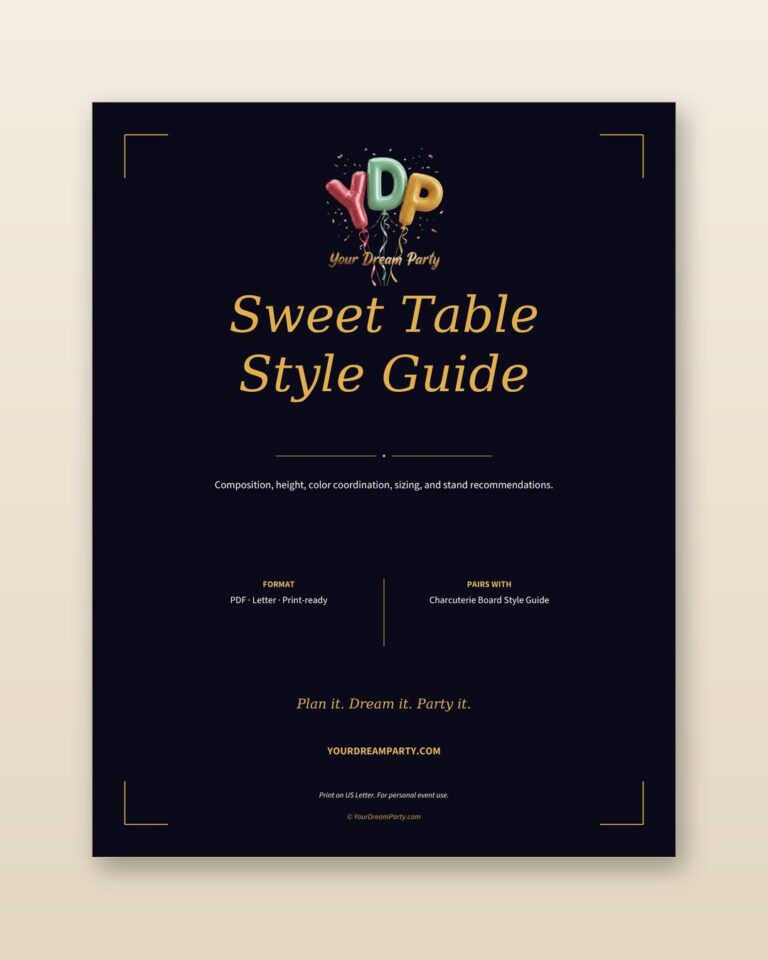
Sweet Table Style Guide
- Hero-and-court layout with 3 zones
- Five-height rule, budget risers and a flat-versus-layered drawing
- 6 color palettes with hex codes
- Cake sizing chart for round, tiered and sheet cakes
What the Cake Portions Planner Builds for Your Party
When you finish, the results page lays out a complete cake plan built from your answers. Each part is a concrete next step drawn from your 4 or 5 answers, whether you are ordering from a bakery or baking at home.
Size recommendation card. A single line names the cake setup that covers your guest count at your chosen slice size. A 100-guest wedding on a tiered cake at the standard cut, with no dessert table, comes out as a 12-inch round base, 9-inch middle and 6-inch top. A 30-guest birthday on a single round at the same cut comes out as a 9-inch round. It is the line you read straight to the bakery counter.
Cake layout and tier plan. A visual breakdown of the recommended structure, per-tier dimensions for a stacked cake, sheet sizing for a sheet, or cupcake counts for a tower, with the widest tier at the base and the diagram narrowing upward. The diagram downloads as a PNG, so it doubles as the reference for the bakery order, the home-baked pan-size list, or whoever runs pickup.
Servings math. Inside the same size card, the calculation is laid out plainly: the base servings of the recommended cake, the slice multiplier, the dessert-table reduction when one applies, and the number of guests that cake feeds. Behind those lines, the planner multiplies your guest count by the same factors and picks the smallest setup that clears the result; a cupcake tower gets a one-sentence count instead. Use it to check the recommendation matches your headcount before you place the deposit.
The cut behind the count. The layout text names the slice its numbers assume, the 1×2 inch wedding standard for rounds and tiers or the 2×2 inch party slice for a sheet, and the multiplier line repeats the slice size you picked. Pass that on so the cutter (usually a partner, a helper, or a hired cake cutter) runs the cut the count assumes rather than improvising on the day.
What to order beyond the cake. The last block covers the serving ware, the presentation props, and the storage you need to actually serve it well, so the plan does not stop at the tier list and leave you without a knife or a cold shelf.
Printed plan. The Print button sends the plan itself (the size, the layout and tier table, the what-to-order list and the disclaimer) to your printer, for the bakery counter, the home-baked pan-size list, or handing to a helper. It leaves off the printables and the Amazon picks, and it prints through your browser, with no PDF file of its own.
Run the Planner Across Common Party-Cake Setups
Three worked examples follow. Each moves through the same steps, apart from the dessert-table question that only the wedding gets, and the result changes with how your answers stack up.
Pattern 1, 30-guest birthday, single round, standard slice. The planner returns a single 9-inch round at 32 servings, covering the 30 guests with a small cushion for seconds. It suits a birthday of 25 to 32 guests, where a single tier covers the headcount. To top the cake once the size is set, see the birthday cake topper ideas guide.
Pattern 2, 80-guest baby shower, tiered, standard slice. The planner returns a 3-tier stack of 6, 9 and 12 inches at 100 servings, the smallest setup in its table that clears 80. The same stack covers any count from 75 to 100 at this cut, where the tiers bring height and any surplus covers the guests who come back for a second small slice.
Pattern 3, 150-guest wedding, tiered, standard slice, dessert table on. With other desserts in the room the planner works the 150 down through the dessert-table reduction, then picks the stack that clears what is left. Take the dessert table away and the same 150 guests need the 4-tier 6, 9, 12 and 14-inch setup at 178 servings instead. Either stack can anchor the cake table at a wedding of this size.
To zoom out to the whole event, the party planning hub walks through everything from venue to vendors, and the party decoration ideas piece covers the palette and florals that frame the cake table.
Pick the Right Answers Before You Run the Planner
The planner is only as sharp as the numbers you feed it. A few minutes on these up front keeps the size honest to your real party.
Base the guest count on likely RSVPs, not the invite list. A 120-person invite that brings 90 yeses should run at 90, not 120. Cake servings track the guest count closely, so the wrong number gives you either a cake that runs short at the cut or one that finishes the night untouched. If the RSVPs are hard to call, run the planner twice (once hopeful, once cautious) and pick the size that splits the difference.
Pick the slice size your cutter will actually use on the day. The standard 1×2 inch cut is the usual one at formal celebrations; the generous party wedge is the casual cut at backyard birthdays; the sliver suits a table where the cake sits alongside 5 other desserts. A size that clashes with the event leaves guests feeling either short-changed or overwhelmed, so settle it while you plan and tell the cutter which one the count assumes.
Pick the cake style that fits the table and the look you want. Tiered and single round carry florals and piped decoration cleanly; a sheet feeds the most per dollar and works where the cake is one of several things on the dessert table; a cupcake tower leaves only a small top cake to cut; multi-tier is for the grand stack. A style that fights the table layout looks misplaced even when the size is right.
Settle the dessert table before you order, not on the day. The planner only asks the question for weddings, anniversaries and milestone birthdays, and the answer moves the order by roughly 30 percent. Settle whether the macarons and mini-cakes are actually happening before you run it, because adding them afterward leaves you holding a cake sized to be the only dessert in the room.
Plan for second helpings. When the dessert table has several other treats, second slices stay rare; when the cake is the only dessert, more guests tend to come back for another small slice. The planner sizes the base recommendation at one slice per guest, so add a 5-to-10 percent cushion in your head if the cake is the only dessert.
Save the plan before you put down the bakery deposit. The printed plan works as the at-a-glance sheet for the bakery counter, the home-baked pan-size list, or the helper running the dessert table. Print it for the planning binder, use Email My Cake Plan to send yourself the size, slice and portion lines to forward to the partner or helper handling the cake cutting, and keep that email on your phone so the cutter can check the slice size on the day.
Frequently Asked Questions
Is the Cake Portions Planner actually free?
Yes. The planner, the size recommendation card, the cake layout and tier plan with its downloadable diagram, the servings math, the beyond-the-cake list, and the print, copy and email options are all free, with no signup. The paid extras are optional printables, led by the Sweet Table Style Guide ($7.00), which takes the result further with the hero-and-court table layout, 6 color palettes with hex codes, and a guide to sizing display stands.
How accurate is the cake portions planner?
The planner uses standard sizing tables (Wilton wedding-cut math for rounds and tiers, 2×2 inch party slices for sheets), and the plan itself tells you to confirm portions with your baker before you order. Accuracy depends on the cutter holding to the slice size the count assumes; a cutter who improvises (thicker first slices, an irregular grid) will fall short of the table's count. Tell the cutter which slice the plan used before the cut and the count has a fair chance of holding.
How many people does a typical wedding cake feed?
A 3-tier round wedding cake with a 12-inch base, 9-inch middle, and 6-inch top gives 100 standard servings; add a 14-inch tier under it and the 4-tier stack gives 178. The planner picks the exact setup for your guest count.
Should I order extra cake in case there are leftovers?
The planner sizes the recommendation at one slice per guest for your chosen slice style (less when a dessert table is on), which covers everyone. The one exception is a single round: it stops at its largest size and suggests a tiered cake for bigger counts. Add a 5-to-10 percent margin in your head if the cake is the only dessert; skip it if the table also has cookies, cupcakes, or a grazing board. Order well over the planner's recommendation and you'll usually end the night with cake going home in foil.
Can I use this planner for a sheet cake?
Yes. Pick "Sheet Cake" in Step 3 and the planner switches to sheet-cake counts: a quarter sheet at 9×13 inches feeds 24, a half sheet at 11×15 inches feeds 35, a 12×18 inch feeds 54, and a full sheet at 18×26 inches feeds 117. Sheet cakes are the most cost-efficient choice when height is not a priority, so think office birthdays, school graduations, and casual milestone parties.
What slice style should I pick for a baby shower or bridal shower?
The standard 1×2 inch cut is the usual one for showers, because the cake is normally the centerpiece and guests expect a full slice. If the shower has a dessert table with cookies, candies, or a fruit display, the Coffee Sliver gives the right size next to everything else. The planner takes one of the 3 slice sizes per run, so to compare, note the result, choose Start Over and run it again with another size.
Can I save or share the result?
Yes. The plan stays saved on this device and reopens when you come back. You can print it or download the cake diagram as a PNG. Email My Cake Plan sends the key lines to your inbox and Copy All copies them, ready to pass to the partner placing the deposit, the helper running the cake cutting on the day, or the bakery counter at pickup. Share passes on your cake style and guest count with a link to the tool.
Ready to Size the Cake Order?
Start with your final guest count and the Cake Portions Planner works back to a bakery-ready plan, with no spreadsheet math on your end. Two minutes, 5 steps, and you have a size recommendation card, a cake layout and tier plan with a downloadable diagram, the servings math behind it, a beyond-the-cake list, and a plan you can print. The Sweet Table Style Guide below takes the result further with a layout built around one focal piece, 6 palettes for the table, and advice on sizing display stands.
This page contains affiliate links to Amazon and other retailers. As an Amazon Associate, we earn from qualifying purchases at no extra cost to you. This helps us keep all our tools free.
Results generated by this tool are for planning and inspiration purposes only. Estimates are based on general guidelines and may vary depending on your specific circumstances. Always verify with your suppliers before making purchasing decisions.
Results are for planning and inspiration purposes only. Always check for food allergies before serving. Always verify with your suppliers before purchasing.