How Does the Wedding Reception Planner Work?
The planner runs 8 short steps. Each answer feeds a different part of the results, so your final plan matches the wedding you are actually hosting, not a generic 100-guest formal template. The whole thing takes under 3 minutes on your phone or laptop, with no signup and no email before you see the plan.
Step 1, reception style. Pick from 8 style directions (Formal & Traditional, Modern & Contemporary, Rustic & Country, Boho & Free-Spirited, Garden Romance, Beach & Coastal, Vintage Glam, Industrial Chic). Your style leads the palette and decor, and it also sets the speech, dinner, and send-off rows of the timeline.
Step 2, guest count. Hybrid preset cards plus manual entry covering 20 to 500 guests. Your count switches the cocktail hour between intimate and full-scale service, sets the length of the dancing block, and reorders the supply picks for medium and large rooms.
Step 3, venue type. Pick from 8 venue types (hotel ballroom, country house or manor, barn or farm, beach or seaside, garden or outdoor, restaurant, tent, religious plus reception combo). Your venue adds a venue-specific logistics note to the season section and tilts the supply picks indoor or outdoor.
Step 4, season. Pick the Spring, Summer, Fall, or Winter card. Your season shapes the Season-Specific Considerations on your results, with 4 tailored bullets each (winter covers heating, coat-check, and fading photography light; summer covers fans, shade, and water stations; spring covers a wet-weather Plan B; fall covers the golden-hour portrait window).
Step 5, budget range. Five bands (Under $5K, $5K-$15K, $15K-$30K, $30K-$60K, $60K+). Your budget range prints on the plan and tilts the supply suggestions toward budget or premium picks.
Step 6, priority elements. Pick exactly 3 priorities from 10 options (food and catering, bar and drinks, photography and video, florals and decor, music and DJ, wedding attire, ceremony setup, cake and desserts, wedding favors, transport). Your 3 picks each get a ~200-word detailed plan and a PRIORITY flag on the vendor checklist.
Step 7, cultural or religious traditions to include. Pick yes, no, or skip. Choose yes and Step 8 opens with the tradition picker; choose no or skip and the traditions step drops out, taking you straight to the review screen.
Step 8, specify traditions (conditional). Multi-select covering 10 tradition categories (Hora or circle dance, tea ceremony, sake ceremony, Garba or sangeet, henna or mehndi, Greek crowning, Jewish chuppah, Indian baraat, unity candle, or other text input). Your choices come back as an integration plan on your results.
🛒 As an Amazon Associate, we earn from qualifying purchases, at no extra cost to you.
Wedding Centerpiece Vase
Check Price on AmazonWedding Balloon Arch Kit
Check Price on AmazonWedding Card Box
Shop on AmazonWhy the Wedding Reception Planner Beats a Flat Vendor Spreadsheet
A blank vendor spreadsheet feels like the cheapest way to start, but it has hidden costs. Start from a flat list and it is easy to split the budget evenly, then overspend on florals while lighting goes underfunded. The gap can surface on the wedding day, when the photographer flags the lighting in the gallery. The planner has you pick your top priorities and shows the usual share of spend for each, so you settle where the money goes before florals can run away with the total.
Five reasons couples return to it across vendor meetings and planning weekends.
- Vendor priority list with lead times. The 10-item list comes with booking windows: 9 to 12 months out for the photographer, 8 to 10 for the caterer, the DJ or band, and the dress, then 4 to 6 months for the baker and transport and 3 to 4 for favors and stationery. A flat list drops everything in one column and leaves you to work out the order.
- Reception flow timeline from cocktail through send-off. Your results lay out the order (cocktail hour, guest seating, speeches, dinner, cake cut and first dance, open dancing, send-off) with a time block on each row, set by your style and guest count. A flat spreadsheet asks you to build the whole running order from scratch.
- Season-Specific Considerations for your time of year. A winter reception faces different logistics than a summer one (heating, daylight, guest comfort). You get 4 season-specific bullets plus a note for your venue type, the details that otherwise surface late in planning.
- Top-3 Priorities detailed with budget allocation. Each of the 3 priorities you mark in Step 6 gets roughly 200 words on your results: who to research, a budget share, a booking timeline, and one paragraph of day-of details to confirm. It is the level of detail you actually want walking into that vendor meeting.
- Cultural traditions integration plan. When you add traditions in Step 8, the planner works them into the reception flow (a Hora dance follows the first dance, a Jewish chuppah takes the early slot immediately after guests are seated, a tea ceremony comes before the dinner toasts). A flat spreadsheet treats traditions as a separate to-do.
The planner teams up well with a few others: the Seating Chart Planner for table arrangement once the guest list firms up, the Party Budget Calculator for sizing the spend across categories, and the Charcuterie & Tablescape Designer for styling the tables to match your reception style.
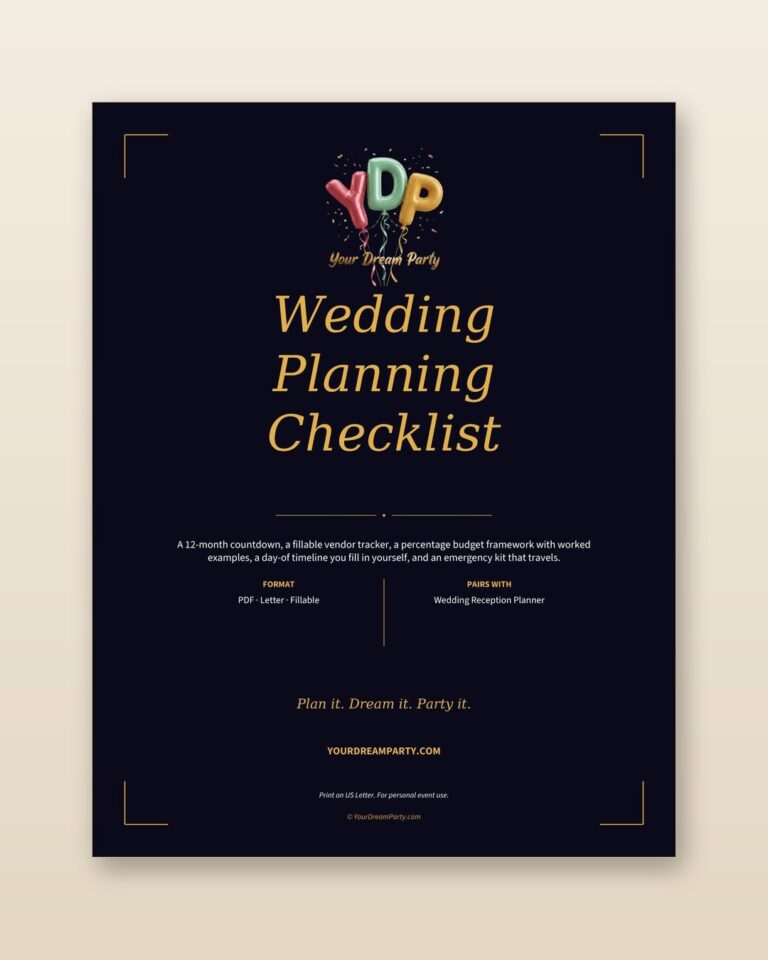
Wedding Planning Checklist
- 12-month countdown, month by month from the engagement
- 6-month intensive and a final-week checklist
- Fillable vendor tracker: 12 rows for contact, deposit, balance, due date
- Budget bands by category, worked through at 3 total budgets
What the Wedding Reception Planner Builds for Your Day
When you finish, you have a complete reception plan, built from all 7 answers (8 when you add traditions). Each part points to a concrete next step in your planning.
Hero results header. A badge row that confirms your style, guest count, venue type, season, and budget band at a glance. It ties the rest of the results to your specific wedding.
Season-Specific Considerations. Four tailored bullets matched to your Step 4 season, plus a note for your venue type. Winter covers heating and coat-check, candlelight, fading photography light, and guest travel risk. Summer covers heat protocols, later dinner timing, heat-tolerant florals, and how late the light holds.
Top-3 Priorities Detailed Plans. Each priority from Step 6 gets a ~200-word section: who to research (the questions to ask at each quote), a budget share of the total, a booking timeline, and a last paragraph on what to check for the day itself. It is written to bring straight into that first vendor meeting.
Vendor Priority List. A 10-item list across food and catering, bar and drinks, photography and video, florals and decor, music and DJ, attire, ceremony setup, cake and desserts, favors, and transport. Each row shows a booking window in months so you know what to book first.
Reception Flow Timeline. The order of the evening from cocktail hour through send-off, with a time block on each row, set by your style and guest count. Share it with the venue coordinator, the photographer, and the DJ so all 3 are working from the same schedule.
Color Palette. Five swatches built from your Step 1 reception style (Garden Romance brings blush, rose, sage, cream, and dusty rose; Modern & Contemporary brings white, near-black, silver, gold, and mid gray). Keep the card on screen as a reference for the florist, the linen rental, and the stationery designer.
Cultural Traditions Integration Plan (conditional). When you select traditions in Step 8, this section shows where each one fits in the reception flow, what equipment or props you need, and any vendor coordination notes. It keeps the traditions front and center without upsetting the rest of the day.
A full planning checklist to go further. Right below your plan sections, the Wedding Planning Checklist PDF offers a 12-month countdown, a vendor tracker, a budget allocation guide, and a day-of timeline template, for couples who want a deeper resource alongside the planner's first pass.
Use the Planner Across Common Reception Layouts
Here are 3 sample receptions. Each one runs the same 8 steps, but different answers lead to a different plan.
Pattern 1, formal traditional, hotel ballroom, fall wedding, 120 guests, $30K-$60K budget, priorities food and photography and florals. You get a Vendor Priority List with the photographer at 9 to 12 months out and the caterer at 8 to 10, a reception flow timeline with a structured speech block, plated 3-course service, and a coordinated send-off, Season-Specific Considerations for fall daylight (the couple's portrait window sits before sunset to catch golden hour), and Top-3 detailed plans for the caterer, the photographer, and the florist, each with a budget share and a booking window. It suits a traditional formal wedding.
Pattern 2, boho free-spirited, barn venue, summer wedding, 80 guests, $15K-$30K budget, priorities photography and music and decor. Here you get a Vendor Priority List with the photographer and videographer at 9 to 12 months out and the DJ or band at 8 to 10, a reception flow timeline with a 2.5-hour dance block and an optional late-night snack 90 minutes in, Season-Specific Considerations for ventilation in the barn and shade for the outdoor cocktail hour, and Top-3 detailed plans that name the photographer questions to ask, the band-versus-DJ tradeoff, and the florist's setup labor line. It fits a relaxed garden or barn wedding.
Pattern 3, modern contemporary, urban restaurant venue, winter wedding, 50 guests, $15K-$30K budget, priorities food and bar and photography. This one produces a Vendor Priority List that flags photography, catering, and the bar as priorities inside the same 10 rows, a reception flow timeline that opens with full cocktail-hour service, Season-Specific Considerations for coat check, candle-warm lighting, and short-daylight portrait timing, and Top-3 detailed plans covering the caterer's staffing ratio, the bar's bartender-to-guest ratio, and the photographer's full-gallery test. It suits an intimate urban wedding.
For more on reception decor and styling, the Wedding Reception Table Decorations and Room Decor guide digs into decor by style, and the Fall Wedding Reception Colors guide matches a fall palette to your venue.
Pick the Right Answers Before You Plan
A few answers sharpen the recommendation. Run through them first, since the planner can only be as precise as what you tell it.
Choose the style to suit the venue. Industrial Chic looks right at home in a warehouse or loft; the same style in a country manor feels off. Pick the style that suits the venue you have booked or are about to book, instead of picking a style and bending the venue to fit. The result page writes the decor language from the style you pick.
Give the guest count you actually expect. The planner takes a preset band or any exact number from 20 to 500, and the plan shifts at 50 guests and again at 200. Round up if RSVPs are still coming in; a small overestimate is easier to absorb than a scramble 3 weeks out.
Pick the venue type before you lock in the season. Venue and season play off each other (a barn in winter needs serious extra heating; a beach in winter needs an enclosed, heated tent). Pick the venue first, then the season, and the Season-Specific Considerations section adds notes on how venue and season work together.
Choose the 3 that matter most. Step 6 locks the remaining cards once you have 3, so the only question is which 3. Pick the ones you care about most (for example food, photography, florals; or photography, music, decor); the other 7 stay plain rows on the vendor checklist. Only your 3 get a detailed plan.
Be honest about the budget range. The planner uses the range, not an exact number. Pick the range that matches what you can spend, not what sounds impressive. The band prints on your plan and tilts the supply suggestions toward budget or premium picks, so pick the one you would actually sign for.
Use the traditions question with intent. Choosing yes means the planner weaves your chosen traditions into the reception flow, and that only works once the traditions are confirmed. If you are still deciding which to include, choose skip and run it again later once you have settled.
Save the result before the first vendor meeting. Your results print clean, copy as plain text, and email as a summary to a partner or planner. Print the vendor priority list and the reception flow timeline for the planning binder, and email the summary to the venue coordinator before the first walk-through.



Shop the Wedding Collection
Mrs. and Mr. mugs, Just Married and Honeymooning tumblers, a Bridesmaid tee and a Wedding Crew tank.
Frequently Asked Questions
Is the Wedding Reception Planner actually free?
Yes. The planner, the result page, the print view, and the vendor priority list are yours free, no signup. Want more? The Wedding Planning Checklist PDF ($12.00) adds a 12-month countdown, a vendor contact tracker, and a day-of timeline template for couples who want a deeper resource.
Can I run the planner on my phone?
Yes. The planner is built for portrait phone screens first, with desktop and tablet layouts that reflow automatically. Couples can run it together on the couch or over coffee during the early planning weekends.
Does the planner handle destination weddings?
Yes. The Step 3 venue picker covers most destination setups (beach or seaside, garden or outdoor, tent). The Season-Specific Considerations adjust to the destination season; for international spots, the seasonal notes still apply, since the planner uses general season labels, not location-specific weather data.
What if our reception style mixes 2 directions?
Pick the closer match to your venue, then treat the palette card and decor notes as a starting point. You can still blend 2 directions through the priorities (a Boho-leaning couple who picks Garden Romance can mark "florals and decor" as a priority to get the full florals and decor plan for that consultation).
How does the planner handle small intimate weddings under 30 guests?
The Step 2 guest count picker goes down to 20. Under 50 guests the plan switches to an intimate-scale cocktail hour, while the 10-row vendor list and the flow blocks hold. It stays useful for small weddings.
Can I add cultural traditions after running the planner?
Yes. Tap Start Over and run the planner again with traditions turned on in Step 7 and selected in Step 8. The integration plan rebuilds around the full reception flow, but Start Over clears the earlier answers, so copy or print that first plan before you begin. You can run it twice: once for the broad strokes, once for the traditions after the family conversations settle.
How does the planner handle a wedding without a ceremony (reception-only)?
The Step 1 style and Step 3 venue picker both handle this. The reception flow timeline already opens at the cocktail hour, so there is no ceremony segment to cut. The vendor list still shows the officiant row, which you can skip. A few season notes and priority plans do mention the ceremony, so read past those lines.
Ready to Plan Your Wedding Reception?
Early planning has a way of spiraling, so run the Wedding Reception Planner to give it a backbone. In under 3 minutes and 8 steps you get a vendor priority list that says how far ahead to book each one, a reception flow timeline, a season-tailored notes section, a 5-swatch palette, and detailed plans for your top 3 priorities. The Wedding Planning Checklist PDF below extends it into a 12-month countdown for couples who want the deeper reference.
This page contains affiliate links to Amazon and other retailers. As an Amazon Associate, we earn from qualifying purchases at no extra cost to you. This helps us keep all our tools free.
Results generated by this tool are for planning and inspiration purposes only. Estimates are based on general guidelines and may vary depending on your specific circumstances. Always verify with your suppliers before making purchasing decisions.