How Does the Charcuterie & Tablescape Designer Work?
The tablescape designer runs 5 short steps. Your occasion can narrow the aesthetics in Step 3 and your aesthetic sets which palettes Step 4 offers, so your palette and lists stay with the look you picked, not a generic rustic farmhouse template. The whole thing takes under 5 minutes on your phone or laptop, with no signup and no email required to see your results.
Step 1, occasion. Pick from 10 occasion options (birthday, baby shower, wedding, bachelorette, anniversary, kids party, dinner party, brunch / tea, cocktail party, holiday gathering). Your occasion sets the title and intro wording on your results, and a kids party also turns the candle picks into battery LED or fairy-light versions.
Step 2, table or board size. Pick small board for 1 to 4 guests, medium board for 5 to 10, long table for 11 to 20, grazing table for 21 plus, or multi-table setup. The size sets which zones appear on your layout diagram, from 2 on a small board up to 6 on a grazing table.
Step 3, aesthetic. Eight aesthetic directions cover rustic farmhouse, modern minimal, boho earthy, coastal Mediterranean, French Provençal, dark moody, garden floral, and vintage tea. The list adjusts to your occasion (a kids party drops dark moody and vintage tea; a wedding drops dark moody, which rarely fits). Your aesthetic guides everything that follows.
Step 4, color palette. Your aesthetic brings up 3 curated presets, each one a fixed row of 5 swatches. Pick dark moody and you see dark-tone presets; pick boho earthy and you see earth-tone presets. Your palette then drives the serving-ware picks, right down to the table linens, and it colors the zones on your layout diagram.
Step 5, review. Check your picks on the review card, hit generate, and your results appear: a visual layout diagram (an SVG map of labeled zones for your surface), a prop and styling list, color-matched serving-ware ideas, decor accents matched to your aesthetic, 3 Pro Tips for your aesthetic, and a downloadable PNG of the layout to pass to a co-host or stylist.
🛒 As an Amazon Associate, we earn from qualifying purchases, at no extra cost to you.
Wooden Charcuterie Board
Check Price on AmazonCheese Knife Set
Check Price on AmazonCandle Holders Set
Shop on AmazonWhy the Charcuterie & Tablescape Designer Beats a Mood Board Spiral
Scrolling through inspiration boards feels like the cheapest styling shortcut, but it has hidden costs. It is easy to save dozens of clashing photos across aesthetics that do not go together, mix props from different palettes, and end up with a board that looks "too much" in the overhead shot. The tablescape designer walks you through 4 clear decisions before the first prop goes down, so your board holds one look from the start.
Five reasons hosts return to it across multiple events.
- One look, start to finish. Pick rustic farmhouse in Step 3 and, in one pass, you get reclaimed wood boards, dried wheat bundles, chalkboard tags wired to the serving boards, and pillar candles in wood holders. A mood-board plan asks you to make those 4 choices separately and hope they go together.
- Color-matched serving ware ideas. The designer matches serving ware (marble platters, ceramic stoneware, wood boards, silver-plate cake stands) to your palette and look. A scroll-built plan leaves you in the serving-ware aisle with nothing to guide the choice.
- Zones drawn for your surface. A small board for 4 guests and a grazing table for 25 are not the same map. Your Step 2 answer decides which zones the diagram blocks out, from a single board plus accents up to a 6-zone grazing spread, while saved inspiration boards usually assume one typical size.
- Decor that comes together. Greenery (eucalyptus, olive branches, dried pampas, lavender bunches), candles (taper, pillar, votive), and linens (burlap and linen runners, gingham, macrame, a velvet accent strip) all sit in the designer's decor lists, and your results bring the set chosen for your look. A scroll-built plan asks you to source each one on its own.
- Styling only, by design. The designer sticks to how the board looks: no food safety advice, no crowd-serving math (that lives in the Party Servings Estimator), no health claims about cured meats or cheeses. Keeping to the look leaves food questions to the right sources and keeps the styling honest.
The designer pairs well with a few of our other tools: the Party Servings Estimator for crowd-quantity math, the Party Color Palette Generator to work out a scheme from an anchor color of your choosing before the linen order, and the Wedding Reception Planner when the tablescape is part of a bigger reception.
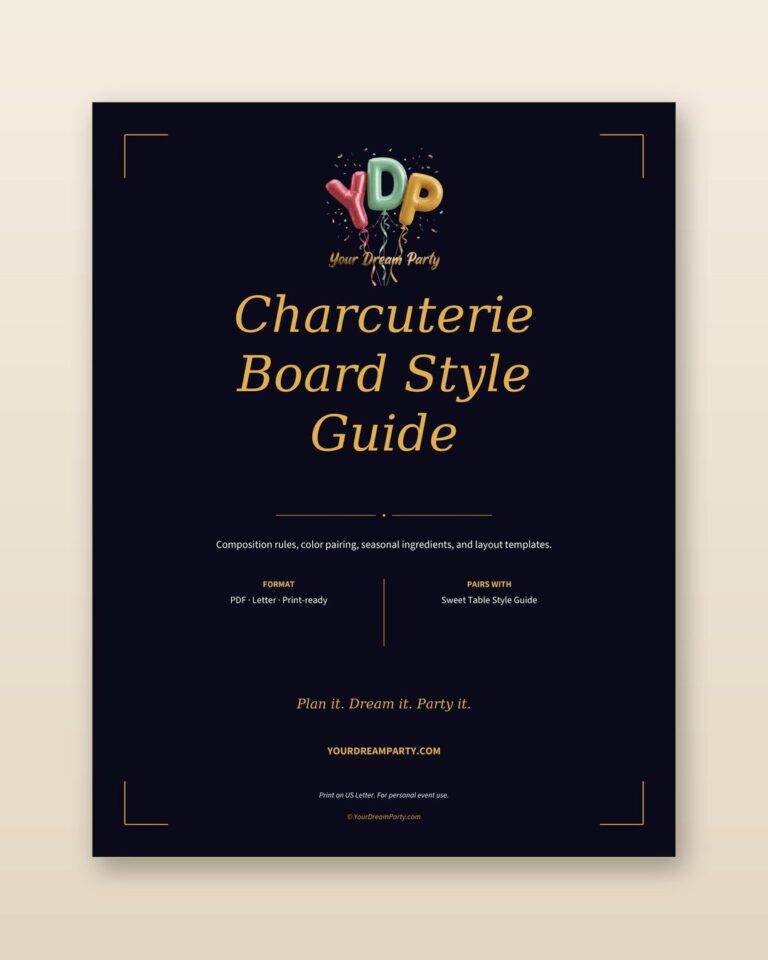
Charcuterie Board Style Guide
- 5 composition rules, from anchors to edges, in working order
- 8 color palettes with hex codes
- Seasonal ingredient swaps for all 4 seasons
- 7 board layout maps and a guest-count sizing table
What the Charcuterie & Tablescape Designer Builds for Your Surface
When you finish, the designer builds a full styling plan from your 4 answers. Each part is a clear next step.
Visual layout diagram. A top-down placement map with every zone blocked out and labeled: the main board, any dip, appetizer, cheese, or charcuterie stations, a dessert or drinks corner if your size has one, and an accent decor zone. A legend underneath ties each palette color to its zone. Print it or share the PNG with a co-host or stylist.
Prop and styling suggestion list. A flat list of 7 or 8 props drawn from your aesthetic, such as serving boards, runners, pinch bowls, glassware, candle holders, or cake stands. It reads like a pick list, not a mood board: the tool tells you to keep the ones that fit your space, and it sets no quantities beyond a styling count in some lines.
Color-matched serving ware ideas. Specific serving-ware picks matched to your palette and look. Rustic farmhouse in sage and cream brings natural wood boards, stoneware bowls, and brass utensils; modern minimal in white, black, and brass brings a matte black slate platter, white matte porcelain, and brass-handled cheese knives.
Decorative element suggestions. Five decor accents chosen for your aesthetic, drawn from greenery (eucalyptus runners, olive branches, dried pampas), candles (tapers in brass holders, pillars in wood, smoked-glass votives), linens (burlap, gingham, macrame, a velvet accent strip), and pieces such as risers or a cake stand. Rustic farmhouse and vintage tea get a different set of 5 each.
Three Pro Tips per aesthetic. Tips on the styling moves that make each look land (rustic farmhouse on staging 3 board heights; dark moody on lighting from below; coastal Mediterranean on picking the bluest blue you can find). The tips are specific to your look, not generic.
Downloadable layout PNG. Save the full layout as a PNG to pass to a stylist or co-host, or to keep on hand for the day itself, when the swatch picker is a distant memory.
A deeper style guide to round it out. Right after the Pro Tips in your results, the Charcuterie Board Style Guide PDF offers composition rules, color pairing, and host presentation tips, for anyone who wants a fuller styling library beyond the single layout.
Use the Tablescape Designer Across Common Hosting Layouts
Here is how 3 different tables come out. Each one runs the same 5 steps, but different answers lead to a different table.
Pattern 1, intimate dinner party, 12 guests, long table, French Provençal aesthetic, soft-pink-and-cream palette. You end up with a Provençal table: a gingham runner, small lavender bunches tied with twine, glass cloches over the cheese rounds, cream ironstone with a soft pink rim, and pressed botanicals in small frames. Three Provençal Pro Tips cover repeating one small pattern, a lavender bunch at each setting, and holding the pastels to 3. It fits an intimate sit-down evening at home.
Pattern 2, baby shower brunch, 25 guests, grazing table, garden floral aesthetic, pastel rainbow palette. This builds a garden-floral grazing table: a eucalyptus runner down the center, abundant garden roses in low vessels, a cake stand garnished with fresh flowers, pastel-mix ceramic platters and bowls, and crystal votives in clusters of 5 to 7. Three garden-floral Pro Tips cover keeping the florals below eye level, running one greenery type the whole way down, and small bud vases over one grand arrangement. It is a natural fit for daytime celebrations that lean visual-heavy.
Pattern 3, cocktail party, 10 guests, medium board, dark moody aesthetic, matte black and gold palette. This one centers on a dark, moody focal board on slate or dark wood: taper candles in brass candlestick holders, a velvet runner accent strip, brass-handled cheese knives, oxblood dahlias and ranunculus, and a single statement candelabra at the center. Three dark-moody Pro Tips cover lighting from below, letting one candelabra anchor the table, and choosing deep flowers over pastels. It suits an adult evening cocktail gathering.
To take these looks further, the Party Centerpiece Ideas guide digs into floral and candle staging, and Party Table Setting Ideas shows how to coordinate place settings with your tablescape.
Pick the Right Answers Before You Design
A few answers sharpen the layout. Run through them first, since the designer can only use what you give it.
Measure the actual surface. A medium board for 5 to 10 guests runs roughly 18 to 24 inches; a long table for 11 to 20 guests runs roughly 6 to 8 feet. Measure before you answer Step 2. Choose long table for something closer to grazing-table size and your diagram loses the cheese station and the dessert station you actually need.
Pick the look to suit the room, not the occasion. Dark moody shines in a low-lit dining room with dimmer switches; the same look in a bright, sunlit kitchen falls flat. Choose your aesthetic to suit the room you are styling. The occasion filter only trims the list for kids parties and weddings, so the room is the better guide.
Lean on 3 of your 5 swatches for a single board. Every preset ships 5 colors, and on one board that spreads too thin for each color to register. Let 3 carry the props and the linens, and hold the last 2 back for a flower accent or one statement item.
Start from the preset list, not from a color idea. The Step 4 picker offers presets that match each aesthetic for a reason: they read cleanly with the look you chose. There are 3 per aesthetic and no custom slot, so the only call is which of the 3 fits the room you are styling.
Decide single board or grazing table early. A single board for 4 guests works as one focal moment; a grazing table for 25 spreads into a long, flowing display. Your Step 2 answer sets this from the start, and changing it once you start setting up means restyling everything.
Save the layout PNG before you shop. The PNG is the easiest thing to follow when styling on the day (Print Layout puts the props, serving ware, and decor on paper for the shopping run). Print it for the planning binder, share it with whoever helps you set up, and check it on the day instead of trusting your memory of a diagram from a week ago.
Frequently Asked Questions
Is the Charcuterie & Tablescape Designer actually free?
Yes. The designer, the result page, the printable summary, and the visual layout diagram are yours free, no signup. Want more? The Charcuterie Board Style Guide PDF ($12.00) adds deeper composition rules, color pairing, and host presentation tips.
Can I run the designer on my phone?
Yes. The designer is built for portrait phone screens first, with desktop and tablet layouts that reflow automatically. Run it the weekend before your event from the couch or the venue itself; no desk needed.
Does the designer handle food safety guidance for cured meats or cheeses?
The designer covers how the board looks, nothing more. Food safety, allergy guidance, and serving-temperature advice are outside what it does. For those, follow USDA guidance or your local food safety authority; the designer does not replace them.
How does the aesthetic filter interact with the occasion picker?
Step 3 can adjust the aesthetic options to your Step 1 occasion. A kids party drops dark moody and vintage tea, since neither one fits; a wedding drops dark moody, which rarely suits a wedding tablescape. This keeps you from pairing a look with an event it clashes with.
Can I save or share the layout?
Your results come as a printable summary, a Copy All bundle of the whole style guide, an email of the plan to yourself, and a downloadable PNG of the layout diagram. Paste the copied text to a stylist, co-host, or rental supplier and they get every list and the palette hex codes without opening the tool; send the PNG along for the map.
Does the designer cover grazing tables for large parties?
Yes. The Step 2 size picker includes grazing table for 21 plus guests and a multi-table setup that splits the spread into dessert, drinks, and grazing zones. A grazing table then draws 6 zones instead of a medium board's 3, adding the cheese station, the charcuterie run, and the dessert station.
How does the designer handle dietary preferences for the food layout?
The designer covers visual styling only, not food selection. For dietary preferences (vegetarian, vegan, gluten-free, halal, kosher), choose your food items separately based on your guest list, then come back to the designer for the styling layout. The look works whatever is on the board.
Ready to Design Your Tablescape?
Open the designer above and 5 steps give you a layout diagram locked to one look, a prop list for your aesthetic, color-coordinated serving-ware ideas, decorative guidance, and 3 Pro Tips for your aesthetic. The Charcuterie Board Style Guide PDF below extends it into a full composition library for anyone who wants the deeper reference.
This page contains affiliate links to Amazon and other retailers. As an Amazon Associate, we earn from qualifying purchases at no extra cost to you. This helps us keep all our tools free.
Results generated by this tool are for planning and inspiration purposes only. Estimates are based on general guidelines and may vary depending on your specific circumstances. Always verify with your suppliers before making purchasing decisions.