How Does the Balloon Garland & Arch Calculator Work?
The calculator runs 7 short rounds. Each answer feeds the formula, so the final count fits the installation you are actually building, not a generic 6-foot organic garland. The full session runs on a phone or laptop, with no signup or email gate before the result.
Step 1, installation type. Pick the shape (garland for an organic draped line, arch for a structured free-standing frame, column for a vertical pillar, cluster for a focal grouping). Your choice multiplies the base count (an arch runs 1.5 times a garland, a column 0.7, a cluster 0.4), and it adds shape-specific supply cards to the result page.
Step 2, indoor or outdoor and ceiling height. A 2-part question. Choose indoor and a second question appears about ceiling height (standard 8 ft, high 10 to 12 ft, vaulted 12 ft plus, or Don't know); choose outdoor and it skips the height check, adding a 10 percent wind-resistance buffer to the count. Indoors, standard, high, and Don't know all come back with a few 16-inch statement balloons in the mix, and the vaulted 12 ft plus answer gets more of them; outdoor leaves the 16-inch balloons out.
Step 3, size or length. A number input taking any value from 1 to 30 feet, with 4 preset cards at 6, 10, 16, and 24 feet; the Imperial and Metric toggle sits under the hero. Your length, the Step 4 density, and the shape multiplier multiply together into the base count. For a column, Step 3 also asks how many you are building (1 to 4, default 2), and the count covers them all.
Step 4, fullness tier. Pick sparse at 8 balloons per foot, standard at 10, lush at 12, or extra-lush at 16. That per-foot number is the density the whole count is built on, and it also decides how full the finished garland reads: sparse stays airy, extra-lush turns into a solid sculpted line.
Step 5, color palette. A picker of 24 swatches supporting up to 5 colors, plus a choice of Even split or Dominant color. On the Even split, the default, the calculator splits the latex count across the swatches you picked in steps of 5, gives any leftover 5s to your earliest picks, starting with the first, and the colors always add up to the latex total. Dominant color shares the same total by pick order instead, 70/30 with 2 colors and 60/30/10 with 3, and prints each color's share beside its count. Each color lands on the result page as its own row carrying a count and a size breakdown.
Step 6, extras. Optional counts for foil letters and numbers (up to 20), balloon bouquets (up to 10), 36-inch feature balloons (up to 6), and a confetti-fill slider running 0 to 30 percent of your latex count. Step 7, review and calculate. The review card lists every answer back, then the calculate button builds the total count by size, the per-color split, the buffer recommendation, the pump-type suggestion, the SVG mockup of the installation in your chosen colors, and a downloadable PNG for handing off to a decorator or florist.
🛒 As an Amazon Associate, we earn from qualifying purchases, at no extra cost to you.
Balloon Garland Kit
Shop on AmazonElectric Balloon Pump
Check Price on AmazonBalloon Arch Frame
Check Price on AmazonWhy the Balloon Garland & Arch Calculator Beats an Eyeball Estimate
Guessing the balloon count is the easiest shortcut in decor planning, and one that often backfires. The decorator who eyeballs it orders light, installs the arch on the day, and finds the gap when half the photo zone shows bare backdrop instead of a full balloon line. The calculator bases the count on per-foot density, so your order matches the run of the arch instead of a hunch.
Five reasons to run it before every balloon order.
- Per-foot density done for you. Indoors with a standard ceiling, a 6-foot organic garland at standard fullness comes back at 65 balloons, 10 of them 16-inch, 35 of them 11-inch and 20 of them 5-inch; a 10-foot lush arch comes back at 180. The numbers come from the same formula on every run, not an inspiration-board comment thread. Eyeballing tends to produce thin arches that look patchy in photos.
- Size split across 5-inch, 11-inch, and 16-inch. Indoors, a garland or arch mixes 3 balloon sizes (fillers, standards, statement pieces) in a set ratio. The calculator picks the ratio off your Step 2 answers: indoors under a standard, high, or unknown ceiling it uses a 5-3-1 mix (5 parts 11-inch, 3 parts 5-inch, 1 part 16-inch), a vaulted ceiling gets the layered 15/55/30 mix with more 16-inch balloons, and outdoors gets a 70/30 mix of 11-inch and 5-inch. A single size misses the textural depth that makes an arch look sculpted.
- A per-color count, not one number for the whole order. Picking 5 swatches and then guessing at quantities is where the arch goes wrong. On the default Even split, the calculator splits the latex count across your swatches in steps of 5, with any spare 5s going to the first colors in your pick order, and gives each color its own breakdown by size that adds up to the size table. That table is what you read off when you order.
- Fullness updates every size count, not just the total. A second run with the Step 4 fullness card switched from Standard to Lush lifts the density from 10 balloons per foot to 12 and rebuilds every size row and every color row from scratch. Doing this by hand is slow and easy to get wrong; the calculator redoes every row for you.
- A spares line printed beside the total. Every result carries a Buffer Recommendation banner telling you to order 10 to 15 percent extra for pops; that number sits next to your total instead of hiding inside it. Skip the spares and a few pops can leave you short mid-build.
The calculator pairs naturally with the Party Color Palette Generator for refining the swatch set before ordering, the Party Budget Calculator for sizing the decor spend, and the Charcuterie & Tablescape Designer for dressing the dessert table in a palette preset close to the arch colors.
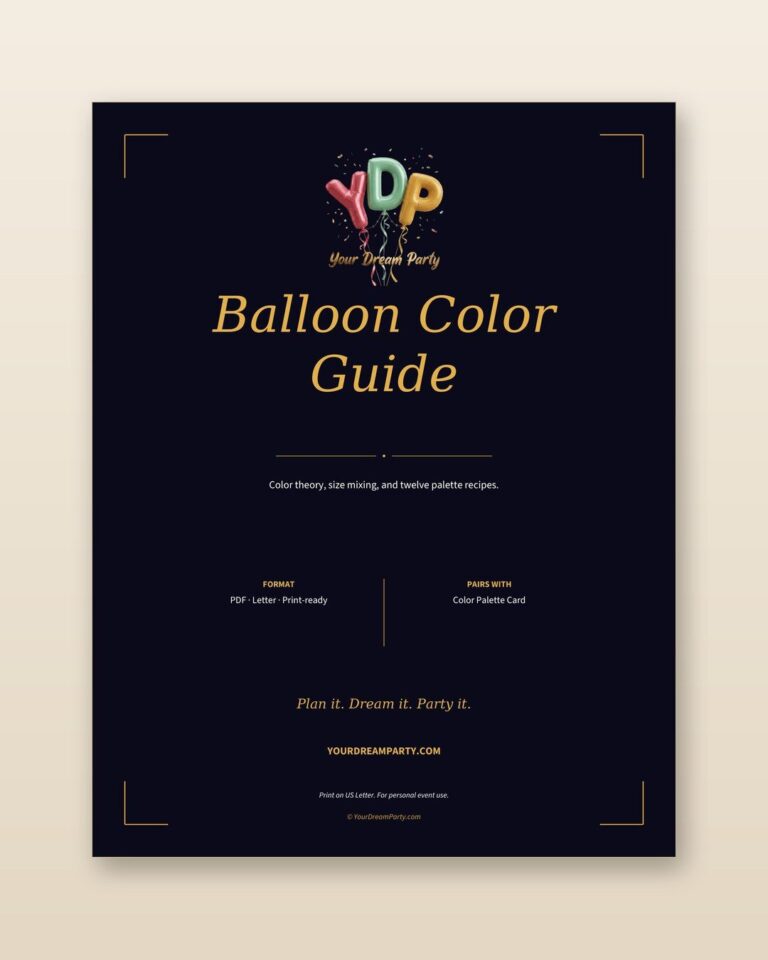
Balloon Color Guide
- 12 palette recipes with hex codes and dominant, supporting and accent roles
- Color-wheel guide: analogous, complementary, triadic and 60-30-10
- Size mix of 11-inch, 5-inch and 16-inch balloons, counts per 10 ft
- 6 size-mix variations
What the Balloon Garland & Arch Calculator Builds for Your Installation
The results page hands you a shopping plan sized to your answers and a general set of assembly steps. Each section turns the math into a clear next step.
Total count by size. The 11-inch standard row and the 5-inch filler row always show; a 16-inch feature row joins them on every indoor plan. Three mixes drive it: 5-3-1 indoors under a standard, high, or unknown ceiling, 15/55/30 under a vaulted ceiling, and 70 percent 11-inch with 30 percent 5-inch outdoors. Hosts buying balloon kits can match the SKU mix to the size split instead of guessing.
Per-color rows you can order straight from. Each swatch you picked gets its own row with a count and its share of each size. On the Even split, a 3-color palette on a 150-balloon total reads 50, 50, 50; the host passes that table to whoever is placing the balloon order without recomputing.
The density you picked, printed back. The total card carries a Density stat with your tier name, and the Copy All text and the email spell it out as balloons per foot, Standard reading 10 balloons/ft and Lush 12. Switching tiers means a fresh run through the steps with a different Step 4 answer.
Buffer recommendation. A banner on the result names a spares range of 10 to 15 percent with a one-line reason. Pick outdoor in Step 2 and that banner changes: it tells you the 10 percent wind buffer is already inside your total, then gives the spares range on top of it.
Pump recommendation with inflation times. All 3 methods are timed for your count: the hand pump (1.5 minutes a balloon) and the electric pump (15 seconds) on every balloon except the foil pieces, and the helium tank (30 seconds a balloon) on the foil letters and numbers alone. The pump count picks the winner: hand pump under 30 balloons, electric from 30 up.
SVG mockup with your colors. A stylized vector drawing of the installation in your chosen palette appears on the result page. The mockup is downloadable as a PNG to hand to a decorator, florist, or co-host, so everyone works from the same picture.
A deeper palette library. The Balloon Color Guide PDF appears after the assembly steps on the result page with 12 named palette recipes (each shade given a role and a hex code), a 5-inch to 16-inch size mixing guide, and seasonal color ideas for hosts who want a deeper palette library beyond the swatch set they entered.
Use the Calculator Across Common Installation Types
Three installation patterns follow below. Each one runs the same 7 steps and produces a count by size and color, but the totals differ because your inputs shape the math differently.
Pattern 1, 6-foot organic garland, indoor, standard ceiling, standard fullness, 3-color palette. This setup comes out at 65 balloons on the 5-3-1 mix, 10 of them 16-inch, 35 of them 11-inch and 20 of them 5-inch. Split evenly across 3 colors it reads 25, 20, 20, your first pick taking the leftover. It suits birthdays and showers at home, over a fireplace or behind a dessert table.
Pattern 2, 8-foot freestanding arch, outdoor garden, lush fullness, 5-color palette. This one lands at 165 balloons: the arch multiplier of 1.5 and the lush density of 12 per foot give 144, the automatic 10 percent wind buffer adds 14, and the 70/30 mix rounds that into 115 of the 11-inch and 50 of the 5-inch. Outdoor keeps the 16-inch line off. Suited to outdoor weddings, rooftop birthdays, and milestone graduation photo zones.
Pattern 3, 4-foot cluster grouping, indoor, standard 8-foot ceiling, 2-color palette. This grouping runs 20 to 30 balloons depending on the fullness tier, on the same 5-3-1 mix, because the cluster shape multiplies the base by 0.4. At sparse and standard fullness the tool points you at a hand pump, at lush and extra-lush (30 balloons) an electric one, and the helium card stays reserved for foil pieces. Sized for entrance accents, dessert-table corners, and gift-table groupings at smaller gatherings.
To picture these patterns styled out, the Balloon Garland Ideas guide walks through the combinations in depth, and the Party Backdrop Ideas guide covers the fabric, floral, and greenery walls that can stand behind the arch in the photo zone.
Pick the Right Answers Before You Calculate
A few inputs sharpen the count. Run through these before you start so the calculator has solid numbers to work with.
Measure the actual installation span. A 6-foot garland over an 8-foot doorway leaves a visible gap on both sides; a 10-foot garland over a 6-foot doorway needs an awkward drape. Measure the run with a tape before you set the length. The math is sharp, but only if the number matches your actual space.
Choose fullness for the room, not the budget. A bright, sunlit room with a clean backdrop forgives sparse fullness; a cluttered or dim room needs lush or extra-lush to look full in photos. Choose honestly so the count matches what the room actually needs.
Cap the palette at 3 to 4 colors for organic garlands. A 5-color palette waters down the texture on an organic garland, because each color gets too few balloons to show up as its own group. Save the fifth color as confetti inside the balloons instead of a separate balloon color.
Decide ceiling height honestly for indoor installations. Vaulted ceilings (12 feet plus) show off 16-inch statement balloons, so the calculator gives the vaulted answer more of them; standard, high and Don't know all come back with the same few, so overstating your ceiling as high changes nothing about the mix.
Set outdoor when the installation will live outdoors, not when the venue has outdoor access. The wind-resistance buffer (10 percent extra) only kicks in when you select outdoor, and adding it to an indoor setup buys balloons you do not need. Pick outdoor only if the arch will physically sit in open-air conditions.
Save the SVG mockup before you order. The mockup is the cleanest reference for the decorator, the florist, and any co-hosts. Print it and pin it to the planning binder; share it as a PNG with whoever is doing the inflation; refer back to it on installation day instead of relying on memory of what the palette swatches looked like a week earlier.
Frequently Asked Questions
Is the Balloon Garland & Arch Calculator actually free?
Yes. The calculator, the result page, the printable summary, the per-color shopping line, and the SVG mockup cost nothing and require no signup. The optional upgrade is the Balloon Color Guide PDF ($7.00), which expands the result with 12 named palette recipes and a deeper size-mixing reference.
Can I run the calculator on my phone?
Yes. The calculator is built for portrait phone screens first, with desktop and tablet layouts that reflow automatically. It works as well during a balloon-supplier scroll as it does while you stand in the venue measuring the install span.
How accurate are the balloon counts?
Counts are built from a set per-foot density for each of the 4 fullness tiers and a multiplier for each of the 4 installation types. The count is only as sound as the numbers you enter, so follow the input tips (accurate span, honest fullness, 3-to-4-color palette). The 10 to 15 percent spares range the result recommends covers pops and any small gap between the plan and the build.
Does the calculator handle metric units?
Yes. An Imperial and Metric toggle sits under the hero and re-flows Step 3, the ceiling labels and the preset lengths. The math runs the same once the value converts. It works in feet internally, and the display matches your toggle choice.
What if I want to mix balloon sizes that the calculator does not show?
The calculator covers the standard 5-inch, 11-inch, and 16-inch trio, since those 3 sizes are the usual building blocks of a garland or arch. Step 6 already takes foil letters and numbers and 36-inch feature balloons and adds them straight onto the total, with their own rows on the result. Anything outside that, a 24-inch jumbo for instance, you count yourself on top of the base.
Can I save or share my balloon count result?
The result page prints, emails you a summary of your setup and counts, and downloads the mockup as a PNG, and Copy All lifts the setup and the counts out as text. Paste that text to a decorator, florist or co-host; the Share button sends your total plus a link to the tool, not the breakdown.
Does the calculator work for foil balloon installations?
The calculator is built for latex balloon installations, because foil sizes and inflation profiles vary by manufacturer. Foil letters and numbers get their own Step 6 count that rides on the total and prints with an inflate-separately note; for any other foil piece, take the latex count as your baseline and follow the supplier's guidance.
Ready to Calculate Your Balloon Count?
Run the Balloon Garland & Arch Calculator up top before anything goes in a cart: 7 steps return a count by size, a per-color shopping line, a spares range, and an SVG mockup that hands off cleanly to whoever is doing the install. The Balloon Color Guide PDF below expands on your result with 12 hand-picked palette recipes for hosts who want the deeper reference.
This page contains affiliate links to Amazon and other retailers. As an Amazon Associate, we earn from qualifying purchases at no extra cost to you. This helps us keep all our tools free.
Results generated by this tool are for planning and inspiration purposes only. Estimates are based on general guidelines and may vary depending on your specific circumstances. Always verify with your suppliers before making purchasing decisions.