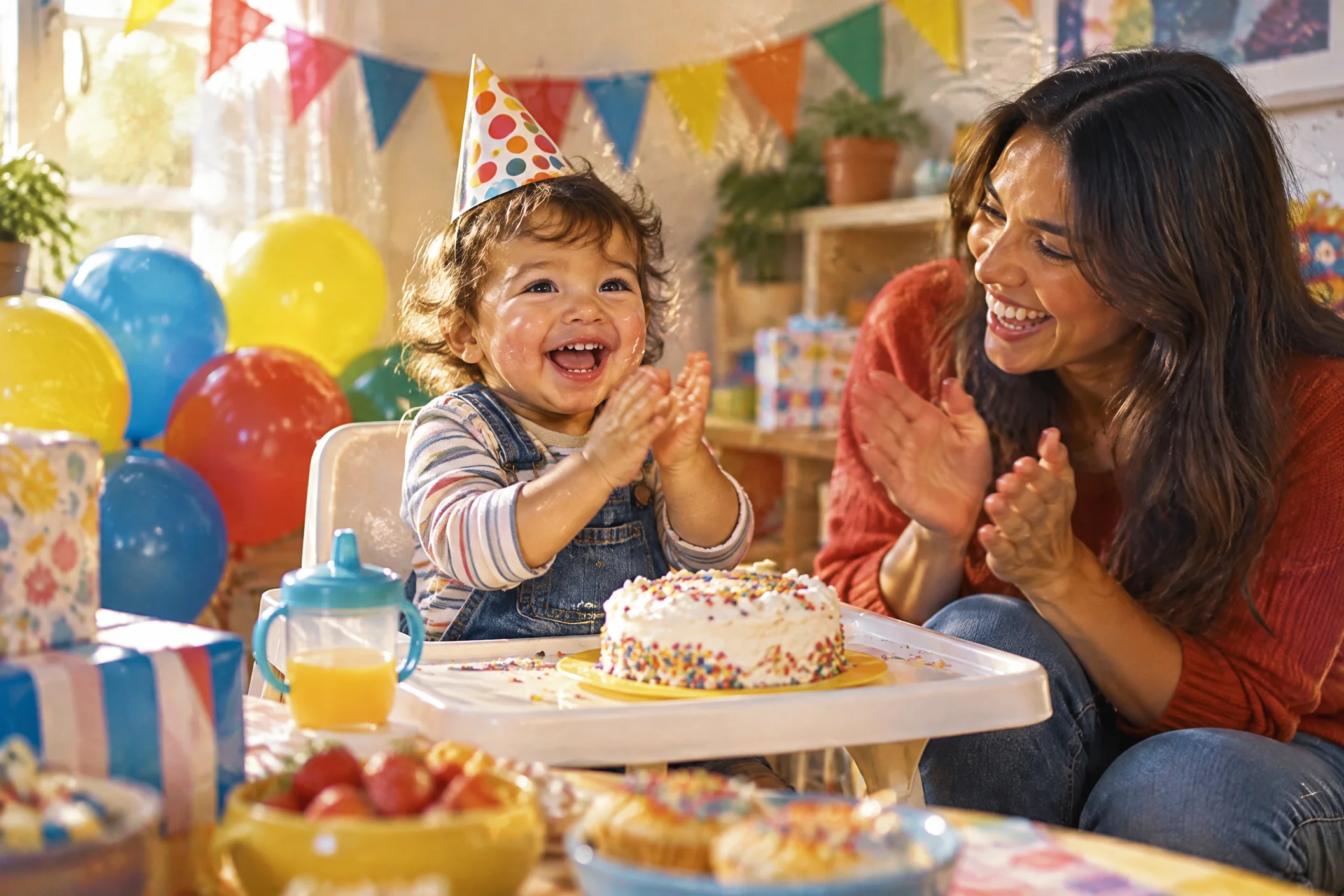
A pastel balloon arch that delights a turning-five guest can overwhelm a 2-year-old, and the sensory tubs that hold a toddler rapt will bore a 5-year-old the moment the games start. Age, not budget, separates strong toddler birthday party ideas across the 2-to-5 band. It sets the format: a 6-to-8-guest sensory-and-snack afternoon at age 2, an 8-to-10-guest playground-and-cake party at age 3, a 10-to-12-guest themed room with games at age 4 (where most 4-year-old birthday party ideas land), or a 12-to-15-guest interactive party at age 5. Parent presence moves with it, from the parent-stay open house that is standard under 4 to the occasional drop-off once they are older. So does the nap, which is what puts you at 10am to 11:15am or 2pm to 3:15pm at 2 or 3, and 10am to noon, 2pm to 4pm, or 3:30pm to 5:30pm at 4 or 5.
Get those wrong and the candles arrive with half the room in meltdown, parents stranded on a porch nobody asked them to wait on, and decor pitched too old for the 2-year-old or too young for the 4-year-old.
This guide goes age band by age band: the venue and format that suit each one, how to pitch the decor, what to feed them, and what to play. The Party Theme & Vibe Finder Quiz picks a direction for you, and the Birthday Party Ideas guide covers the rest. Parties here run from playdate-and-cupcakes at age 2 to backyard activity stations at age 5.
Quick Stats: 4 Age Bands (2-5) | 5 Toddler Palettes | Free Theme Quiz Available
Four Toddler Age Bands That Set the Birthday Plan
Their age shapes the whole party: how they arrive, what they play, how the candles go, and how it all winds down. Start there, with your child's stage and attention span, and the format, the decor, the food, and the games get much easier to choose. There are 4 ages to know: turning-two, turning-three, turning-four, and turning-five.

Turning-two: a 6-to-8-guest sensory-and-snack afternoon. Give it 60 to 75 minutes, sensory play tubs, one low coffee table as the cake table, and a parent-stay open house. That is about right for a 2-year-old. Fill the tubs with moldable play sand, and add a mini ball pit and a foam play tunnel. Keep the decor light (no balloon arch, only a small cluster and a "Happy 2nd Birthday" banner) and the milk and juice cartons coming. Host 10am to 11:15am or 2pm to 3:15pm so you miss the lunch-and-nap clash. The First Birthday Party Ideas guide does the same for anyone coming from the 1-year mark.
Turning-three: an 8-to-10-guest playground-and-cake party. Book 75 minutes at a local playground, an indoor play center, an indoor trampoline park (toddler session), or a sensory-play studio. This is the age where parallel play starts turning into playing together. Hang a single themed banner on the venue's snack-room wall, set a small cake table with the cake and 8 to 10 cupcakes, and let parents stay with refreshments at a side table. Skip hosting at home at this age if your living room runs under 270 square feet; 8 to 10 toddlers plus their parents will swamp the floor.
Turning-four: a 10-to-12-guest themed room. Plan 2 hours around one clear theme that runs through the decor, the cake, the favor bags, and the activity stations. This is the age it all clicks. Themes worth picking: dinosaurs, unicorns, construction trucks, princesses, superheroes, garden bugs, under-the-sea. By 4, your child will usually tell you which one. Add a themed banner and balloon cluster, a themed cake with character toppers, 2 to 3 activity stations, and a games block before the cake. The Kids Party Themes guide breaks the themes down one by one.
Turning-five: a 12-to-15-guest party the birthday child helps run. Give it 2 hours at home with backyard or living-room activity stations, at an indoor play center with an extended booking, or at a bowling alley toddler session. By 5, your child starts leading their friends through the afternoon themselves. Go fuller on the decor (a small balloon arch in 2 themed tones, a hand-lettered banner with their name, a themed cake-table backdrop), add a 30-to-45-minute games block (musical chairs, pin-the-tail, treasure hunt, parachute games), and let some parents stay while others drop off. The 1st Birthday Party Games and Activities guide runs past the first year, and its section for ages 3 to 9 has the games to fill it.
🛒 As an Amazon Associate, we earn from qualifying purchases, at no extra cost to you.
Fit the Venue and Format to the Age Band, Not the Mood Board
The venue you pick is what keeps the party together for 60 to 75 minutes at 2 or 3 and up to 2 hours at 4 or 5, or what loses the room by minute 60. Three things settle it anywhere between 2 and 5.

Stay home for the 2-year-old, and weigh a venue from 3 up. A turning-two party at home works around naps, snacks, and the first signs of a meltdown, with none of the parking and transition hassle of a venue. From turning-three on, a party out (indoor play center, sensory studio, trampoline park toddler session, bowling alley kids session, indoor mini-golf) raises the energy and lets the venue handle the activities for you. Skip a formal restaurant or cafe at every toddler age; no toddler sits through a meal that long. The Birthday Party Venue Ideas guide covers venues at every budget.
At home, invite twice your child's age plus 2. That gives you 6 guests at a turning-two, 8 at a turning-three, 10 at a turning-four, and 12 at a turning-five. Then remember the parents: 6 toddlers plus 6 parents in one room is a full house. Out at a venue you can stretch to 12 to 15 toddlers at 4 or 5, where the space swallows the extra bodies. Skip inviting past 15; the candles turn into chaos and the parents end up waiting in line at the favor-bag table.
Slot the party between naps and meals, never across them. A 10am-to-11:15am morning misses the lunch-and-nap clash entirely and catches everyone at their best. A 2pm-to-3:15pm afternoon lands after most toddlers have woken from a midday nap, so check your own child's pattern before you book. A 3:30pm-to-5:30pm slot only works at 4 or 5, once the nap has moved later or gone. Skip 12pm to 2pm, which runs straight through lunch and nap; expect tears before the 75 minutes are up.
Seasonal Decorations Checklist
- A color palette for each season, with what each color is for
- Buy, reuse and make checklists for all 4 seasons
- 3 quick projects per season
- 2 winter variations: festive and modern
Pitch the Decor at the Age Band, Not One Above or One Below
Pitch the decor right and the photos look like they belong to the child having the birthday. Pitch it wrong and the room is either too elaborate for a turning-two or too bare for a turning-five. Three rules keep the decor at the right age.
Use a small balloon cluster, not a full arch, under age 4. A 2-to-3-foot cluster on the wall behind the cake table looks better than a 7-foot arch at 2 or 3. Arches earn their keep from 4 up, once the cake table is where the candles get blown out and the family photo happens. At 4 or 5, hang a 5-to-7-foot arch in 2 or 3 pastel tones with a "4" or "5" foil number pair at the center. The Birthday Party Decorations guide goes deeper on building the whole look.
Hold the palette to 2 or 3 toddler-friendly tones. Five palettes suit this age. Pastel-rainbow (soft pink, mint, butter yellow). Unicorn (lilac, pink, gold). Dinosaur (sage green, ochre, terracotta). Construction (yellow, gray, orange). Garden-bugs (sage, butter, soft pink). Skip high-contrast schemes (red-and-black, deep navy, all-white) between 2 and 4; they photograph far older than the child having the party.
Give the room one hero corner, not 3 competing ones. One cake-table backdrop with a banner, a balloon cluster, and a themed topper is what every photo will be taken against. A second decorated spot (a favor-bag corner with a small sign, a craft station with a themed tablecloth) adds to it without stealing attention. Skip decorating 4 or 5 corners; the photos scatter and the candle moment looks cluttered. The Rainbow Birthday Decorations guide shows the pastel-rainbow palette in full.
Food, Cake, and Drinks That Hold a Toddler-Friendly Window
Food is what keeps everyone in the room for the candles instead of wandering off halfway through. Three rules sort it out.

Serve finger food, never a seated meal. Mini cheese-and-cracker platters, fruit cups, mini-sandwich triangles, mini-pizza slices, and rice-cake snacks all work anywhere from 2 to 5. Add a small cake (an 8-to-10-inch tier feeds 10 to 12 toddlers) and a tray of 10 to 15 cupcakes for anyone who wants to skip a slice. Skip a seated 3-course meal; no toddler stays at a table for 10 minutes. Always check for food allergies before serving.
Bring the cake out 30 minutes into a 60-to-75-minute party at 2 or 3, and 60 to 75 minutes into a 90-to-120-minute party at 4 or 5. By then the toddlers are still with you and the parents have settled. That leaves 30 to 45 minutes for candles, cake, photos, and favor bags, and the party closes by the 75-minute mark at 2 or 3 and the 2-hour mark at 4 or 5, before anyone melts down.
Stick to juice cartons, milk, and water. A cooler with small juice cartons (1 per toddler), small milk cartons, and water cups at the snack table covers everyone. Skip soda and other carbonated drinks entirely at this age; the parents will notice. Label each drink clearly ("juice," "milk," "water") for the parents who are staying, and give them their own side table with coffee, tea, and sparkling water.
Games, Activity, and Entertainment Programming by Age
Get the activities right and the toddlers play happily with parents nearby. Get them wrong and you spend the afternoon breaking up tears. Three rules cover the play from 2 to 5.
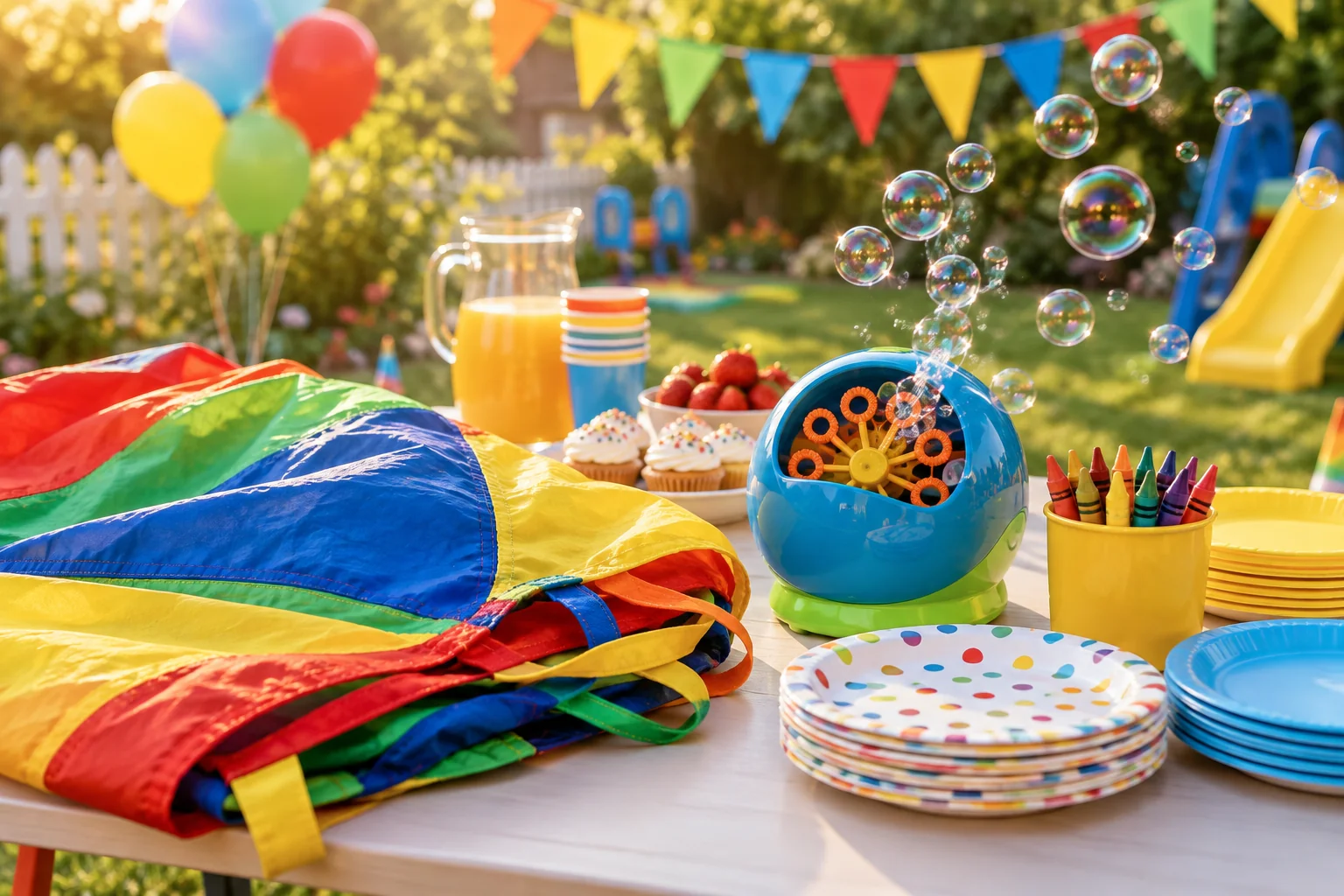
Let them play alongside each other under 3, and play together from 4. A turning-two or turning-three party runs best on sensory and craft play (play-sand tubs, foam play tunnel, bubble machine, a simple craft station) where the toddlers set their own pace. At 4 and 5, they are ready for real games (musical chairs, pin-the-tail, treasure hunt, parachute games, freeze-dance, duck-duck-goose) in a 30-to-45-minute block before the cake. The Kids Party Games guide lists the games themselves.
Put a small craft in the first half hour. A simple station (decorate-your-cupcake corner, paper-crown decorating, cookie-icing, fairy-wand or superhero-cape making) fills the 20 to 30 minutes after everyone arrives and sends each toddler home with something they made. Use washable supplies, station one adult at the table, and give them a firm finish time. Skip any craft running past 30 minutes; attention wanders around minute 25.
Add one bit of entertainment (bubbles, music, or a visit) at the energy peak. Five options land well 30 to 45 minutes in, when the room is at its liveliest. A 15-to-20-minute bubble machine. A short children's sing-along. A costumed visit from a local princess, dinosaur, or pirate performer. A small magic act. A parachute circle. Skip the full 60-minute hired entertainer under 4; their attention will not last long enough to justify it. The Sleepover Party Ideas guide covers older siblings, the 1st Birthday Party Games and Activities guide moves from sensory play for 1-year-olds to games for kids, teens, and adults, and the 5-Year-Old Birthday Party Ideas guide goes deeper on turning five.
How the Party Theme & Vibe Finder Quiz Narrows the Theme
The free Party Theme & Vibe Finder Quiz scores up to 20 themes against your answers and hands back the 3 closest that do not share a dominant color, each with a palette and a set of decoration ideas, in under 2 minutes. A flat-spread photo saved from a "toddler birthday board" rarely survives contact with a real living room, a real guest mix, and a 3-year-old's attention span; the quiz weighs the venue and the crowd, and the attention span stays yours to plan around.
Tell it the occasion, the vibe you want, the color family you lean toward, where you are hosting (indoor home, garden, rented hall, restaurant, beach or outdoor, or not decided yet), who is coming, and the season. It returns your top 3 theme matches, each with an atmosphere note, a 5-color palette with hex codes, and 5 decoration ideas. The Kids Party Themes guide runs through the themes, the Pool Party Ideas guide covers a summer poolside version, and the Teen Birthday Party Ideas guide is there for the older sibling.
Frequently Asked Questions
What are the best birthday party ideas for a 4-year-old?
Pick the theme they have been asking about: dinosaurs, unicorns, construction trucks, princesses, garden-bugs, or under-the-sea. Give it 2 hours, at home or out. Add a themed banner and balloon cluster, 2 to 3 activity stations, and a 30-to-45-minute games block before the cake. Keep the list to 10 or 12 toddlers, slot the party between naps and meals (10am to noon or 2pm to 4pm), and serve finger food with a themed cake. If they have no favorite yet, the Party Theme & Vibe Finder Quiz picks a decor direction, palette included, for the rest of that plan to hang on, in under 2 minutes.
How long should a toddler birthday party last?
A turning-two runs 60 to 75 minutes. A turning-three runs 75 minutes. A turning-four runs 2 hours. A turning-five runs 2 hours. Under 3, their attention holds for 60 to 75 minutes; by 4 or 5 it stretches to 2 hours. Skip anything past 2 hours, and at 2 or 3 expect tears once you pass the 75-minute mark.
How many guests should I invite to a toddler birthday?
At home, invite twice their age plus 2 (6 at a turning-two, 8 at a turning-three, 10 at a turning-four, 12 at a turning-five). Out at a venue at 4 or 5, you can stretch to 12 or 15, since the space takes the extra bodies. Then count the parents too; under 4, almost every toddler arrives with one who stays.
What food works for a toddler birthday party?
Serve finger food, not a seated meal. Mini cheese-and-cracker platters, fruit cups, mini-sandwich triangles, mini-pizza slices, and rice-cake snacks all work from 2 to 5. Add a small cake (an 8-to-10-inch tier feeds 10 to 12) and a cupcake tray for anyone who wants to skip a slice. Always check for food allergies before serving.
What decorations work for a toddler birthday?
A small balloon cluster (not a full arch) and a hand-lettered or printed banner look best at 2 or 3. Move up to a small balloon arch (5 to 7 feet) with a "4" or "5" foil number pair at 4 or 5. Hold the palette to 2 or 3 pastel or theme-matching tones, give the room one cake-table backdrop worth photographing, and skip decorating 4 or 5 corners at once.
What games and activities work for a toddler birthday?
Under 3, let them play alongside each other with sensory tubs, moldable play sand, a foam play tunnel, a bubble machine, and a simple craft station. From 4 up, move into real games (musical chairs, pin-the-tail, treasure hunt, parachute games, freeze-dance, duck-duck-goose) in a 30-to-45-minute block before the cake. Add one bit of entertainment (bubbles, a sing-along, a costumed visit) at the 30-to-45-minute energy peak.
When is the best time of day for a toddler birthday party?
A 10am or 2pm start works best anywhere from 2 to 5. Wrap up by 11:15am or 3:15pm at 2 or 3, and by noon or 4pm for a 2-hour party at 4 or 5. Both starts miss the lunch-and-nap clash and catch everyone at their best. Skip 12pm to 2pm, which runs straight through both; expect tears before the 75 minutes are up. Check your own child's nap pattern before you book.
Ready to Lock the Toddler Birthday Plan?
Everything about a toddler party follows from their age, so settle that first. Match the venue to it. Pitch the decor at their age, with 2 or 3 tones and one cake-table backdrop worth photographing. Put out finger food and a small cake or cupcake station. Then plan the play, however they play best at that age, before the candles come out.
The free Party Theme & Vibe Finder Quiz turns your answers into 3 ranked themes in one go. The Seasonal Decorations Checklist below has the season-by-season guide, a shopping list for each season, and 3 quick decor projects per season you can use again for the next sibling.
This page contains affiliate links to Amazon and other retailers. As an Amazon Associate, we earn from qualifying purchases at no extra cost to you. This helps us keep all our tools free.
Results are for planning and inspiration purposes only. Always check for food allergies before serving. Always verify with your suppliers before purchasing.